

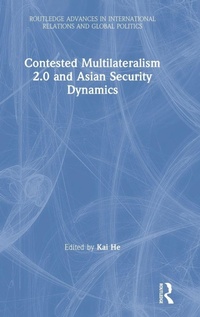
Contested Multilateralism 2.0 and Asian Security Dynamics
1st Edition
Published on 13. May 2020
Book
Hardback
168 pages
978-0-367-89337-8 (ISBN)
Description
In the 1990s there was a wave of multilateralism in the Asia Pacific, led primarily by ASEAN. Since the Global Financial Crisis of 2008, however, many non-ASEAN states have attempted to seize the initiative, including the USA, Japan, China, South Korea, and Australia.
Kai He and his contributors debate the reasons for this contested multilateralism and the impacts it will have on the region's security and political challenges. Will the "Indo-Pacific turn" be a blessing or a curse for regional stability and prosperity? Using a diverse range of theoretical and empirical perspectives, these leading scholars contribute views on this question and on the diverse strategies of the great and middle powers in the region.
This collection will be of great interest to scholars and students of international relations in the Asia Pacific and of great value to policy makers in the region and beyond.
Kai He and his contributors debate the reasons for this contested multilateralism and the impacts it will have on the region's security and political challenges. Will the "Indo-Pacific turn" be a blessing or a curse for regional stability and prosperity? Using a diverse range of theoretical and empirical perspectives, these leading scholars contribute views on this question and on the diverse strategies of the great and middle powers in the region.
This collection will be of great interest to scholars and students of international relations in the Asia Pacific and of great value to policy makers in the region and beyond.
Reviews / Votes
'Assembling a team of leading scholars, Kai He and his colleagues have convincingly argued that "contested multilateralism 2.0" is the key to understanding the new security dynamics in Asia. A must read for all students who care about the future of Asia and multilateralism.' - Shiping Tang, distinguished professor, Fudan University and author of The Social Evolution of International Politics'Regional and international institutions in East Asia have been changing their roles, functions and geographical scope along with radical power shifts in East Asian politics. Institutions have become more important tools for national foreign policies and for creating a new regional and international order. Professor He's new edited book contributes to our understanding of this new phenomenon both theoretically and empirically, by putting together different theoretical perspectives and national policy orientations of the major countries in the region. I recommend this book to both researchers and policy practitioners who are interested in, and deal with, this important region.' - Yoshinobu Yamamoto, Professor Emeritus, University of Tokyo, Japan
More details
Series
Language
English
Place of publication
London
United Kingdom
Publishing group
Taylor & Francis Ltd
Target group
College/higher education
Illustrations
3 s/w Zeichnungen, 2 s/w Tabellen
2 Tables, black and white; 3 Line drawings, black and white
Dimensions
Height: 240 mm
Width: 161 mm
Thickness: 15 mm
Weight
452 gr
ISBN-13
978-0-367-89337-8 (9780367893378)
Copyright in bibliographic data and cover images is held by Nielsen Book Services Limited or by the publishers or by their respective licensors: all rights reserved.
Schweitzer Classification
Other editions
Additional editions
Book
05/2020
1st Edition
Routledge
€53.80
Shipment within 15-20 days
E-Book
04/2020
1st Edition
Routledge
€47.49
Available for download
E-Book
04/2020
1st Edition
Routledge
€47.49
Available for download
Person
Kai He is a Professor of International Relations in the Griffith Asia Institute and Centre for Governance and Public Policy at Griffith University in Brisbane, Australia. He is currently an Australian Research Council Future Fellow (2017-2020) and a Visiting Chair Professor of International Relations at Nankai University, China (2018-2021).
Content
Acknowledgments List of Contributors List of Abbreviations List of Figures List of Tables INTRODUCTION Chapter 1: Contested Multilateralism 2.0 and Regional Order Transition (Kai He) SECTION 1: DEBATING REGIONAL IMPLICATIONS Chapter 2: Multilateralism and Regional Order in Contested Asia (Nick Bisley) Chapter 3: Disconnecting from the Region: The Asia-Pacific Minus the US? (T. J. Pempel) Chapter 4: Minilateral Security's Relevance to US Strategy in the Indo-Pacific: Challenges and Prospects (William Tow) Chapter 5: Asia's Competing Multilateral Initiatives: Quality Versus Quantity (Mark Beeson) SECTION 2: REGIONAL ACTORS AND INSTITUTIONAL BEHAVIOR Chapter 6: China and the New Institutional Balancing in the Indo-Pacific: Challenging or Conforming to the International Order? (Jingdon Yuan) Chapter 7: Japan's Role Conception in Multilateral Initiatives in the Asia-Pacific (Hidetaka Yoshimatsu) Chapter 8: South Korea's Role Conception and Strategies for Multilateralism: A 'Balance of Role' Analysis (Jaechun Kim and William Kang) Chapter 9: MIKTA: A Case Study of Australian Multilateralism (Melissa Conley Tyler) Chapter 10: ASEAN and Multilateralism 2.0: Locating ASEAN Centrality within the FOIP and the BRI (See Seng Tan) Index