

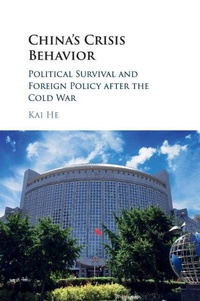
China's Crisis Behavior
Political Survival and Foreign Policy after the Cold War
Published on 1. March 2018
Book
Paperback/Softback
186 pages
978-1-316-50678-3 (ISBN)
Description
Since the end of the Cold War, China has experienced several notable interstate crises: the 1999 'embassy bombing' incident, the 2001 EP-3 mid-air collision with a United States aircraft, and the Diaoyu/Senkaku dispute with Japan. China's response to each incident, however, has varied considerably. Drawing from a wealth of primary sources and interviews, this book offers a systematic analysis of China's crisis behavior in order to identify the factors which determine when Chinese leaders decide to escalate or scale down their response to crises. Inspired by prospect theory - a Nobel Prize-winning behavioral psychology theory - Kai He proposes a 'political survival prospect' model as a means to understand the disparities in China's behavior. He argues that China's response depends on a combination of three factors that shape leaders' views on the prospects for their 'political survival status', including the severity of the crisis, leaders' domestic authority, and international pressure.
Reviews / Votes
'Kai He provides an excellent analysis of China's inter-state crises behaviour in the post-Cold War era. By combining insights from prospect theory and regime survival theory, he offers a valuable analysis of a crucial set of cases in a rigorous fashion. This book is not only useful for Sinologists, but also for anyone interested in China's sometimes enigmatic behaviour in its relations with other states.' T. V. Paul, James McGill Professor of International Relations, McGill University, Montreal 'Kai He's cutting edge study of Chinese crisis management is essential reading for students of Chinese foreign policy as well as anyone seeking insights into an increasingly assertive twenty-first century China. China's Crisis Behavior operationalizes an elegant and innovative theoretical framework to examine a timely and critically important topic for Asia and the world. This pioneering volume provides comprehensive and authoritative treatment of multiple cases of Chinese crises spanning a twenty-year period under three different paramount Chinese leaders, including current President Xi Jinping. Highly recommended.' Andrew Scobell, Senior Political Scientist, RAND Corporation 'When embroiled in international crises, Chinese leaders escalate in some cases, yet accommodate, even compromise in others: why? In this astute, original book, Kai He argues that nothing about Chinese leaders' international crises behavior can be understood without grasping how they see their prospect for political survival. Their perceptions of gains and losses are shaped by international pressure, the severity of the crisis, and the leaders' domestic authority which combine to define China's responses. With a concern for the choices of individual leaders in crisis situations, Kai He cleverly puts to the task prospect theory, the most influential descriptive theory of decision making under risk, and relies on a wealth of fresh sources to help us understand how Chinese leaders are likely to behave when the next crisis erupts. For anyone interested in China's rise, crisis diplomacy and the political psychology of strategy, this is an essential read.' Pascal Vennesson, Nanyang Technological University, SingaporeMore details
Language
English
Place of publication
Cambridge
United Kingdom
Target group
Professional and scholarly
Product notice
Paperback (trade)
Illustrations
3 Tables, black and white; 3 Line drawings, black and white
Dimensions
Height: 229 mm
Width: 152 mm
Thickness: 11 mm
Weight
279 gr
ISBN-13
978-1-316-50678-3 (9781316506783)
Copyright in bibliographic data and cover images is held by Nielsen Book Services Limited or by the publishers or by their respective licensors: all rights reserved.
Schweitzer Classification
Other editions
Additional editions
Book
04/2016
Cambridge University Press
€135.50
Shipment within 15-20 days
Person
Kai He is Associate Professor of International Relations at Griffith University, Australia. From 2009 to 2010, he was a postdoctoral fellow in the Princeton-Harvard 'China and the World Program' (CWP). He is the author of Institutional Balancing in the Asia Pacific: Economic Interdependence and China's Rise (2009) and the co-author of Prospect Theory and Foreign Policy Analysis in the Asia Pacific: Rational Leaders and Risky Behavior (2013). His research has been supported by grants and fellowships from the John D. and Catherine T. MacArthur Foundation, the Lynde and Harry Bradley Foundation, the East-West Center in Washington DC, and the East Asia Institute in Seoul.
Content
1. China's foreign policy crises after the Cold War; 2. Political survival and China's crisis behavior; 3. The Yinhe incident and the Taiwan Strait crisis; 4. The embassy bombing incident and the EP-3 mid-air collision; 5. The Impeccable incident and the boat collision crisis; 6. The Scarborough shoal dispute and Diaoyu/Senkaku purchase crisis; 7. Leadership transition and China's future crisis behavior; Conclusion.