

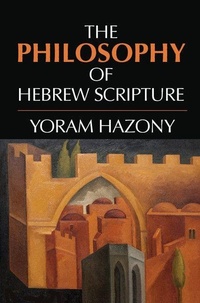
The Philosophy of Hebrew Scripture
An Introduction
1st Edition
Published on 30. July 2012
Book
Hardback
388 pages
978-1-107-00317-0 (ISBN)
Description
What if the Hebrew Bible wasn't meant to be read as 'revelation'? What if it's not really about miracles or the afterlife - but about how to lead our lives in this world? The Philosophy of Hebrew Scripture proposes a new framework for reading the Bible. It shows how biblical authors used narrative and prophetic oratory to advance universal arguments about ethics, political philosophy and metaphysics. It offers bold new studies of biblical narratives and prophetic poetry, transforming forever our understanding of what the stories of Abel, Abraham, Jacob, Joseph, Moses and David and the speeches of Isaiah and Jeremiah, were meant to teach. The Philosophy of Hebrew Scripture assumes no belief in God or other religious commitment. It assumes no previous background in Bible. It is free of disciplinary jargon. Open the door to a book you never knew existed. You'll never read the Bible the same way again.
Reviews / Votes
'It would be hard to exaggerate the importance of Hazony's splendid work. This bold attempt to distil the intellectual essence of biblical wisdom deserves the widest possible audience and the most careful attention, regardless of religious denomination or lack of it, from philosophers.' Standpoint Magazine 'Not only is The Philosophy of Hebrew Scripture a must for philosophy scholars, but also for every thinking Jew who wants to understand and appreciate the Torah from an intellectual perspective. Written in an accessible style, it casts new light on biblical characters and narrative, encouraging us to use our minds to understand its psychological and philosophical complexity.' Doreen Wachmann, Jewish Telegraph 'As an approach to the Old Testament as philosophy, worthy to be placed alongside any 'reasoned' later work it is something of a masterpiece.' Church Times 'First, Hazony's work is an important contribution to understanding the dynamic of the biblical story of Cain and Abel. Second, Hazony's argument is important for understanding not just Genesis 4 but as a radical critique of the general understanding of the entire Hebrew Bible.' Steven D. Ealy, Books and CultureMore details
Language
English
Place of publication
Cambridge
United Kingdom
Target group
Professional and scholarly
Illustrations
1 Line drawings, unspecified
Dimensions
Height: 240 mm
Width: 161 mm
Thickness: 26 mm
Weight
754 gr
ISBN-13
978-1-107-00317-0 (9781107003170)
Copyright in bibliographic data and cover images is held by Nielsen Book Services Limited or by the publishers or by their respective licensors: all rights reserved.
Schweitzer Classification
Other editions
Additional editions
Book
07/2012
1st Edition
Cambridge University Press
€47.00
Shipment within 15-20 days
Yoram Hazony
Philosophy of Hebrew Scripture
E-Book
07/2012
Cambridge University Press
€24.49
Available for download
Yoram Hazony
The Philosophy of Hebrew Scripture
E-Book
07/2012
1st Edition
Cambridge University Press
€27.99
Available for download
Person
Yoram Hazony is Provost of the Shalem Center in Jerusalem and a Senior Fellow in the Department of Philosophy, Political Theory and Religion (PPR). Hazony's previous books include The Jewish State: The Struggle for Israel's Soul and The Dawn: Political Teachings of the Book of Esther. His essays and articles have appeared in The New York Times, The New Republic, Commentary, Azure and Ha'aretz, among other publications. He is author of a regular blog on philosophy, Judaism, Israel and higher education called Jerusalem Letters. Hazony received a BA from Princeton University in East Asian Studies and a PhD from Rutgers University in Political Theory.
Content
1. Introduction: beyond reason and revelation; Part I: Reading Hebrew Scripture: 2. The structure of the Hebrew Bible; 3. What is the purpose of the Hebrew Bible?; 4. How does the Bible make arguments of a general nature?; Part II: The Philosophy of Hebrew Scripture: Five Studies: 5. The ethics of a shepherd; 6. The history of Israel, Genesis-Kings: a political philosophy; 7. Jeremiah and the problem of knowing; 8. Truth and being in Hebrew scripture; 9. Jerusalem and Carthage; Part III: Conclusion: 10. God's speech after reason and revelation.