

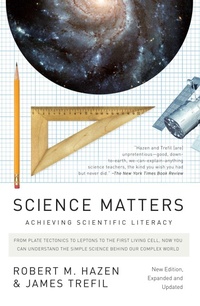
Science Matters
Achieving Scientific Literacy
Published on 2. June 2009
Book
Paperback/Softback
384 pages
978-0-307-45458-4 (ISBN)
Description
Knowledge of the basic ideas and principles of science is fundamental to cultural literacy. But most books on science are often too obscure or too specialized to do the general reader much good.
Science Matters is a rare exception-a science book for the general reader that is informative enough to be a popular textbook for introductory courses in high school and college, and yet well-written enough to appeal to general readers uncomfortable with scientific jargon and complicated mathematics. And now, revised and expanded for the first time in nearly two decades, it is up-to-date, so that readers can enjoy Hazen and Trefil's refreshingly accessible explanations of the most recent developments in science, from particle physics to biotechnology.
Science Matters is a rare exception-a science book for the general reader that is informative enough to be a popular textbook for introductory courses in high school and college, and yet well-written enough to appeal to general readers uncomfortable with scientific jargon and complicated mathematics. And now, revised and expanded for the first time in nearly two decades, it is up-to-date, so that readers can enjoy Hazen and Trefil's refreshingly accessible explanations of the most recent developments in science, from particle physics to biotechnology.
More details
Edition
Revised edition
Language
English
Place of publication
New York
United States
Publishing group
Random House USA Inc
Edition type
Revised edition
Product notice
Paperback (trade)
Dimensions
Height: 202 mm
Width: 132 mm
Thickness: 23 mm
Weight
433 gr
ISBN-13
978-0-307-45458-4 (9780307454584)
Copyright in bibliographic data and cover images is held by Nielsen Book Services Limited or by the publishers or by their respective licensors: all rights reserved.
Schweitzer Classification
Other editions
Additional editions
E-Book
06/2009
Anchor
€8.99
Available for download
Previous edition

Book
12/1990
Bantam Books
€33.76
Article exhausted; check for reprint
Persons
ROBERT M. HAZEN is the author of more than 350 articles and 20 books on earth science, materials science, origins of life, history and music. A Fellow of the American Association for the Advancement of Science, he received the Mineralogical Society of America Award, the Ipatief Prize, the ASCAP-Deems Taylor Award, and other awards for his research and writing. Hazen is a researcher at the Carnegie Institution for Science and is Robinson Professor of Earth Sciences at George Mason University. His recent books include Genesis: The Scientific Quest for Life's Origins and The Sciences: An Integrated Approach (with James Trefil).
JAMES TREFIL, Robinson Professor of Physics at George Mason University, is the author of over 40 books and 100 articles in professional journals. He is a fellow of the American Physical Society, the American Association for the Advancement of Science, and the World Economic Forum. He is the recipient of the Andrew Gemant Award (American institute of Physics), the Westinghouse and Subaru Awards (American Association for the Advancement of Science) and the 2008 Science Writing Award (American Physical Society). His most recent books are Why Science and The Sciences: An Integrated Approach (with Robert Hazen).
JAMES TREFIL, Robinson Professor of Physics at George Mason University, is the author of over 40 books and 100 articles in professional journals. He is a fellow of the American Physical Society, the American Association for the Advancement of Science, and the World Economic Forum. He is the recipient of the Andrew Gemant Award (American institute of Physics), the Westinghouse and Subaru Awards (American Association for the Advancement of Science) and the 2008 Science Writing Award (American Physical Society). His most recent books are Why Science and The Sciences: An Integrated Approach (with Robert Hazen).
Content
CONTENTS
INTRODUCTION
Scientific Literacy: What It Is, Why It’s Important, and Why We Don’t Have It
ONE. Knowing
The universe is regular and predictable.
TWO. Energy
Energy is conserved and always goes from more useful
to less useful forms.
THREE. Electricity and Magnetism
Electricity and magnetism are two aspects of the same force.
FOUR. The Atom
All matter is made of atoms.
FIVE. The World of the Quantum
Everything comes in discrete units and you can’t measure anything without changing it.
SIX. Chemical Bonding
Atoms are bound by electron glue.
SEVEN. Atomic Architecture
The way a material behaves depends on how its atoms are arranged.
EIGHT. Nuclear Physics
Nuclear energy comes from the conversion of mass.
NINE. The Fundamental Structure of Matter
All matter is really made of quarks and leptons.
TEN. Astronomy
Stars experience a cycle of birth and death.
ELEVEN. The Cosmos
The universe was born at a specific time in the past, and it has been expanding ever since.
TWELVE. Relativity
Every observer sees the same laws of nature.
THIRTEEN. The Restless Earth
Earth’s surface is constantly changing, and no feature on Earth is permanent.
FOURTEEN. Earth Cycles
Earth operates in cycles.
FIFTEEN. The Ladder of Life
All living things are made from cells, the chemical factories of life.
SIXTEEN. The Code of Life
All life is based on the same genetic code.
SEVENTEEN. Biotechnology
All life is based on the same chemistry and genetic code.
EIGHTEEN. Evolution
All forms of life evolved by natural selection.
NINETEEN. Ecosystems
All life is connected.
Epilogue
The Role of Science
Index
INTRODUCTION
Scientific Literacy: What It Is, Why It’s Important, and Why We Don’t Have It
ONE. Knowing
The universe is regular and predictable.
TWO. Energy
Energy is conserved and always goes from more useful
to less useful forms.
THREE. Electricity and Magnetism
Electricity and magnetism are two aspects of the same force.
FOUR. The Atom
All matter is made of atoms.
FIVE. The World of the Quantum
Everything comes in discrete units and you can’t measure anything without changing it.
SIX. Chemical Bonding
Atoms are bound by electron glue.
SEVEN. Atomic Architecture
The way a material behaves depends on how its atoms are arranged.
EIGHT. Nuclear Physics
Nuclear energy comes from the conversion of mass.
NINE. The Fundamental Structure of Matter
All matter is really made of quarks and leptons.
TEN. Astronomy
Stars experience a cycle of birth and death.
ELEVEN. The Cosmos
The universe was born at a specific time in the past, and it has been expanding ever since.
TWELVE. Relativity
Every observer sees the same laws of nature.
THIRTEEN. The Restless Earth
Earth’s surface is constantly changing, and no feature on Earth is permanent.
FOURTEEN. Earth Cycles
Earth operates in cycles.
FIFTEEN. The Ladder of Life
All living things are made from cells, the chemical factories of life.
SIXTEEN. The Code of Life
All life is based on the same genetic code.
SEVENTEEN. Biotechnology
All life is based on the same chemistry and genetic code.
EIGHTEEN. Evolution
All forms of life evolved by natural selection.
NINETEEN. Ecosystems
All life is connected.
Epilogue
The Role of Science
Index