

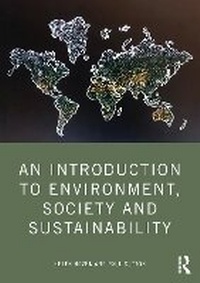
An Introduction to Environment, Society and Sustainability
1st Edition
Published on 7. October 2024
Book
Paperback/Softback
360 pages
978-1-032-26503-2 (ISBN)
Description
This timely and innovative book delves into the complex interplay of human activities and natural limits in generating today's sustainability challenges. By contrasting the pressures of growing populations with ecological footprints associated with consumption, the volume navigates the contested terrain where human societies generate environmental impacts.
Adorned with illustrative figures, examples and case studies throughout, this book presents insightful analysis of ecological, economic, technological, and social justice responses to the challenges faced by human civilization, including land degradation, climate change, pollution, and overexploitation of natural resources. Many of these issues are wicked problems, characterized by incomplete information, multiple stakeholders, and contested approaches to addressing them. In simple terms, sustainability issues are an interplay between population growth and rising consumption, which are placing impossible demands on finite resources. Potential solutions to the crisis are split between green growth approaches that emphasize technology and institutional capacity to guide economic growth in more sustainable ways, and degrowth approaches that call for a fundamental rethinking of the way we structure society and generate value. This book emerged from a student seminar where undergraduate and graduate students highlighted sustainability topics of concern, helped consider their framing, and then assisted with co-writing several of the chapters. The volume encourages readers to consider structural questions that underpin sustainability dilemmas, and begins with four theoretical frameworks for understanding sustainability issues: ideas from the natural sciences, the population/consumption debate, economic frameworks, and ethical approaches. It then uses a systems approach to apply these theoretical ideas to complex global systems such as the atmosphere, oceans, and agriculture.
This volume will be of pivotal interest to students, scholars and academics in the fields of environmental studies, environment and society, human geography and environmental geography, as well as those with an interest in these areas more generally.
Adorned with illustrative figures, examples and case studies throughout, this book presents insightful analysis of ecological, economic, technological, and social justice responses to the challenges faced by human civilization, including land degradation, climate change, pollution, and overexploitation of natural resources. Many of these issues are wicked problems, characterized by incomplete information, multiple stakeholders, and contested approaches to addressing them. In simple terms, sustainability issues are an interplay between population growth and rising consumption, which are placing impossible demands on finite resources. Potential solutions to the crisis are split between green growth approaches that emphasize technology and institutional capacity to guide economic growth in more sustainable ways, and degrowth approaches that call for a fundamental rethinking of the way we structure society and generate value. This book emerged from a student seminar where undergraduate and graduate students highlighted sustainability topics of concern, helped consider their framing, and then assisted with co-writing several of the chapters. The volume encourages readers to consider structural questions that underpin sustainability dilemmas, and begins with four theoretical frameworks for understanding sustainability issues: ideas from the natural sciences, the population/consumption debate, economic frameworks, and ethical approaches. It then uses a systems approach to apply these theoretical ideas to complex global systems such as the atmosphere, oceans, and agriculture.
This volume will be of pivotal interest to students, scholars and academics in the fields of environmental studies, environment and society, human geography and environmental geography, as well as those with an interest in these areas more generally.
More details
Language
English
Place of publication
London
United Kingdom
Publishing group
Taylor & Francis Ltd
Target group
College/higher education
Undergraduate Advanced and Undergraduate Core
Illustrations
156 farbige Abbildungen, 112 Farbfotos bzw. farbige Rasterbilder, 44 farbige Zeichnungen, 5 s/w Tabellen
5 Tables, black and white; 44 Line drawings, color; 112 Halftones, color; 156 Illustrations, color
Dimensions
Height: 245 mm
Width: 172 mm
Thickness: 18 mm
Weight
764 gr
ISBN-13
978-1-032-26503-2 (9781032265032)
Copyright in bibliographic data and cover images is held by Nielsen Book Services Limited or by the publishers or by their respective licensors: all rights reserved.
Schweitzer Classification
Other editions
Additional editions
Helen Hazen | Paul Sutton
An Introduction to Environment, Society and Sustainability
E-Book
10/2024
1st Edition
Routledge
€49.99
Available for download
Helen Hazen | Paul Sutton
An Introduction to Environment, Society and Sustainability
E-Book
10/2024
1st Edition
Routledge
€49.99
Available for download
Helen Hazen | Paul Sutton
An Introduction to Environment, Society and Sustainability
Book
10/2024
1st Edition
Routledge
€200.54
Shipment within 10-20 days
Persons
Helen Hazen is a teaching professor at the University of Denver. After completing an undergraduate degree in geography at Oxford University, she worked in the field of environmental conservation before earning a Ph.D. in geography from the University of Minnesota. Dr. Hazen has published on a variety of aspects of human-environment interactions, including the role of the World Heritage Program in environmental protection and biases in ecosystem protection. Her teaching interests focus on health, environment, and sustainability and have led to the publication of undergraduate textbooks in health geography and population geography.
Paul Sutton is a professor in the Department of Geography and the Environment at the University of Denver. Dr. Sutton is also a member of the board of trustees for the small town of Morrison, CO (pop ~350). He also serves on the board of the Denver Regional Council of Governments. Dr. Sutton obtained his B.S. from Union College in Chemistry, his M.A. in Statistics and PhD in Geography from UCSB. His research interests are in the general area of human-environment relations with a particular interest in population geography, sustainability science, and ecological economics.
Paul Sutton is a professor in the Department of Geography and the Environment at the University of Denver. Dr. Sutton is also a member of the board of trustees for the small town of Morrison, CO (pop ~350). He also serves on the board of the Denver Regional Council of Governments. Dr. Sutton obtained his B.S. from Union College in Chemistry, his M.A. in Statistics and PhD in Geography from UCSB. His research interests are in the general area of human-environment relations with a particular interest in population geography, sustainability science, and ecological economics.
Content
'1. Introduction to Sustainability and the Human-Environment System. 2. Biophysical Perspectives on Sustainability. 3. Population and Consumption. 4. Economic Perspectives on Sustainability. 5. Ethical Approaches to Sustainability. 6. Earth's Atmosphere. 7. Oceans. 8. Fresh Water. 9. Wildlands. 10. Agriculture. 11. Urban Systems. 12. Conclusion.