

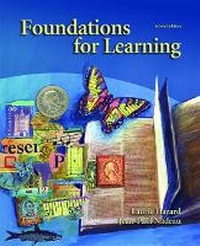
Foundations for Learning
2nd Edition
Published on 21. February 2008
Book
Paperback/Softback
192 pages
978-0-13-813202-6 (ISBN)
Description
The focus of Foundations for Learning is on academic adjustment for first-year college students with personal development issues seamlessly integrated into the academic emphasis. The theme is claiming an education and taking responsibility for one's own education. What is most unique about this book is that it addresses both the attitudinal variables and personality traits that affect college achievement like locus of control, conceptions of intelligence, and intellectual curiosity in relation to specific study-related behaviors such as text annotation and active listening. Students are pushed to consider how each skill set, perception, and attitude connects with and influences the other.
Reviews / Votes
"Foundations for Learning is excellent. It is concise and to the point with theory as well as application. The textbook can be used as a stand-alone resource to implement the entire curriculum. It is easy to read and integrates student vignettes that appeal to our classes. Many texts are on the market to address first year needs and issues. This book is easily readable while maintaining high academic quality."- Sally Riconscente, Bryant University
"The textbook is clearly organized and easy to read. The Student Portraits allow readers to read quotes from former students and to relate their experiences to those students. The Make It Personal questions encourage readers to actively read the text because they are being asked about their own experiences. My students have learned about themselves academically and socially through the Locus of Control and Study Habits Inventory as well as by doing the Activities prompts that bring them into contact with faculty, staff and their peers and then reflecting on their experiences in their journal."
- Janice Dexter-Ganek, Bryant University
More details
Edition
2nd edition
Language
English
Place of publication
United States
Publishing group
Pearson Education (US)
Target group
Professional and scholarly
Dimensions
Height: 235 mm
Width: 191 mm
Weight
336 gr
ISBN-13
978-0-13-813202-6 (9780138132026)
Copyright in bibliographic data and cover images is held by Nielsen Book Services Limited or by the publishers or by their respective licensors: all rights reserved.
Schweitzer Classification
Other editions
New editions
Laurie L. Hazard | Jean-Paul Nadeau
Foundations for Learning
Claiming Your Education Plus NEW MyStudentSuccessLab 2012 Update -- Access Card Package
Book
08/2012
3rd Edition
Prentice Hall
€38.83
Article is exhausted; no reprint
Book
01/2012
3rd Edition
Pearson
€73.03
Article not available at the moment
Persons
Laurie L. Hazard has been teaching and designing curricula for First-Year Experience and study skills courses for the last fifteen years. She is the Director of the Academic Center for Excellence and Writing Center at Bryant University in Smithfield, Rhode Island, and the Curriculum Coordinator for their First-Year Experience course. Her area of expertise is the personality traits and attitudes of college students that influence academic achievement and mediate the utilization of newly learned study strategies.
As a New England Peer Tutor Association Board member, she has hosted their Annual Forum at her institution. Laurie regularly presents at national conferences such as the First Year Experience and Students in Transition, the Conference on College Composition, and the College Reading and Learning Association. Laurie has taught courses in college reading and study skills, liberal arts seminars, psychology, personality psychology, abnormal psychology, and social psychology.
Laurie has done extensive work writing about and assessing the effectiveness of learning assistance programs and FYE courses. She has been a Guest Editorial Board member for the Learning Assistance Review. Publications by Laurie and her co-author include: Exploring the Evidence, Volume III: Reporting Outcomes of First-Year Seminars, a monograph published by the National Resource Center for The First-Year Experience and Students in Transition and "What Does It Mean to be `College-Ready'?", an article which appears in Connection: The Journal of the New England Board of Higher Education, at http://www.nebhe.org/index.php?option=com_content&task=view&id=34&Itemid=71.
Laurie was recently selected by the National Resource Center for The First-Year Experience and Students in Transition as a top ten Outstanding First-Year Student Advocate.
Jean-Paul Nadeau is an instructor at Bristol Community College in Fall River, Massachusetts.
As a New England Peer Tutor Association Board member, she has hosted their Annual Forum at her institution. Laurie regularly presents at national conferences such as the First Year Experience and Students in Transition, the Conference on College Composition, and the College Reading and Learning Association. Laurie has taught courses in college reading and study skills, liberal arts seminars, psychology, personality psychology, abnormal psychology, and social psychology.
Laurie has done extensive work writing about and assessing the effectiveness of learning assistance programs and FYE courses. She has been a Guest Editorial Board member for the Learning Assistance Review. Publications by Laurie and her co-author include: Exploring the Evidence, Volume III: Reporting Outcomes of First-Year Seminars, a monograph published by the National Resource Center for The First-Year Experience and Students in Transition and "What Does It Mean to be `College-Ready'?", an article which appears in Connection: The Journal of the New England Board of Higher Education, at http://www.nebhe.org/index.php?option=com_content&task=view&id=34&Itemid=71.
Laurie was recently selected by the National Resource Center for The First-Year Experience and Students in Transition as a top ten Outstanding First-Year Student Advocate.
Jean-Paul Nadeau is an instructor at Bristol Community College in Fall River, Massachusetts.
Content
1. Claiming Your Education The Professor and Student Contract
Intellectual Curiosity
Active vs. Passive Learning
Collaboration
Doing Research
Plagiarism and Intellectual Property
Claiming an Education
2. Developing Academic Self-Concept
Relating to Your Family and Culture: How Your Academic Self-Concept Has Been Developing Up to Now
Relating to Your New Peers
Relating in Cyberspace
Relating to Your New Environment
3. Reconceiving Diversity
Diversity in College
The Difficulty of Defining Diversity
Defining Diversity
4. Planning and Prioritizing
Time Management and Academic Goal Setting
Time Management and College Success
Self-Regulating Your Own Learning
How to Manage Your Time
Motivation and Procrastination
5. Developing Metacognitive Skills.
Why Should I Change?
Student Attitudes Toward Learning
Approaches to Learning
6. Developing Communication Skills
Writing Products Versus the Writing Process
Using Feedback to Best Advantage
Participating in Class Discussion
Writing the Research Paper
Making In-Class Presentations
7. Readingand Note Taking for Optimal Performance in Lectures and on Exams
The Components of Test Preparation
Benefits of Employing These Approaches to Studying
Approaches to Test Taking
Self-Evaluation of Preparedness for Tests and Exams
8. Taking Responsibility in College and Life
Glossary
Index
Intellectual Curiosity
Active vs. Passive Learning
Collaboration
Doing Research
Plagiarism and Intellectual Property
Claiming an Education
2. Developing Academic Self-Concept
Relating to Your Family and Culture: How Your Academic Self-Concept Has Been Developing Up to Now
Relating to Your New Peers
Relating in Cyberspace
Relating to Your New Environment
3. Reconceiving Diversity
Diversity in College
The Difficulty of Defining Diversity
Defining Diversity
4. Planning and Prioritizing
Time Management and Academic Goal Setting
Time Management and College Success
Self-Regulating Your Own Learning
How to Manage Your Time
Motivation and Procrastination
5. Developing Metacognitive Skills.
Why Should I Change?
Student Attitudes Toward Learning
Approaches to Learning
6. Developing Communication Skills
Writing Products Versus the Writing Process
Using Feedback to Best Advantage
Participating in Class Discussion
Writing the Research Paper
Making In-Class Presentations
7. Readingand Note Taking for Optimal Performance in Lectures and on Exams
The Components of Test Preparation
Benefits of Employing These Approaches to Studying
Approaches to Test Taking
Self-Evaluation of Preparedness for Tests and Exams
8. Taking Responsibility in College and Life
Glossary
Index