

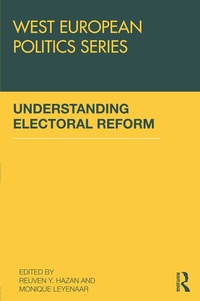
Understanding Electoral Reform
1st Edition
Published on 10. November 2011
Book
Hardback
248 pages
978-0-415-68889-5 (ISBN)
Description
The field of elections and electoral systems, and particularly electoral reform, has exhibited tremendous growth and cross-national appeal over the last two decades. However, beyond an increased knowledge of voting rules and their consequences for political representation, little attention has been devoted to the question of why electoral systems have recently undergone substantial change in several liberal democracies.
This book addresses several new approaches to electoral reform. First, the scope of the study of electoral reform has been expanded. Second, contrary to previous studies of electoral reform, the conviction that the determinants of reform can be explained by one single approach has been replaced by a belief in a more comprehensive framework for analysis. Third, we move beyond political parties (acting in parliament and government) as the most significant source of electoral reform. Fourth, a focus on the determinants of electoral reform allows us to include motivations and objectives of electoral reform. A final advancement in the study of electoral reform is the inclusion of countries other than 'established' democracies.
This book was published as a special issue of West European Politics.
This book addresses several new approaches to electoral reform. First, the scope of the study of electoral reform has been expanded. Second, contrary to previous studies of electoral reform, the conviction that the determinants of reform can be explained by one single approach has been replaced by a belief in a more comprehensive framework for analysis. Third, we move beyond political parties (acting in parliament and government) as the most significant source of electoral reform. Fourth, a focus on the determinants of electoral reform allows us to include motivations and objectives of electoral reform. A final advancement in the study of electoral reform is the inclusion of countries other than 'established' democracies.
This book was published as a special issue of West European Politics.
More details
Series
Language
English
Place of publication
London
United Kingdom
Publishing group
Taylor & Francis Ltd
Target group
College/higher education
Product notice
sewn/stitched
Cloth over boards
Illustrations
3 s/w Abbildungen, 4 s/w Zeichnungen
4 Line drawings, black and white; 3 Illustrations, black and white
Dimensions
Height: 234 mm
Width: 156 mm
Thickness: 16 mm
Weight
526 gr
ISBN-13
978-0-415-68889-5 (9780415688895)
Copyright in bibliographic data and cover images is held by Nielsen Book Services Limited or by the publishers or by their respective licensors: all rights reserved.
Schweitzer Classification
Other editions
Additional editions
Reuven Hazan | Monique Leyenaar
Understanding Electoral Reform
Book
08/2018
1st Edition
Routledge
€81.99
Shipment within 10-20 days
Reuven Hazan | Monique Leyenaar
Understanding Electoral Reform
E-Book
06/2014
1st Edition
Routledge
€69.99
Available for download
Reuven Hazan | Monique Leyenaar
Understanding Electoral Reform
E-Book
06/2014
1st Edition
Routledge
€69.99
Available for download
Persons
Reuven Y. Hazan is Professor at the Political Science Department of the Hebrew University of Jerusalem, Israel.
Monique Leyenaar is Professor of Political Science at Radboud University Nijmegen, The Netherlands.
Monique Leyenaar is Professor of Political Science at Radboud University Nijmegen, The Netherlands.
Content
1. Reconceptualizing Electoral Reform Monique Leyenaar & Reuven Y. Hazan 2. Electoral Reform in Europe since 1945 Alan Renwick 3. The Barriers to Electoral System Reform: A Synthesis of Alternative Approaches Giden Rahat & Reuven Y. Hazan 4. A Conceptual Framework for Major, Minor, and Technical Electoral Reform Kristof Jacobs & Monique Leyenaar 5. The Rise of Gender Quota Laws: Expanding the Spectrum of Determinants for Electoral Reform Karen Celis, Mona Lena Krook & Petra Meier 6. Cultural Explanations of Electoral Reform: A Policy Cycle Model Pippa Norris 7. Electoral reform and Direct Democracy in Canada: When Citizens Become Involved Lawrence LeDuc 8. Party Preferences and Electoral Reform: How Time in Government Affects the Likelihood of Supporting Electoral Change Jean-Benoit Pilet & Damien Bol 9. Democracy as a Cause of Electoral Reform: Jurisprudence and Electoral Change in Canada Richard S. Katz 10. When Electoral Reform Fails: The Stability of Proportional Representation in Post-Communist Democracies Csaba Nikolenyi 11. Veto Players and Electoral Reform in Belgium Marc Hooghe & Kris Deschouwer 12. The Different Trajectories of Italian Electoral Reforms Gianfranco Baldini