

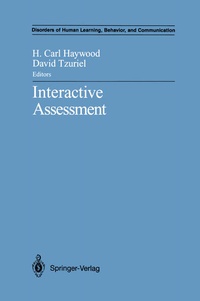
Interactive Assessment
Published on 16. December 1991
Book
Hardback
XII, 527 pages
978-0-387-97587-0 (ISBN)
Description
The terms interactive and dynamic would never have been associated with psychological and psychoeducational assessment a generation ago. They have currency now because of widespread dissatisfaction with the normative, standardized testing model, criticism of theoretical concepts of intelligence, recognition of abuses of standardized intelligence testing, and frustration with prediction and classification as primary goals of assessment. It is almost certainly true that public policy concerns propel scientific activity far more often than science propels public policy! In the case of psychological assessment, public policy concerns have arisen in the last 20 years primarily around issues of possible "discrimination" against members of ethnic minorities. At the same time, there has been a re surgence of dedication to "excellence in education" goals. These concerns have led to such extreme measures as prohibition of the use of standard ized intelligence tests to determine school placement decisions, especially for minority children. They have led also to a search for alternatives to standardized, normative testing. The chapters in this volume represent a variety of answers to this need.
More details
Series
Edition
1992 ed.
Language
English
Place of publication
New York
United States
Target group
College/higher education
Professional and scholarly
Research
Illustrations
6 s/w Abbildungen
XII, 527 p. 6 illus.
Dimensions
Height: 241 mm
Width: 160 mm
Thickness: 34 mm
Weight
975 gr
ISBN-13
978-0-387-97587-0 (9780387975870)
DOI
10.1007/978-1-4612-4392-2
Schweitzer Classification
Other editions
Additional editions
H. Carl Haywood | David Tzuriel
Interactive Assessment
E-Book
11/2013
Springer
€213.99
Available for download
H. Carl Haywood | David Tzuriel
Interactive Assessment
Book
07/2013
Springer
€213.99
Shipment within 15-20 days
Content
1 Theoretical Bases of Interactive Assessment.- 1 The Development of Interactive-Dynamic Approaches to Assessment of Learning Potential.- 2 Psychoeducational Assessment from a Transactional Perspective.- 3 The Learning Test Concept: Origins, State of the Art, and Trends.- 4 Reflections on Remediation and Transfer: A Vygotskian Perspective.- 2 Research on Interactive Assessment and Related Issues.- 5 Induction of Logic Structures in the Mentally Retarded: An Assessment and Invervention Instrument.- 6 The Dynamic Assessment of Intelligence.- 7 Dynamic Group Assessment for Prescriptive Teaching: Differential Effects of Treatments.- 8 Assessment of Attention, Simultaneous-Successive Coding, and Planning.- 9 Assessing Cognitive Modifiability of Infants and Toddlers: Observations Based on Mediated Learning Experience.- 10 Evaluating Preschool Programs: The Role of Dynamic Assessment.- 3 Applications of Interactive Assessment.- 11 Dynamic Assessment of Adults with Learning Difficulties.- 12 Cognitive Competence: Reality and Potential in the Deaf.- 13 Improving the Quality of Instruction: Roles for Dynamic Assessment.- 14 A Dynamic Assessment for Undergraduate Admission: The Inverse Relationship Between Modifiability and Predictability.- 15 Assessing the Learning Potential of Penitentiary Inmates: An Application of Feuerstein's Learning Potential Assessment Device.- 16 Process-Based Instruction: Integrating Assessment and Instruction.- 4 Case Studies of Interactive Assessment.- 17 Mediated Learning Experience Approach in the Assessment and Treatment of Borderline Psychotic Adolescents.- 18 A Case Study in the Induction of Logic Structures.- 5 Public Policy Issues in Psychoeducational Assessment.- 19 Policy Implications of Psychological Assessment of Minority Children.- 20Larry P., PASE, and Social Science in the Courtroom: The Science and Politics of Identifying and Educating Very Slow Learners.- Epilogue: The Status and Future of Interactive Assessment.- Author Index.