

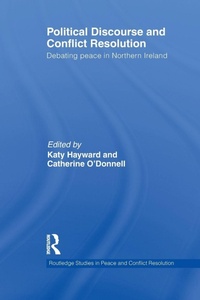
Political Discourse and Conflict Resolution
Debating Peace in Northern Ireland
1st Edition
Published on 30. May 2012
Book
Paperback/Softback
256 pages
978-0-415-64203-3 (ISBN)
Description
This book offers new insights into the close relationship between political discourses and conflict resolution through critical analysis of the role of discursive change in a peace process.
Just as a peace process has many dimensions and stakeholders, so the discourses considered here come from a wide range of sources and actors. The book contains in-depth analyses of official discourses used to present the peace process, the discourses of political party leaders engaging (or otherwise) with it, the discourses of community-level activists responding to it, and the discourses of the media and the academy commenting on it. These discourses reflect varying levels of support for the peace process - from obstruction to promotion - and the role of language in moving across this spectrum according to issue and occasion. Common to all these analyses is the conviction that the language used by political protagonists and cultural stakeholders has a profound effect on progression towards peace.
Bringing together leading experts on Northern Ireland's peace process from a range of academic disciplines, including political science, sociology, linguistics, history, geography, law, and peace studies, this book offers new insights into the discursive dynamics of violent political conflict and its resolution.
Just as a peace process has many dimensions and stakeholders, so the discourses considered here come from a wide range of sources and actors. The book contains in-depth analyses of official discourses used to present the peace process, the discourses of political party leaders engaging (or otherwise) with it, the discourses of community-level activists responding to it, and the discourses of the media and the academy commenting on it. These discourses reflect varying levels of support for the peace process - from obstruction to promotion - and the role of language in moving across this spectrum according to issue and occasion. Common to all these analyses is the conviction that the language used by political protagonists and cultural stakeholders has a profound effect on progression towards peace.
Bringing together leading experts on Northern Ireland's peace process from a range of academic disciplines, including political science, sociology, linguistics, history, geography, law, and peace studies, this book offers new insights into the discursive dynamics of violent political conflict and its resolution.
More details
Series
Language
English
Place of publication
London
United Kingdom
Publishing group
Taylor & Francis Ltd
Target group
College/higher education
Professional and scholarly
Postgraduate and Professional
Dimensions
Height: 234 mm
Width: 156 mm
Thickness: 13 mm
Weight
380 gr
ISBN-13
978-0-415-64203-3 (9780415642033)
Copyright in bibliographic data and cover images is held by Nielsen Book Services Limited or by the publishers or by their respective licensors: all rights reserved.
Schweitzer Classification
Other editions
Additional editions
Katy Hayward | Catherine O'Donnell
Political Discourse and Conflict Resolution
Debating Peace in Northern Ireland
E-Book
10/2010
Routledge
€77.99
Available for download
Katy Hayward | Catherine O'Donnell
Political Discourse and Conflict Resolution
Debating Peace in Northern Ireland
E-Book
10/2010
Routledge
€77.99
Available for download
Katy Hayward | Catherine O'Donnell
Political Discourse and Conflict Resolution
Debating Peace in Northern Ireland
Book
09/2010
1st Edition
Routledge
€231.80
Shipment within 15-20 days
Persons
Katy Hayward is Lecturer in Sociology at Queen's University Belfast.
Catherine O'Donnell is an independent scholar. She was an IRCHSS post-doctoral fellow at the Humanities Institute of Ireland, University College Dublin, 2005-2007.
Catherine O'Donnell is an independent scholar. She was an IRCHSS post-doctoral fellow at the Humanities Institute of Ireland, University College Dublin, 2005-2007.
Content
1. Introduction: Political Discourse and Conflict Resolution Katy Hayward 2. Constructing Legitimacy in Political Discourse in the Early Phase of the Troubles Sissel Rosland 3. Finding Consensus: Political Discourse in the Republic of Ireland on the Troubles and Peace Process Catherine O'Donnell 4. Interpreting New Labour's Political Discourse on the Peace Process Aaron Edwards 5. Discourse Worlds in Northern Ireland: The Legitimisation of the 1998 Agreement Laura Filardo-Llamas 6. 'Humespeak': The SDLP, Political Discourse and the Peace Process P. J. McLoughlin 7. DUP Discourses on Violence and their Impact on the Peace Process Amber Rankin and Gladys Ganiel 8. The Old Order Changeth - or Not? Modern Discourses within the Orange Order James W. McAuley and Jonathan Tonge 9. Continuity and Change in the Discourse of Republican Former Prisoners Peter Shirlow, Jonathan Tonge and James W. McAuley 10. Imagining 'A Shared Future': Post-Conflict Discourses on Peace-Building Milena Komarova 11. Sectarian Demography: Dubious Discourses of Ethno-National Conflict Owen McEldowney, James Anderson and Ian Shuttleworth 12. 'From Belfast to Baghdad...'?: Discourses of Northern Ireland's 'Model' of Conflict Resolution Eamonn O'Kane 13. 'The IRA Are Not Al-Qaeda': 'New Terrorism' Discourse and Irish Republicanism Mark McGovern 14. Debating Peace and Conflict in Northern Ireland: Towards a Narrative Approach Adrian Little