

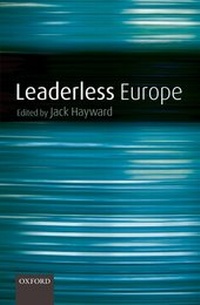
Leaderless Europe
Published on 29. May 2008
Book
Hardback
330 pages
978-0-19-953502-6 (ISBN)
Description
From its antecedents in the 1950s, successive forms of European integration were intended to be leaderless. They have succeeded only too well in demonstrating that much can be achieved without sustained leadership. The attachment to national sovereignty of most of the European elites and mass populations has meant that confederalism has been implicitly accepted for the foreseeable future. This book attempts to clarify three clusters of issues. First, as European integration has advanced, who has provided the impetus? Particular insiders have episodically exerted decisive innovative influence, despite the need to conciliate the jealous champions of national sovereignty. Three case studies are offered: economic and monetary policy, environmental policy and technology policy. The second part examines why the European Union is currently leaderless. The weakened Commission and the increasingly assertive European Council and Council of Ministers have contended for control of agenda-setting but it is in the sphere of foreign and security policy that the EU's logic of leaderlessness has been most conspicuous. Finally, reduced capacity of the Franco-German tandem to offer acceptable leadership and British incapacity to join or replace them in providing overall leadership is also discussed.
More details
Language
English
Place of publication
Oxford
United Kingdom
Target group
Professional and scholarly
Dimensions
Height: 240 mm
Width: 162 mm
Thickness: 23 mm
Weight
655 gr
ISBN-13
978-0-19-953502-6 (9780199535026)
Copyright in bibliographic data and cover images is held by Nielsen Book Services Limited or by the publishers or by their respective licensors: all rights reserved.
Schweitzer Classification
Person
Jack Hayward taught politics at the Universities of Sheffield, Keele, Hull, and Oxford, retiring in 1998 as Director of the Oxford Institute of European Studies and Professional Fellow of St. Antony's College. Since then he has been a part-time Research Professor of Politics at the University of Hull. He has also been a Visiting Professor to several French Universities, for one year each at Sorbonne Nouvelle and the Paris Institute of Political Studies, as well as for shorter periods at the Universities of Bordeaux, Grenoble, and Rennes.
Content
PART I: WHO LEAD EUROPE; PART II: WHY IS THE EU CURRENTLY LEADERLESS?; PART III: WHERE CAN POLITICAL LEADERSHIP COME FROM?