

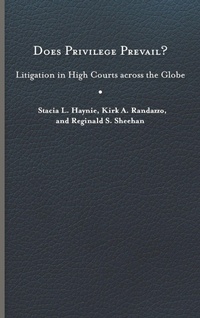
Does Privilege Prevail?
Litigation in High Courts Across the Globe
Published on 17. April 2024
Book
Hardback
188 pages
978-0-8139-5110-2 (ISBN)
Description
The first transnational comparative study of legal party capability theory
Justice is supposed to be blind. Cynics will say they know better. But what do the facts say? This groundbreaking study provides objective, data-driven answers to long-standing questions about winners and losers in courtrooms across the world. Does the party with the greater resources, such as money and influence, always prevail-and if so, why? Does Privilege Prevail? is the first book to evaluate these questions using a multi-country approach and, in doing so, assess what legal professionals and political scientists call party capability theory.
Stacia Haynie, Kirk Randazzo, and Reginald Sheehan analyze over fifteen thousand litigation outcomes of the high courts of six countries-Australia, Canada, India, the Philippines, South Africa, and the United Kingdom-from 1970 to 2000. This unprecedented trove of data reveals that while the "haves" of society do undoubtedly enjoy certain advantages in the judicial system, a more complex explanation for legal outcomes is required than party capability theory provides-especially when it comes to assessing the role of attorneys and their legal teams or the components of the docket where judges can provide avenues for the "have nots" to succeed.
Justice is supposed to be blind. Cynics will say they know better. But what do the facts say? This groundbreaking study provides objective, data-driven answers to long-standing questions about winners and losers in courtrooms across the world. Does the party with the greater resources, such as money and influence, always prevail-and if so, why? Does Privilege Prevail? is the first book to evaluate these questions using a multi-country approach and, in doing so, assess what legal professionals and political scientists call party capability theory.
Stacia Haynie, Kirk Randazzo, and Reginald Sheehan analyze over fifteen thousand litigation outcomes of the high courts of six countries-Australia, Canada, India, the Philippines, South Africa, and the United Kingdom-from 1970 to 2000. This unprecedented trove of data reveals that while the "haves" of society do undoubtedly enjoy certain advantages in the judicial system, a more complex explanation for legal outcomes is required than party capability theory provides-especially when it comes to assessing the role of attorneys and their legal teams or the components of the docket where judges can provide avenues for the "have nots" to succeed.
Reviews / Votes
"A much-needed book that makes a strong contribution to the study of law and courts and of political science."-Jennifer Barnes Bowie, University of Richmond, coauthor of The View from the Bench and Chambers: Examining Judicial Process and Decision Making on the U.S. Courts of AppealsMore details
Series
Language
English
Place of publication
Charlottesville
United States
Target group
Professional and scholarly
Product notice
Cloth over boards
Illustrations
39 tables, 6 charts
Dimensions
Height: 235 mm
Width: 157 mm
Thickness: 15 mm
Weight
434 gr
ISBN-13
978-0-8139-5110-2 (9780813951102)
Copyright in bibliographic data and cover images is held by Nielsen Book Services Limited or by the publishers or by their respective licensors: all rights reserved.
Schweitzer Classification
Other editions
Additional editions
Stacia L. Haynie | Kirk A. Randazzo | Reginald S. Sheehan
Does Privilege Prevail?
Litigation in High Courts across the Globe
E-Book
04/2024
1st Edition
Naval Institute Press
from
€69.99
Available for download
Persons
Stacia L. Haynie is President of Midwestern State University.
Kirk A. Randazzo is Professor of Political Science at the University of South Carolina.
Reginald S. Sheehan is Professor Emeritus of Political Science at Michigan State University.
Kirk A. Randazzo is Professor of Political Science at the University of South Carolina.
Reginald S. Sheehan is Professor Emeritus of Political Science at Michigan State University.