

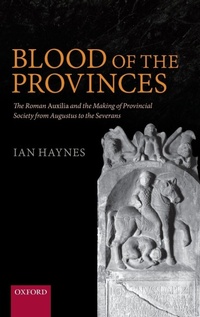
Blood of the Provinces
The Roman Auxilia and the Making of Provincial Society from Augustus to the Severans
Published on 3. October 2013
Book
Hardback
448 pages
978-0-19-965534-2 (ISBN)
Description
Blood of the Provinces is the first fully comprehensive study of the largest part of the Roman army, the auxilia. This non-citizen force constituted more than half of Rome's celebrated armies and was often the military presence in some of its territories. Diverse in origins, character, and culture, they played an essential role in building the empire, sustaining the unequal peace celebrated as the pax Romana, and enacting the emperor's writ.
Drawing upon the latest historical and archaeological research to examine recruitment, belief, daily routine, language, tactics, and dress, this volume offers an examination of the Empire and its soldiers in a radical new way. Blood of the Provinces demonstrates how the Roman state addressed a crucial and enduring challenge both on and off the battlefield - retaining control of the miscellaneous auxiliaries upon whom its very existence depended. Crucially, this was not simply achieved by pay and punishment, but also by a very particular set of cultural attributes that characterized provincial society under the Roman Empire. Focusing on the soldiers themselves, and encompassing the disparate military communities of which they were a part, it offers a vital source of information on how individuals and communities were incorporated into provincial society under the Empire, and how the character of that society evolved as a result.
Drawing upon the latest historical and archaeological research to examine recruitment, belief, daily routine, language, tactics, and dress, this volume offers an examination of the Empire and its soldiers in a radical new way. Blood of the Provinces demonstrates how the Roman state addressed a crucial and enduring challenge both on and off the battlefield - retaining control of the miscellaneous auxiliaries upon whom its very existence depended. Crucially, this was not simply achieved by pay and punishment, but also by a very particular set of cultural attributes that characterized provincial society under the Roman Empire. Focusing on the soldiers themselves, and encompassing the disparate military communities of which they were a part, it offers a vital source of information on how individuals and communities were incorporated into provincial society under the Empire, and how the character of that society evolved as a result.
Reviews / Votes
fascinating and authoritative... Essential for students of the Roman world, this book also offers plenty of interest to more general readers. * Current Archaeology * superb study * Times Literary Supplement * For those with a serious interest in the Roman army and more widely in the impact of the Roman empire on provincial populations, I have no hesitation in recommending a book that came out late last year - Ian Haynes, The Blood of the Provinces. * Adrian Goldsworthy, Ancient Historian and Novelist * This book is a crucial contribution not only to Roman military studies but to Roman archaeology and history more generally ... Blood of the Provinces has set the bar high for future work on the Roman military * Tyler Franconi, Bryn Mawr Classical Review * excellent ... For any student of the Roman army or of Roman provincial life, this book is essential reading ... In this formidable volume, Haynes has given us a study of the auxilia that is unlikely to be superseded in a generation. * Colin E. P. Adams, American Historical Review * I. Haynes's book is the first fully rounded attempt to evoke auxiliaries as people, family men and social actors, not just within the context of Rome's armies but also in the creation of provincial societies. A century on, it is a worthy twenty-first-century volume to place alongside Cheesmans classic. * Simon James, Britannia *More details
Language
English
Place of publication
Oxford
United Kingdom
Target group
College/higher education
Professional and scholarly
For students and scholars interested in archaeology, especially classical archaeology, Roman history, and military history.
Illustrations
50 in-text black and white illustrations
Dimensions
Height: 240 mm
Width: 161 mm
Thickness: 29 mm
Weight
837 gr
ISBN-13
978-0-19-965534-2 (9780199655342)
Copyright in bibliographic data and cover images is held by Nielsen Book Services Limited or by the publishers or by their respective licensors: all rights reserved.
Schweitzer Classification
Other editions
Additional editions
Ian Haynes
Blood of the Provinces
The Roman Auxilia and the Making of Provincial Society from Augustus to the Severans
Book
12/2016
Oxford University Press
€55.70
Shipment within 15-20 days
Ian Haynes
Blood of the Provinces
The Roman Auxilia and the Making of Provincial Society from Augustus to the Severans
E-Book
10/2013
1st Edition
OUP eBook
€28.49
Available for download
Person
Ian Haynes is Professor of Archaeology at Newcastle University. He has worked on Roman sites in Britain, Italy, Germany, Romania, Bulgaria, and the Czech Republic, and is currently project director of excavations at Maryport, Cumbria. Professor Haynes was formerly chair of the archaeology committee of the Roman Society and is a Fellow of the Society of Antiquaries, and a trustee of both the Clayton Trust and the Vindolanda Trust.
Content
ACKNOWLEDGEMENTS; ABBREVIATIONS; LIST OF FIGURES; LIST OF TABLES; SECTION 1: THE AUXILIA AND THE STRUCTURES OF IMPERIAL POWER; SECTION 2: THE HUMAN RESOURCE: THE RECRUITMENT OF THE AUXILIA AND ITS CONSEQUENCES; SECTION 3: A HOME FROM ROME: DAILY LIFE IN THE AUXILIA; SECTION 4: THROUGH THE EYES OF BELIEVERS: RELIGION, RITUAL ACTIVITY AND CULT PRACTICE; SECTION 5: ARMS AND THE MEN: EQUIPMENT, TACTICS AND IDENTITY; SECTIION 6: PEN AND SWORD: COMMUNICATION AND CULTURAL TRANSFORMATION; SECTION 7: AUXILIARY VETERANS AND THE MAKING OF PROVINCIAL SOCIETY; BIBLIOGRAPHY; INDEX