

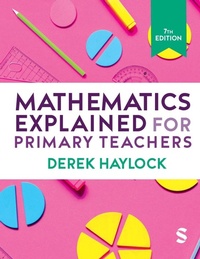
Mathematics Explained for Primary Teachers
7th Edition
Published on 3. April 2024
Book
Hardback
544 pages
978-1-5296-2630-8 (ISBN)
Description
Build your confidence in the primary classroom
Deepen your own mathematical subject knowledge
Discover why generations of primary teachers have relied on Derek Haylock's explanations of key mathematical concepts to support their understanding and strengthen their teaching
This seventh edition has been fully updated to offer a broader exploration of mastery teaching, deeper connections to contemporary research and new coverage of how children learn to count.
It is supported by a fantastic range of online resources including lesson plans, videos and test questions to extend your own learning.
Deepen your own mathematical subject knowledge
Discover why generations of primary teachers have relied on Derek Haylock's explanations of key mathematical concepts to support their understanding and strengthen their teaching
This seventh edition has been fully updated to offer a broader exploration of mastery teaching, deeper connections to contemporary research and new coverage of how children learn to count.
It is supported by a fantastic range of online resources including lesson plans, videos and test questions to extend your own learning.
More details
Edition
7th Revised edition
Language
English
Place of publication
London
United Kingdom
Target group
Professional and scholarly
Edition type
Revised edition
Dimensions
Height: 241 mm
Width: 196 mm
Thickness: 34 mm
Weight
1198 gr
ISBN-13
978-1-5296-2630-8 (9781529626308)
Copyright in bibliographic data and cover images is held by Nielsen Book Services Limited or by the publishers or by their respective licensors: all rights reserved.
Schweitzer Classification
Other editions
Additional editions
Derek Haylock
Mathematics Explained for Primary Teachers
Book
04/2024
7th Edition
SAGE Publications Ltd
€115.40
Shipment within 3-4 weeks
Derek Haylock
Mathematics Explained for Primary Teachers
E-Book
03/2024
7th Edition
SAGE Publications Ltd
€61.49
Available for download
Derek Haylock
Mathematics Explained for Primary Teachers
E-Book
03/2024
7th Edition
SAGE Publications Ltd
€61.49
Available for download
Previous edition
Derek Haylock | Ralph Manning
Mathematics Explained for Primary Teachers
Book
12/2018
6th Edition
SAGE Publications Ltd
€238.00
Shipment within 15-20 days
Person
Derek Haylock is an education writer, with an extensive list of publications in the field of mathematics education. He worked for over 30 years in teacher education, both initial and in-service, and was Co-Director of Primary Initial Teacher Training and responsible for the mathematics components of the primary programmes at the University of East Anglia (UEA) in Norwich. He has considerable practical experience of teaching and researching in primary classrooms. His work in mathematics education has taken him to Germany, Belgium, Lesotho, Kenya, Brunei, India and Sweden. As well as his publications in the field of education, he has written seven books of Christian drama for young people and a Christmas musical (published by Church House/National Society). For 15 years after his time at UEA, he was in great demand as a consultant and professional speaker. His work as a writer continues.
Content
SECTION A: MATHEMATICAL UNDERSTANDING
Chapter 1: Primary Teachers' Insecurity about Mathematics
Chapter 2: Mathematics in the Primary Curriculum
Chapter 3: Learning How to Learn Mathematics
SECTION B: MATHEMATICAL REASONING AND PROBLEM SOLVING
Chapter 4: Key Processes in Mathematical Reasoning
Chapter 5: Modelling and Problem Solving
SECTION C: NUMBERS AND CALCULATIONS
Chapter 6: Numbers and Place Value
Chapter 7: Addition and Subtraction Structures
Chapter 8: Mental Strategies for Addition and Subtraction
Chapter 9: Written Methods for Addition and Subtraction
Chapter 10: Multiplication and Division Structures
Chapter 11: Mental Strategies for Multiplication and Division
Chapter 12: Written Methods for Multiplication and Division
SECTION D: FURTHER NUMBER CONCEPTS AND SKILLS
Chapter 13: Natural Numbers: Some Key Concepts
Chapter 14: Integers: Positive and Negative
Chapter 15: Fractions and Ratios
Chapter 16: Decimal Numbers and Rounding
Chapter 17: Calculations with Decimals
Chapter 18: Proportionality and Percentages
SECTION E: ALGEBRA
Chapter 19: Algebraic Reasoning
Chapter 20: Coordinates and Linear Relationships
SECTION F: MEASUREMENT
Chapter 21: Concepts and Principles of Measurement
Chapter 22: Perimeter, Area and Volume
SECTION G: GEOMETRY
Chapter 23: Angle
Chapter 24: Transformations and Symmetry
Chapter 25: Classifying Shapes
SECTION H: STATISTICS AND PROBABILITY
Chapter 26: Handling Data
Chapter 27: Comparing Sets of Data
Chapter 28: Probability
Chapter 1: Primary Teachers' Insecurity about Mathematics
Chapter 2: Mathematics in the Primary Curriculum
Chapter 3: Learning How to Learn Mathematics
SECTION B: MATHEMATICAL REASONING AND PROBLEM SOLVING
Chapter 4: Key Processes in Mathematical Reasoning
Chapter 5: Modelling and Problem Solving
SECTION C: NUMBERS AND CALCULATIONS
Chapter 6: Numbers and Place Value
Chapter 7: Addition and Subtraction Structures
Chapter 8: Mental Strategies for Addition and Subtraction
Chapter 9: Written Methods for Addition and Subtraction
Chapter 10: Multiplication and Division Structures
Chapter 11: Mental Strategies for Multiplication and Division
Chapter 12: Written Methods for Multiplication and Division
SECTION D: FURTHER NUMBER CONCEPTS AND SKILLS
Chapter 13: Natural Numbers: Some Key Concepts
Chapter 14: Integers: Positive and Negative
Chapter 15: Fractions and Ratios
Chapter 16: Decimal Numbers and Rounding
Chapter 17: Calculations with Decimals
Chapter 18: Proportionality and Percentages
SECTION E: ALGEBRA
Chapter 19: Algebraic Reasoning
Chapter 20: Coordinates and Linear Relationships
SECTION F: MEASUREMENT
Chapter 21: Concepts and Principles of Measurement
Chapter 22: Perimeter, Area and Volume
SECTION G: GEOMETRY
Chapter 23: Angle
Chapter 24: Transformations and Symmetry
Chapter 25: Classifying Shapes
SECTION H: STATISTICS AND PROBABILITY
Chapter 26: Handling Data
Chapter 27: Comparing Sets of Data
Chapter 28: Probability