

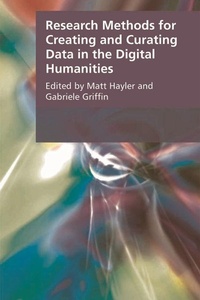
Research Methods for Creating and Curating Data in the Digital Humanities
Published on 30. May 2016
Book
Paperback/Softback
256 pages
978-1-4744-0965-0 (ISBN)
Description
The first volume to focus on digitising and curating data online as research methods for Digital Humanities
As all scholars increasingly use digital tools to support their research, and every internet user becomes used to data being available, elucidating, and engaging, the creative aspects of Digital Humanities work are coming under increasing scrutiny. This volume explores the practice of making new tools, new images, new collections, and new artworks in an academic environment, detailing who needs to be involved and what their roles might be, and how they come together to produce knowledge as a collective. The chapters presented here demonstrate that creation is never neutral with political and theoretical concerns intentionally or unavoidably always being written into the fabric of what is being made, even if that's the seeming neatness of computer code. In presenting their own creative research, the writers in this volume offer examples of practice that will be of use to anyone interested in learning more about contemporary Digital Humanities scholarship and its implications.
Key features:
First volume to explore digitisation practices as research methods for Humanities scholarsProvides a practical and critical approach to issues of digitisation Discusses actual digitisation projects on a 'how-to' basisAddresses issues such as digital photography, multi-spectral imaging, rekeying, metadata, online simulation, artistic practice online
As all scholars increasingly use digital tools to support their research, and every internet user becomes used to data being available, elucidating, and engaging, the creative aspects of Digital Humanities work are coming under increasing scrutiny. This volume explores the practice of making new tools, new images, new collections, and new artworks in an academic environment, detailing who needs to be involved and what their roles might be, and how they come together to produce knowledge as a collective. The chapters presented here demonstrate that creation is never neutral with political and theoretical concerns intentionally or unavoidably always being written into the fabric of what is being made, even if that's the seeming neatness of computer code. In presenting their own creative research, the writers in this volume offer examples of practice that will be of use to anyone interested in learning more about contemporary Digital Humanities scholarship and its implications.
Key features:
First volume to explore digitisation practices as research methods for Humanities scholarsProvides a practical and critical approach to issues of digitisation Discusses actual digitisation projects on a 'how-to' basisAddresses issues such as digital photography, multi-spectral imaging, rekeying, metadata, online simulation, artistic practice online
More details
Series
Language
English
Place of publication
Edinburgh
United Kingdom
Target group
Professional and scholarly
Product notice
Paperback (trade)
Unsewn / adhesive bound
Illustrations
35 colour illustrations, 4 black and white tables
Dimensions
Height: 233 mm
Width: 154 mm
Thickness: 17 mm
Weight
357 gr
ISBN-13
978-1-4744-0965-0 (9781474409650)
Copyright in bibliographic data and cover images is held by Nielsen Book Services Limited or by the publishers or by their respective licensors: all rights reserved.
Schweitzer Classification
Other editions
Additional editions
Matt Hayler | Gabriele Griffin
Research Methods for Creating and Curating Data in the Digital Humanities
E-Book
05/2016
1st Edition
Edinburgh University Press
€0.00
Available for download
Persons
Matt Hayler is a Lecturer in post-1980s Literature at the University of Birmingham specializing in Digital and Cyberculture Studies, specifically (post)phenomenology and Cognitive Science influenced approaches to e-reading and to technology more broadly. Recent publications include Challenging the Phenomena of Technology (Palgrave 2015) and chapters on technology and the digital humanities in forthcoming volumes on Futures for English Studies (Palgrave 2016, co-written with Marilyn Deegan) and Theatre Performance and Cognition (Methuen 2016). Gabriele Griffin is Chair in Gender Research at Uppsala University, Sweden. She has a long-standing research interest in research methods for the Humanities, and in women's cultural production. Recent publications include The Emotional Politics of Research Collaboration (co-ed.; Routledge 2013) and The Social Politics of Research Collaboration (co-ed.; Routledge 2013). She is editor of the 'research Methods for the Arts and Humanities' series (Edinburgh UP).
Content
1. Introduction, Matt Hayler and Gabriele Griffin; 2. Choices in Digitization for the Digital Humanities, Simon Tanner, Laura Gibson, Rebecca Kahn and Geoff Laycock; 3. Curating the language of letters: historical linguistic methods in the museum, Mel Evans; 4. Connecting with the past - opportunities and challenges in digital history Thomas Nygren, Zephyr Frank, Nicholas Bauchand Erik Steiner; 5. The object and the event: Time-based digital simulation and illusion in the fine arts, Stephen Hilyard; 6. Data visualisation and the Humanities Lisa Otty and Tara Thomson; 7. Curating Mary Digitally: Digital Methodologies and Representations of Medieval Material Culture, Cecilia Lindhe, Ann-Catrine Eriksson, Jim Robertsson and Mattis Lindmark; 8. Raising language awareness using digital media: methods for revealing linguistic stereotyping, Mats Deutschmann, Anders Steinvall and Anna Lagerstroem; 9. A world of possibilities: digitisation and the humanities, Marilyn Deegan.