

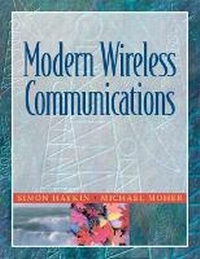
Modern Wireless Communications
United States Edition
Published on 26. March 2004
Book
Hardback
576 pages
978-0-13-022472-9 (ISBN)
Description
For courses in Wireless Communication.
This text provides a self-motivating introduction to wireless communications; it presents topics in a manner consistent with their natural evolution, based on the principle of increasing spectral efficiency of the radio transmission. Wireless Systems begins with a discussion of FDMA systems and follows the evolution through TDMA, CDMA, and SDMA techniques. Engineering principles required for each multiple access strategy are presented parallel with it.
This text provides a self-motivating introduction to wireless communications; it presents topics in a manner consistent with their natural evolution, based on the principle of increasing spectral efficiency of the radio transmission. Wireless Systems begins with a discussion of FDMA systems and follows the evolution through TDMA, CDMA, and SDMA techniques. Engineering principles required for each multiple access strategy are presented parallel with it.
More details
Language
English
Place of publication
United States
Publishing group
Pearson Education (US)
Target group
College/higher education
Dimensions
Height: 226 mm
Width: 241 mm
Thickness: 26 mm
Weight
1004 gr
ISBN-13
978-0-13-022472-9 (9780130224729)
Copyright in bibliographic data and cover images is held by Nielsen Book Services Limited or by the publishers or by their respective licensors: all rights reserved.
Schweitzer Classification
Content
1. Introduction.
2. Propagation and Noise.
3. Modulation, and Frequency-Division Multiple Access.
4. Coding, and Time-Division Multiple Access.
5. Spread Spectrum, and Code Division Multiple Access.
6. Diversity, and Space-Division Multiple Access.
7. Wireless Architectures.
Appendix A: Fourier Theory.
Appendix B: Bessel Functions.
Appendix C: Random Variables and Random Processes.
Appendix D: Matched Filters.
Appendix E: Error Function.
Appendix F: MAP Algorithm.
Appendix G: Capacity of MIMO Links.
Appendix H: Eigendecomposition.
Appendix I: Adaptive Array Antenna.
2. Propagation and Noise.
3. Modulation, and Frequency-Division Multiple Access.
4. Coding, and Time-Division Multiple Access.
5. Spread Spectrum, and Code Division Multiple Access.
6. Diversity, and Space-Division Multiple Access.
7. Wireless Architectures.
Appendix A: Fourier Theory.
Appendix B: Bessel Functions.
Appendix C: Random Variables and Random Processes.
Appendix D: Matched Filters.
Appendix E: Error Function.
Appendix F: MAP Algorithm.
Appendix G: Capacity of MIMO Links.
Appendix H: Eigendecomposition.
Appendix I: Adaptive Array Antenna.