


Adaptive Filter Theory
International Edition
4th Edition
Published on 28. January 2004
Book
Paperback/Softback
936 pages
978-0-13-048434-5 (ISBN)
Description
Adaptive Filter Theory, 4e, is ideal for courses in Adaptive Filters.
Haykin examines both the mathematical theory behind various linear adaptive filters and the elements of supervised multilayer perceptrons. In its fourth edition, this highly successful book has been updated and refined to stay current with the field and develop concepts in as unified and accessible a manner as possible.
Haykin examines both the mathematical theory behind various linear adaptive filters and the elements of supervised multilayer perceptrons. In its fourth edition, this highly successful book has been updated and refined to stay current with the field and develop concepts in as unified and accessible a manner as possible.
More details
Edition
4th edition
Language
English
Place of publication
United States
Publishing group
Pearson Education (US)
Target group
Professional and scholarly
Dimensions
Height: 177 mm
Width: 236 mm
Thickness: 34 mm
Weight
1311 gr
ISBN-13
978-0-13-048434-5 (9780130484345)
Copyright in bibliographic data and cover images is held by Nielsen Book Services Limited or by the publishers or by their respective licensors: all rights reserved.
Schweitzer Classification
Other editions
New editions
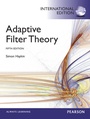
Book
08/2013
5th Edition
Pearson Education Limited
€110.99
Shipment within 10-20 days
Previous edition

Book
01/1996
3rd Edition
Pearson
€56.94
Article exhausted; check for reprint
Content
Background and Overview.
1. Stochastic Processes and Models.
2. Wiener Filters.
3. Linear Prediction.
4. Method of Steepest Descent.
5. Least-Mean-Square Adaptive Filters.
6. Normalized Least-Mean-Square Adaptive Filters.
7. Transform-Domain and Sub-Band Adaptive Filters.
8. Method of Least Squares.
9. Recursive Least-Square Adaptive Filters.
10. Kalman Filters as the Unifying Bases for RLS Filters.
11. Square-Root Adaptive Filters.
12. Order-Recursive Adaptive Filters.
13. Finite-Precision Effects.
14. Tracking of Time-Varying Systems.
15. Adaptive Filters Using Infinite-Duration Impulse Response Structures.
16. Blind Deconvolution.
17. Back-Propagation Learning.
Epilogue.
Appendix A. Complex Variables.
Appendix B. Differentiation with Respect to a Vector.
Appendix C. Method of Lagrange Multipliers.
Appendix D. Estimation Theory.
Appendix E. Eigenanalysis.
Appendix F. Rotations and Reflections.
Appendix G. Complex Wishart Distribution.
Glossary.
Abbreviations.
Principal Symbols.
Bibliography.
Index.
1. Stochastic Processes and Models.
2. Wiener Filters.
3. Linear Prediction.
4. Method of Steepest Descent.
5. Least-Mean-Square Adaptive Filters.
6. Normalized Least-Mean-Square Adaptive Filters.
7. Transform-Domain and Sub-Band Adaptive Filters.
8. Method of Least Squares.
9. Recursive Least-Square Adaptive Filters.
10. Kalman Filters as the Unifying Bases for RLS Filters.
11. Square-Root Adaptive Filters.
12. Order-Recursive Adaptive Filters.
13. Finite-Precision Effects.
14. Tracking of Time-Varying Systems.
15. Adaptive Filters Using Infinite-Duration Impulse Response Structures.
16. Blind Deconvolution.
17. Back-Propagation Learning.
Epilogue.
Appendix A. Complex Variables.
Appendix B. Differentiation with Respect to a Vector.
Appendix C. Method of Lagrange Multipliers.
Appendix D. Estimation Theory.
Appendix E. Eigenanalysis.
Appendix F. Rotations and Reflections.
Appendix G. Complex Wishart Distribution.
Glossary.
Abbreviations.
Principal Symbols.
Bibliography.
Index.