

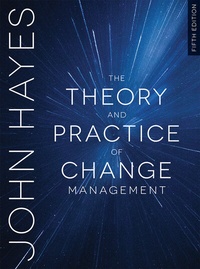
The Theory and Practice of Change Management
Description
John Hayes' bestselling textbook combines a scholarly discussion of change management with a host of practical tools and techniques. It provides future managers with all the skills they need to diagnose the need for change and to ensure its successful implementation. The book's unique underpinning framework views change as a purposeful and constructed sequence of events, rather than something chaotic and unmanageable. Its hands-on approach includes a number of 'Change Tools' that students can apply to various scenarios, an array of case studies and examples based on real-life organisations worldwide and video interviews with experienced change practitioners, who share their insights on key topics.
The book will be essential reading for final-year business undergraduates, as well as MBA and postgraduate students who are taking modules in change management or organisational change. It is also ideal for change practitioners and consultants.
Reviews / Votes
It would be hard to improve on the last edition of Hayes' book, but this version does. Wonderfully clear, it is a useful book for course leaders in the human side of strategy, and a great lifelong learning companion for anyone moving into a change agent's role or looking to change their organisation. The new, reframed chapters on making change stick are a great addition. * Peter Antonioni, UCL School of Management, UK * Getting people to change, even when it is in their best interest to do so, is the most difficult task faced by any leader. Hayes makes this content readily accessible, in one of the best management texts I have ever read. * Nicholas S. Miceli, Park University, USA * In our turbulent times, the management of organizational change has become more important than ever. John Hayes's book systemizes the complex field of change management and orders it into a clear and logical process. Highly recommended reading for both students and practitioners who want to learn how change management works and why. * Professor Dr Arjan Kozica, ESB Business School, Reutlingen University, Germany * This text has three great strengths as an effective learning resource: it is one of the few texts where chapters clearly align with managing the change process; it emphasises the people management issues associated with implementing change; and each chapter provides at least one brief practical case study, drawing from a range of industries and organisations located around the globe. * Jan Fermelis, Deakin University, Australia * This excellent book gives a thorough view of the many forms and stages of change management processes in today's organisations. The multimedia learning aids and case studies unpack crucial issues further for the reader, offering useful insights into reasons for the possible success or failure of various change initiatives. * Tom Calvard, University of Edinburgh Business School, UK * Organizational change is a complex and paradoxical phenomenon. Scholars endlessly discuss the dilemmas and conflicting epistemological stances, while practitioners need insightful examples, clear frameworks and practical guidelines on how to realize change successfully. In a marvelously comprehensible way, John Hayes offers a clear balance between both worlds and by doing so demystifies the world of change management. I strongly recommend this book to practitioners and scholars alike. * Antonie van Nistelrooij, Vrije Universitet Amsterdam, Netherlands * There is a lot to like about this textbook! John Hayes guides us through the challenges of managing organisational change and combines important theoretical concepts with practical exercises on how to facilitate change more effectively. All students and industry practitioners would benefit from the ideas and concepts in this text-a must read for all who want to make a difference and manage change successfully. * Jane Boeske, University of Southern Queensland, Australia * This updated edition of John Hayes's text offers a useful structure for students and instructors to understand managing change in an organizational context. Interesting case studies and examples, from both a regional and global vantage, help those with an interest in, or already working for, national and multi-national organizations. Valuable reading, and an excellent study tool! * Alastair Watson, University of Wollongong in Dubai * The text does a fine job detailing change management processes, balancing theory, and covering the tools necessary for practitioners. It has rapidly become a staple in my organization change graduate course. * Dr. Arthur Sementelli, Florida Atlantic University, USA *More details
Other editions
New editions
Additional editions
Previous edition
Person
Content
PART I: MANAGING CHANGE: A PROCESS PERSPECTIVE.- 1. Process Models of Change.- 2. Leading Change: A Process Perspective.- PART II: RECOGNISING THE NEED FOR CHANGE.- 3. Patterns of Change.- 4. Recognising the Need or Opportunity for Change.- 5. Starting the Change.- 6. Building Change Relationships.- PART III: DIAGNOSING WHAT NEEDS TO BE CHANGED.- 7. Diagnosis.- 8. Gathering and Interpreting Information.- PART IV: LEADING AND MANAGING THE PEOPLE ISSUES.- 9. The Role of Leadership in Change Management.- 10. Power, Politics and Stakeholder Management.- 11. Responsible Change Management: An Ethical Approach.- 12. Managing Context to promote ethical practice.- 13. Communicating Change.- 14. Motivating Others to Change.- 15. Supporting Others through Change.- PART V: PLANNING AND PREPARING FOR CHANGE.- 16. Shaping Implementation Strategies.- 17. Developing a Change Plan.- 18. Types of Intervention.- 19. Action Research.- 20. Appreciative Inquiry.- 21. Training and Development.- 22. High Performance Management.- 23. Business Process Re-engineering.- 24. Lean.- 25. Culture Profiling.- 26 Value Innovation.- 27. Selecting Interventions.- PART VI: IMPLEMENTING CHANGE AND REVIEWING PROGRESS.- 28. Implementing Change.- 29. Reviewing and Keeping the Change on Track.- PART VII: SUSTAINING CHANGE.- 30. Making Change Stick.- 31. Spreading Change.- PART VIII: LEARNING.- 32. Change Managers Learning From Their Own Experience.- 33. Facilitating Collective Learning.- 34. Pulling it All Together: A Concluding Case Study.