

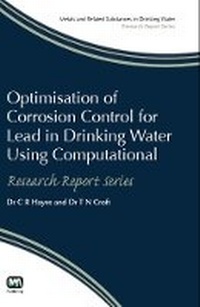
Optimisation of Corrosion Control for Lead in Drinking Water Using Computational Modelling Techniques
Published on 15. January 2013
Book
Paperback/Softback
67 pages
978-1-78040-478-3 (ISBN)
Description
In many respects, lead in drinking water has become a forgotten problem, since the mid 1980s when a range of environmental controls were implemented to reduce exposure to lead. This is largely because the sampling protocols, that underpin regulatory controls, are mostly inadequate and have tended to under-estimate the amount of lead that can be present in drinking water (IWA, 2010).
Optimisation of Corrosion Control for Lead in Drinking Water Using Computational Modelling Techniques shows how compliance modelling has been used to very good effect in the optimisation of plumbosolvency control in the United Kingdom, particularly in the optimisation of orthophosphate dosing. Over 100 water supply systems have been modelled, involving 30% of the UK's water companies. This "proof-of-concept" project has the overall objective of demonstrating that these modelling techniques could also be applicable to the circumstances of Canada and the United States, via three case studies.
This report is the first in the Research Report Series published by the IWA Specialist Group on Metals and Related Substances in Drinking Water.
Authors: Dr. C. R. Hayes and Dr. T. N. Croft Collaborators A. Campbell, City of Ottawa Water (CA) I. P. Douglas, City of Ottawa Water (CA) P. Gadoury, Providence Water (US) M. R. Schock, US Environmental Protection Agency (US)
Optimisation of Corrosion Control for Lead in Drinking Water Using Computational Modelling Techniques shows how compliance modelling has been used to very good effect in the optimisation of plumbosolvency control in the United Kingdom, particularly in the optimisation of orthophosphate dosing. Over 100 water supply systems have been modelled, involving 30% of the UK's water companies. This "proof-of-concept" project has the overall objective of demonstrating that these modelling techniques could also be applicable to the circumstances of Canada and the United States, via three case studies.
This report is the first in the Research Report Series published by the IWA Specialist Group on Metals and Related Substances in Drinking Water.
Authors: Dr. C. R. Hayes and Dr. T. N. Croft Collaborators A. Campbell, City of Ottawa Water (CA) I. P. Douglas, City of Ottawa Water (CA) P. Gadoury, Providence Water (US) M. R. Schock, US Environmental Protection Agency (US)
More details
Series
Language
English
Place of publication
London
United Kingdom
Target group
College/higher education
Professional and scholarly
Dimensions
Height: 234 mm
Width: 156 mm
Thickness: 18 mm
ISBN-13
978-1-78040-478-3 (9781780404783)
Copyright in bibliographic data and cover images is held by Nielsen Book Services Limited or by the publishers or by their respective licensors: all rights reserved.
Schweitzer Classification
Other editions
Additional editions
Colin Hayes | T. N. Croft | Corine Houtman
Optimisation of Corrosion Control for Lead in Drinking Water Using Computational Modelling Techniques
E-Book
01/2013
IWA Publishing
€124.99
Available for download
Content
Contents: Introduction; Corrective water treatment for reducing lead in drinking water; Regulatory background in the United States and the need for further optimisation of plumbosolvency control; Regulatory background in Canada and the need for further optimisation of plumbosolvency control; Optimisation of plumbosolvency control in the United Kingdom and the use of computational modelling techniques; Project outline, objectives and benefits; Description of the computational compliance models; Introduction; The single pipe model; The zonal modelling framework; Simulating sampling; Simulation of water flow in a pipe using computational fluid dynamics; Introduction; The fluid flow equations and their computational solution; Comparison of plug and laminar flow along a straight pipe; Application of volumetric profiles; Calibration and validation; Calibration; Validation ; Case study: City A (US); Case study: City B (CA); Case study: City C (US); Investigations into sequential sampling; Sequential sampling surveys in Cities A, B and C; Modelling zonal compliance; Using Reynold's Number; Modelling sequential sampling at a single house; Discussion; The use of modelling in the optimisation of plumbosolvency control; Regulatory aspects; Operational aspects; Risk assessment; The way forward; Conclusions; Calibration data; Examples of model output