

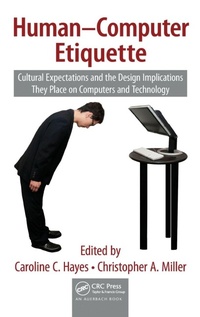
Human-Computer Etiquette
Cultural Expectations and the Design Implications They Place on Computers and Technology
1st Edition
Published on 14. December 2010
Book
Hardback
406 pages
978-1-4200-6945-7 (ISBN)
Description
Written by experts from various fields, this edited collection explores a wide range of issues pertaining to how computers evoke human social expectations. The book illustrates how socially acceptable conventions can strongly impact the effectiveness of human-computer interactions and how to consider such norms in the design of human-computer interfaces. Providing a complete introduction to the design of social responses to computers, the text emphasizes the value of social norms in the development of usable and enjoyable technology. It also describes the role of socially correct behavior in technology adoption and how to design human-computer interfaces for a competitive global market.
More details
Series
Language
English
Place of publication
London
United Kingdom
Publishing group
Taylor & Francis Ltd
Target group
Professional and scholarly
Professional and Professional Practice & Development
Illustrations
72 s/w Abbildungen, 12 s/w Tabellen
12 Tables, black and white; 72 Illustrations, black and white
Dimensions
Height: 240 mm
Width: 161 mm
Thickness: 26 mm
Weight
775 gr
ISBN-13
978-1-4200-6945-7 (9781420069457)
Copyright in bibliographic data and cover images is held by Nielsen Book Services Limited or by the publishers or by their respective licensors: all rights reserved.
Schweitzer Classification
Other editions
Additional editions
Caroline C. Hayes | Christopher a. Miller
Human-Computer Etiquette
Cultural Expectations and the Design Implications They Place on Computers and Technology
E-Book
12/2010
1st Edition
Auerbach
€204.99
Available for download
Caroline C. Hayes | Christopher a. Miller
Human-Computer Etiquette
Cultural Expectations and the Design Implications They Place on Computers and Technology
E-Book
12/2010
1st Edition
Auerbach
€205.99
Available for download
Persons
Caroline C. Hayes, Christopher A. Miller
Content
Chapter 1: Human-Computer Etiquette: Should Computers Be Polite? Part I: Etiquette and Multicultural Collisions. Chapter 2: As Human-Computer Interactions Go Global. Chapter 3: Etiquette to Bridge Cultural Faultlines: Cultural Fault lines in Multinational Teams: Potential for Unintended Rudeness. Part II: Introducing Etiquette and Culture into Software. Chapter 4: Computational Models of Etiquette and Culture. Chapter 5: The Role of Politeness in Interactive Educational Software for Language Tutoring. Chapter 6: Designing for Other Cultures: Learning Tools Design in the Nasa Amerindian Context. Part III: Etiquette and Development of Trust. Chapter 7: Network Operations: Developing Trust in Human and Computer Agents. Chapter 8: Etiquette in Distributed Game-Based Training: Communication, Trust, Cohesion. Part IV: Anthropomorphism: Computer Agents that Look or Act Like People. Chapter 9: Etiquette in Motivational Agents: Engaging Users and Developing Relationships. Chapter 10: Anthropomorphism and Social Robots: Se tting Etiquette Expectations. Part V: Understanding Humans: Physiological and Neurological Indicators. Chapter 11: The Social Brain: Behavioral, Computational, and Neuroergonomic Perspectives. Chapter 12: Etiquette Considerations for Adaptive Systems that Interrupt: Cost and Benefits. Part VI: The Future: Polite and Rude Computers as Agents of Social Change. Chapter 13: Etiquette-Based Sociotechnical Design. Chapter 14: Politechnology: Manners Maketh Machine. Chapter 15: Epilogue. Index.