

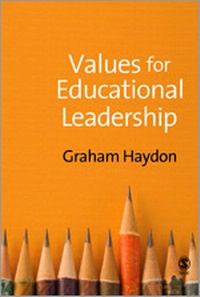
Values for Educational Leadership
1st Edition
Published on 4. June 2007
Book
Paperback/Softback
128 pages
978-1-4129-3468-8 (ISBN)
Description
`If you are intending to embark upon or support others taking part in any of the programmes of the National College for School Leadership I would definitely keep this book close by' - Cliff Jones, CPD Update
What are values? Where do our values come from? How do our values make a difference to education?
For educational leaders to achieve distinction in their practice, it is vital to establish their own clear sense of values rather than reacting to the implicit values of others. This engaging book guides readers in thinking for themselves about the values they bring to their task and the values they intend to promote. Crucially, the book promotes critical thought and constructive analysis about the underlying values involved with:
- aims and moral purpose in education
- individual qualities in educational leadership
- vision in education
- school ethos and culture
- the school as an educational community.
By inviting reflection using valuable case studies and work-through activities, as well as referring to a wide range of academic literature, this book will be an important resource for those working towards professional qualifications such as NPQH, and invaluable for anyone aspiring to excellence in educational leadership.
Graham Haydon is Senior Lecturer in Philosophy of Education at the Institute of Education, University of London, where he teaches on Masters courses in Values in Education and Applied Educational Leadership and Management.
What are values? Where do our values come from? How do our values make a difference to education?
For educational leaders to achieve distinction in their practice, it is vital to establish their own clear sense of values rather than reacting to the implicit values of others. This engaging book guides readers in thinking for themselves about the values they bring to their task and the values they intend to promote. Crucially, the book promotes critical thought and constructive analysis about the underlying values involved with:
- aims and moral purpose in education
- individual qualities in educational leadership
- vision in education
- school ethos and culture
- the school as an educational community.
By inviting reflection using valuable case studies and work-through activities, as well as referring to a wide range of academic literature, this book will be an important resource for those working towards professional qualifications such as NPQH, and invaluable for anyone aspiring to excellence in educational leadership.
Graham Haydon is Senior Lecturer in Philosophy of Education at the Institute of Education, University of London, where he teaches on Masters courses in Values in Education and Applied Educational Leadership and Management.
More details
Language
English
Place of publication
Thousand Oaks
United States
Target group
College/higher education
Professional and scholarly
Dimensions
Height: 234 mm
Width: 156 mm
Weight
211 gr
ISBN-13
978-1-4129-3468-8 (9781412934688)
Copyright in bibliographic data and cover images is held by Nielsen Book Services Limited or by the publishers or by their respective licensors: all rights reserved.
Schweitzer Classification
Other editions
Additional editions
Graham Haydon
Values for Educational Leadership
Book
06/2007
1st Edition
SAGE Publications Inc
€231.76
Shipment within 10-20 days
Graham Haydon
Values for Educational Leadership
E-Book
06/2007
1st Edition
SAGE Publications Ltd
€74.99
Available for download
Graham Haydon
Values for Educational Leadership
E-Book
06/2007
1st Edition
SAGE Publications Ltd
from
€74.99
Available for download
Content
Acknowledgements
Introduction
1. Values and their place in educational leadership
2. Educational aims and moral purpose
3. The individual leader
4. Vision in education
5. School ethos and culture
6. Community and democracy
7. References
8. Index
Introduction
1. Values and their place in educational leadership
2. Educational aims and moral purpose
3. The individual leader
4. Vision in education
5. School ethos and culture
6. Community and democracy
7. References
8. Index