

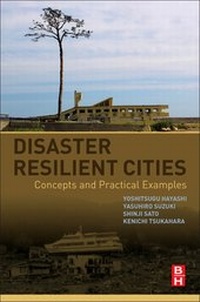
Disaster Resilient Cities
Concepts and Practical Examples
Published on 17. March 2016
Book
Paperback/Softback
206 pages
978-0-12-809862-2 (ISBN)
Description
Disaster Resilient Cities: Concepts and Practical Examples discusses natural disasters, their complexity, and the exploration of different ways of thinking regarding the resilience of structures. The book provides a blueprint for structural designers to better prepare structures for all types of natural hazards during the design stage.
Brief and readable, this book analyzes various examples of disaster damage from earthquakes, tsunamis, and floods, together with their causal mechanisms. Practical methods to plan and design structures based on their regions, cities, as well as the particular countermeasures are also included for study.
Brief and readable, this book analyzes various examples of disaster damage from earthquakes, tsunamis, and floods, together with their causal mechanisms. Practical methods to plan and design structures based on their regions, cities, as well as the particular countermeasures are also included for study.
More details
Language
English
Place of publication
Woburn
United States
Publishing group
Elsevier - Health Sciences Division
Target group
Professional and scholarly
Structural Engineers, Earthquake Engineers, Structural Designers, and Construction Engineers
Dimensions
Height: 229 mm
Width: 152 mm
Weight
320 gr
ISBN-13
978-0-12-809862-2 (9780128098622)
Copyright in bibliographic data and cover images is held by Nielsen Book Services Limited or by the publishers or by their respective licensors: all rights reserved.
Schweitzer Classification
Other editions
Additional editions
Yoshitsugu Hayashi | Yasuhiro Suzuki | Shinji Sato
Disaster Resilient Cities
Concepts and Practical Examples
E-Book
03/2016
Butterworth-Heinemann
€71.95
Available for download
Persons
Yoshitsugu Hayashi is Distinguished Professor & Director of the Center for Sustainable Development and Global Smart City at Chubu University, Japan, and Distinguished Guest Professor, Tsinghua University, China. He is Executive Committee member of the Club of Rome and Ex-President (2013-19) and Chair of COVID-19 Task Force of WCTRS (World Conference on Transport Research Society). He is the author of more than 230 peer-reviewed papers and 40 books, including Elsevier's book Disaster Resilient Cities. His research areas include urbanization and motorization, urban smart growth/shrink management, rail transit systems, QOL based project evaluation method replacing cost-economic benefit analysis, and smart transport and cities. He was also a board member of the Engineering Academy of Japan, co-editor of Elsevier's journal Transport Policy and Associate Editor of Elsevier's Transportation Research Part D journal. Professor, Disaster Mitigation Research Center, Nagoya University Professor, Department of Civil Engineering, the University of Tokyo Professor, Disaster Risk Reduction Research Center, Graduate School of Engineering, Kyushu University
Author
Distinguished Professor and Director, Center for Sustainable Development and Global Smart City, Chubu University, Kasugai, Aichi, Japan
Disaster Mitigation Research Center, Nagoya University, Nagoya, Japan
Department of Civil Engineering, the University of Tokyo, Tokyo, Japan
Disaster Risk Reduction Research Center, Graduate School of Engineering, Kyushu University, Fukuoka, Japan
Content
Chapter 1. Introduction - Why Resilience is Lost?Chapter 2. Emerging Crisis in Resilience over the world2.1 The Great East Japan Earthquake (Kato T., Sato)2.2 Mega-flood in Bangkok, Thailand (Nakamura)2.3 Super-typhoon Haiyan in Philippines2.4 Disaster resilience learned from the 2007 Peru Earthquake2.5 Losing resilience of Nomadic life due to urbanization in Mongolia (Ishii)2.6 Losing reconstruction capacity of traditional wooden houses in JapanChapter 3. Learning Disaster Resilience from the Great East Japan Earthquake3.1 Understanding spatial variation of tsunami3.2 Understanding of tsunami damages as "Lost Stock"3.3 Measuring damage and recovery status of residents in terms of "Quality of Life"Chapter 4. Regional Grand Design for Improving Disaster Resilience4.1 Optimum sea-wall height based on risk analysis with land use and soft measures4.2 Earthquake damage risk evaluation by micro geo data4.3 Consensus building for resilient society4.4 Resilient grand design based on QOL4.5 Paradigm change in flood protection strategies for enhancing resilience (Kachi)4.6 Smart shrink strategy and the fiscal system