

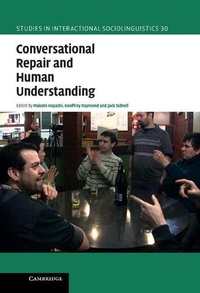
Conversational Repair and Human Understanding
Published on 17. January 2013
Book
Hardback
396 pages
978-1-107-00279-1 (ISBN)
Description
Humans are imperfect, and problems of speaking, hearing and understanding are pervasive in ordinary interaction. This book examines the way we 'repair' and correct such problems as they arise in conversation and other forms of human interaction. The first book-length study of this topic, it brings together a team of scholars from the fields of anthropology, communication, linguistics and sociology to explore how speakers address problems in their own talk and that of others, and how the practices of repair are interwoven with non-verbal aspects of communication such as gaze and gesture, across a variety of languages. Specific chapters highlight intersections between repair and epistemics, repair and turn construction, and repair and action formation. Aimed at researchers and students in sociolinguistics, speech communication, conversation analysis and the broader human and social sciences to which they contribute - anthropology, linguistics, psychology and sociology - this book provides a state-of-the-art review of conversational repair, while charting new directions for future study.
Reviews / Votes
'Repair is absolutely central to any analysis of language and social life as self-organizing natural systems. Here, major scholars insightfully demonstrate repair's relevance to action formation, human understanding and language diversity. A central resource!' Charles Goodwin, University of California, Los Angeles '... breaks new ground in our understanding of human interaction, and of conversational repair in particular. Essential reading for anyone analysing talk and interaction.' Celia Kitzinger, University of York 'Conversational repair has been a classic research topic in conversation analysis, and the present volume counts as one of the best collections of studies on this topic ... Conversational Repair and Human Understanding is a new classic of conversational repair research.' Xiaoli Zhou and Guodong Yu, Shanxi UniversityMore details
Series
Language
English
Place of publication
Cambridge
United Kingdom
Target group
Professional and scholarly
Illustrations
3 Tables, black and white; 10 Halftones, unspecified; 10 Halftones, black and white; 4 Line drawings, black and white
Dimensions
Height: 235 mm
Width: 157 mm
Thickness: 28 mm
Weight
792 gr
ISBN-13
978-1-107-00279-1 (9781107002791)
Copyright in bibliographic data and cover images is held by Nielsen Book Services Limited or by the publishers or by their respective licensors: all rights reserved.
Schweitzer Classification
Other editions
Additional editions
Makoto Hayashi | Geoffrey Raymond | Jack Sidnell
Conversational Repair and Human Understanding
Book
05/2018
Cambridge University Press
€55.50
Shipment within 15-20 days
Makoto Hayashi
Conversational Repair and Human Understanding
E-Book
01/2013
Cambridge University Press
€21.99
Available for download
Makoto Hayashi | Geoffrey Raymond | Jack Sidnell
Conversational Repair and Human Understanding
E-Book
12/2012
1st Edition
Cambridge University Press
€26.49
Available for download
Persons
Makoto Hayashi is Associate Professor in the Department of East Asian Languages and Cultures at the University of Illinois, Urbana-Champaign. Geoffrey Raymond is Associate Professor of Sociology at the University of California, Santa Barbara. Jack Sidnell is Associate Professor of Anthropology at the University of Toronto.
Content
1. Conversational repair and human understanding: an introduction Makoto Hayashi, Geoffrey Raymond and Jack Sidnell; 2. Ten operations in self-initiated, same-turn repair Emanuel A. Schegloff; 3. Self-repair and action construction Paul Drew, Traci Walker and Richard Ogden; 4. On the place of hesitating in delicate formulations: a turn constructional infrastructure for collaborative indiscretion Gene H. Lerner; 5. One question after another: same-turn-repair in the formation of yes/no type initiating actions Geoffrey Raymond and John Heritage; 6. On the interactional import of self-repair in the courtroom Tanya Romaniuk and Susan Ehrlich; 7. Defensive mechanisms: I-mean prefaced utterances in complaint and other conversational sequences Douglas W. Maynard; 8. Availability as a trouble source in directive-response sequences Mardi Kidwell; 9. Epistemics, action formation, and other-initiation of repair: the case of partial questioning repeats Jeffrey D. Robinson; 10. Proffering insertable elements: a study of other-initiated repair in Japanese Makoto Hayashi and Kaoru Hayano; 11. Alternative, subsequent descriptions Jack Sidnell and Rebecca Barnes; 12. Huh? What? - A first survey in 21 languages N. J. Enfield, Mark Dingemanse, Julija Baranova, Joe Blythe, Penelope Brown, Tyko Dirksmeyer, Paul Drew, Simeon Floyd, Sonja Gipper, Rosa Gisladottir, Gertie Hoymann, Kobin H. Kendrick, Stephen C. Levinson, Lilla Magyari, Elizabeth Manrique, Giovanni Rossi, Lila San Roque and Francisco Torreira.