

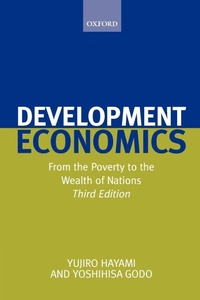
Development Economics
From the Poverty to the Wealth of Nations
3rd Edition
Published on 3. February 2005
Book
Paperback/Softback
448 pages
978-0-19-927271-6 (ISBN)
Description
This textbook provides a comprehensive, systematic treatise on development economics, combining classical political economy, modern institutional theory, and current development issues. Grown out of twenty years' experience of teaching in the United States and Japan, its treatment is global, although the organizing principle is the East Asian development experience. Taking a comparative institutional analysis approach, it also outlines quantitative characteristics of Third World development in terms of population growth, natural resource depletion, capital accumulation, and technological change.
Development Economics addresses one major question: Why has a small set of countries achieved a high level of affluence while the majority remain poor and stagnant? One obvious factor is a the ability to adopt and develop advanced technology, due in large measure to the difficulty experienced by low-income economies in preparing appropriate institutions for borrowing advanced technology given their social and cultural constraints. This volume explores the nature of these constraints, with the aim of identifying the means to remove them, and examines countries where the constraints have been successfully lifted---most notably Japan and East Asian NIEs.
This fully revised and updated third edition also incorporates analyses of several recent changes and newly emerged problems relevant to the global economy: recurrent economic crises in Latin America contrasted with the recovery of East Asia from the 1997-8 financial crisis; a paradigm change in international development assistance from 'the Washington Consensus' to the 'the Post-Washington Consensus', with a major shift in its focus from economic growth to poverty reduction as manifested in the United Nations' Millennium Development Goals; and the stalemate in international collaboration on the environment as represented by delays in the ratification of the Kyoto Protocol. In exploring these issues, Development Economics provides important lessons on what institutions can promote economic growth, reduce poverty, and conserve the environment through the borrowing of technology.
Development Economics addresses one major question: Why has a small set of countries achieved a high level of affluence while the majority remain poor and stagnant? One obvious factor is a the ability to adopt and develop advanced technology, due in large measure to the difficulty experienced by low-income economies in preparing appropriate institutions for borrowing advanced technology given their social and cultural constraints. This volume explores the nature of these constraints, with the aim of identifying the means to remove them, and examines countries where the constraints have been successfully lifted---most notably Japan and East Asian NIEs.
This fully revised and updated third edition also incorporates analyses of several recent changes and newly emerged problems relevant to the global economy: recurrent economic crises in Latin America contrasted with the recovery of East Asia from the 1997-8 financial crisis; a paradigm change in international development assistance from 'the Washington Consensus' to the 'the Post-Washington Consensus', with a major shift in its focus from economic growth to poverty reduction as manifested in the United Nations' Millennium Development Goals; and the stalemate in international collaboration on the environment as represented by delays in the ratification of the Kyoto Protocol. In exploring these issues, Development Economics provides important lessons on what institutions can promote economic growth, reduce poverty, and conserve the environment through the borrowing of technology.
Reviews / Votes
Review from previous edition This is a well written and nicely argued book. [It] would constitute a core book around which to structure a course in Economic Development. * Journal of Development Studies * This remarkable book offers a unified, coherent, and optimistic overview of the discipline. * Journal of Economic Literature * A comprehensive textbook on development economics. * Development Policy Review *More details
Edition
3rd Revised edition
Language
English
Place of publication
Oxford
United Kingdom
Target group
Professional and scholarly
Post-graduate and senior undergraduate students in economic development, economic growth, economics of low-income economies, comparative economic systems, agricultural and industrial economics, economic history, and the history of economic thought. Scholars in political science, sociology, and anthropology, and policymakers and administrators working in development.
Edition type
Revised edition
Illustrations
numerous figures & tables
Dimensions
Height: 234 mm
Width: 156 mm
Thickness: 24 mm
Weight
679 gr
ISBN-13
978-0-19-927271-6 (9780199272716)
Copyright in bibliographic data and cover images is held by Nielsen Book Services Limited or by the publishers or by their respective licensors: all rights reserved.
Schweitzer Classification
Other editions
Additional editions
The late Yujiro Hayami | Yoshihisa Godo
Development Economics
From the Poverty to the Wealth of Nations
Book
02/2005
3rd Edition
Oxford University Press
€277.30
Shipment within 15-20 days
Persons
Yujiro Hayami was Chairman of the Graduate Faculty at the Foundation for Advanced Studies on International Development and Professor at the National Graduate Institute of Policy Studies, Tokyo.
Yoshihisa Godo is Associate Professor of Economics at Meijigakuin University and Visiting Associate Professor at the National Graduate Institute for Policy Studies, Tokyo.
Yoshihisa Godo is Associate Professor of Economics at Meijigakuin University and Visiting Associate Professor at the National Graduate Institute for Policy Studies, Tokyo.
Content
Introduction ; 1. A Theoretical Framework for Economic Development ; 2. A Comparative Perspective on Developing Economies ; 3. Population Growth and the Constraint of Natural Resources ; 4. Breaking the Resource Constraint ; 5. Capital Accumulation and Economic Development ; 6. Patterns and Sources of Technological Progress ; 7. Income Distribution and Environmental Problems ; 8. Market and State ; 9. The Role of Community in Economic Development ; 10. Tradition and Modernization: A Concluding Remark ; Bibliography ; Index