

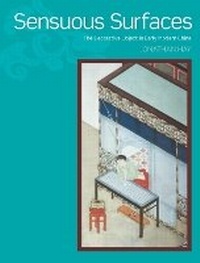
Sensuous Surfaces
The Decorative Object in Early Modern China
Published on 1. September 2010
Book
Hardback
440 pages
978-1-86189-408-3 (ISBN)
Description
Sensuous Surfaces is a richly illustrated and in-depth introduction to the decorative arts in Ming and Qing dynasty China. Jonathan Hay explores materials and techniques, as well as issues of patronage and taste, which together formed a loose system of informal rules that affected every level of decoration in early modern China, from an individual object to the arrangement of an entire residential interior. By engaging the actual and metaphoric potential of surface, Hay contends, this system guided the production and use of the decorative arts during a period of explosive growth, which started in the late sixteenth century and continued until the mid-nineteenth century. This understanding of decorative arts in China made a fundamental contribution to the sensory education of its early modern urban population, both as individuals and in their established social roles. Sensuous Surfaces is also an elegant meditation on the role of pleasure in decoration. Often intellectually dismissed as merely pleasurable, Hay argues that decoration is better understood as a necessary form of art which can fulfil its function only by engaging the human capacity for erotic response.
Featuring around 250 colour images of a wide range of early modern Chinese objects and artworks, this book will engage anyone with an interest in decoration, art, China - or the experience of pleasure itself.
To hear Jonathan Hay's interview on New Books in East Asian Studies, please click here.
Featuring around 250 colour images of a wide range of early modern Chinese objects and artworks, this book will engage anyone with an interest in decoration, art, China - or the experience of pleasure itself.
To hear Jonathan Hay's interview on New Books in East Asian Studies, please click here.
Reviews / Votes
In addition to communicating Hays own pleasure in his subject, the book itself is also a pleasure to behold with a well-designed layout and many excellent illustrations. Decoration is a fascinating subject which resonates far beyond any particular period or country. * <i>ARLIS</i> * a very intelligent book, and each of the authors main points is fleshed out in complex detail. Hay is to be commended for restoring the decorative arts to a central place within the theoretical discourse of art history. * <i>Orientations</i> * Jonathan Hays Sensuous Surfaces, focusing on portable interior decorative objects of the Ming and Qing periods, circa 1570-1840, examines the fascinating yet little-explored sensuous surfaces of what the Qing taste-maker Li Yu called wanhao zhi wu orpleasurable things. * <i>Oxford Art Journal</i> * this book fills a large gap in the literature on the Chinese decorative arts, providing the most comprehensive study to date on the subject underpinned by a novel methodological approach. As well as having excellent and copious illustrations, the book also benefits from a useful bibliography and a character list for Chinese terms and categories . . . a very welcome and overdue publication.& * <i>Etudes Chinoises</i> *More details
Language
English
Place of publication
London
United Kingdom
Illustrations
229 illustrations, 223 in colour
Dimensions
Height: 250 mm
Width: 190 mm
ISBN-13
978-1-86189-408-3 (9781861894083)
Copyright in bibliographic data and cover images is held by Nielsen Book Services Limited or by the publishers or by their respective licensors: all rights reserved.
Schweitzer Classification
Person
Jonathan Hay is Ailsa Mellon Bruce Professor of Fine Arts at the Institute of Fine Arts, New York University, He has written widely on the visual and material culture of Ming-Qing China, including Shitao: Painting and Modernity in Early Qing China (2001).
Content
Preface THE DECORATIVE OBJECT 1 Decoration as Luxury 2 The Object Thinks with Us 3 Surface, Metaphor, Affect THE SURFACESCAPE OF THE OBJECT 4 Monochrome Smoothness 5 Material Patterning 6 Formal Pattern 7 Depiction 8 Inscription 9 Fictive Surface 10 Diversified Surface THE SURFACESCAPE OF THE ROOM 11 Layering across Hierarchy 12 Object Landscapes 13 The Atmospherics of Surface 14 The Erotic Economy of Decoration Acknowledgments