

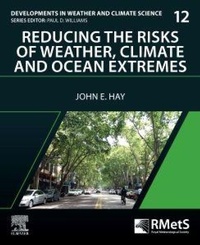
Reducing the Risks of Weather, Climate and Ocean Extremes
Volume 12
Will be published approx. on 1. March 2026
Book
Paperback/Softback
300 pages
978-0-443-45122-5 (ISBN)
Description
Reducing the Risks of Weather, Climate and Ocean Extremes presents evidence-based and practical guidance on appropriate ways to manage the rapidly increasing impacts and risks associated with extreme weather, climate and ocean events. This book specifically addresses the needs and challenges laid out in the author’s two earlier volumes: Science of Weather, Climate and Ocean Extremes, 2022, and Consequences of Weather, Climate and Ocean Extremes, 2025.
The book emphasizes the importance of proactive risk management at local, national, and global levels, drawing on lessons learned from past experiences to inform effective strategies. It explores the complexities of managing the consequences of these extremes, highlighting the role of communication, engagement, and inclusiveness in fostering
resilience within communities. Additionally, the text addresses the necessity of monitoring and evaluating climate risk management initiatives to ensure their effectiveness and adaptability. By synthesizing insights across various scales, this author aims to empower readers to navigate the challenges posed by climate variability and change.
This book serves as a vital resource for researchers and practitioners committed to reducing risks and enhancing resilience in the face of an increasingly unpredictable climate.
Members of the Royal Meteorological Society are eligible for a 35% discount on all Developments in Weather and Climate Science series titles. See the RMetS member dashboard for the discount code.
The book emphasizes the importance of proactive risk management at local, national, and global levels, drawing on lessons learned from past experiences to inform effective strategies. It explores the complexities of managing the consequences of these extremes, highlighting the role of communication, engagement, and inclusiveness in fostering
resilience within communities. Additionally, the text addresses the necessity of monitoring and evaluating climate risk management initiatives to ensure their effectiveness and adaptability. By synthesizing insights across various scales, this author aims to empower readers to navigate the challenges posed by climate variability and change.
This book serves as a vital resource for researchers and practitioners committed to reducing risks and enhancing resilience in the face of an increasingly unpredictable climate.
Members of the Royal Meteorological Society are eligible for a 35% discount on all Developments in Weather and Climate Science series titles. See the RMetS member dashboard for the discount code.
More details
Series
Language
English
Place of publication
United States
Product notice
Paperback (trade)
Unsewn / adhesive bound
Dimensions
Height: 235 mm
Width: 191 mm
Weight
450 gr
ISBN-13
978-0-443-45122-5 (9780443451225)
Copyright in bibliographic data and cover images is held by Nielsen Book Services Limited or by the publishers or by their respective licensors: all rights reserved.
Schweitzer Classification
Other editions
Additional editions
E-Book
04/2026
Elsevier
€153.99
Available for download
Person
John E. Hay is Adjunct Professor at the University of the South Pacific and Griffith University. He has more than 50 years of experience in academia, the private sector, and governmental organisations. His work has focused on bringing an interdisciplinary approach to the environmental sciences, and to technical- and policy-relevant assessments and guidance, especially regarding atmospheric and oceanic extremes, in the context of climate variability and change. John has worked as a consultant and advisor to many national governments and regional and international organisations. He is a recipient of the Nobel Peace Prize, awarded jointly to the Intergovernmental Panel on Climate Change (IPCC) and Al Gore, and of a prestigious fellowship from the Guggenheim Foundation.
Content
1. Introduction
2. Managing the Current and Anticipated Consequences of Weather, Climate and Ocean Extremes
3. Local-level Perspectives on Managing Weather and Climate Extremes
4. National-level Perspectives on Managing Weather, Climate and Ocean Extremes
5. Global-level Perspectives on Managing Weather, Climate and Ocean Extremes
6. Monitoring and Evaluating Climate Risk Management Initiatives
7. From Hindsights to Insights to Foresights and Oversights
2. Managing the Current and Anticipated Consequences of Weather, Climate and Ocean Extremes
3. Local-level Perspectives on Managing Weather and Climate Extremes
4. National-level Perspectives on Managing Weather, Climate and Ocean Extremes
5. Global-level Perspectives on Managing Weather, Climate and Ocean Extremes
6. Monitoring and Evaluating Climate Risk Management Initiatives
7. From Hindsights to Insights to Foresights and Oversights