

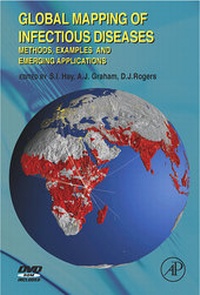
Global Mapping of Infectious Diseases
Methods, Examples and Emerging Applications
Published on 16. February 2007
Book
Paperback/Softback
444 pages
978-0-12-031764-6 (ISBN)
Description
First published in 1963, Advances in Parasitology contains comprehensive and up-to-date reviews in all areas of interest in contemporary parasitology. This volume is an outline of global environmental and global population data including scripts for predicting disease distributions and evaluating the accuracy of these mapped products. Several application chapters discuss current research topics appropriately addressed at the global scale. Topics such as tick-borne disease and the mapping of geographic and phylogenetic space; implications of global ecozonation and transportation networks on pathogen flow; and the impacts of climate change on vector-borne diseases are covered in this latest volume.
More details
Language
English
Place of publication
San Diego
United States
Publishing group
Elsevier Science Publishing Co Inc
Target group
Professional and scholarly
Researchers in parasitology, tropical medicine, epidemiology and public health
Dimensions
Height: 229 mm
Width: 152 mm
Weight
750 gr
ISBN-13
978-0-12-031764-6 (9780120317646)
Copyright in bibliographic data and cover images is held by Nielsen Book Services Limited or by the publishers or by their respective licensors: all rights reserved.
Schweitzer Classification
Other editions
Additional editions
Global Mapping of Infectious Diseases
Methods, Examples and Emerging Applications
E-Book
03/2007
Academic Press
€175.00
Available for download
Persons
Content
Models for Vectors and Vector-Borne Diseases
Global Environmental Data for Mapping Infectious Disease Distribution
Issues of Scale and Uncertainty in the Global Remote Sensing of Disease
Determining Global Population Distribution: Methods, Applications and Data
Defining the Global Spatial Limits of Malaria Transmission in 2005
The Global Distribution of Yellow Fever and Dengue
Global Epidemiology, Ecology and Control of Soil-Transmitted Helminth Infections
Tick-borne Disease Systems: Mapping Geographic and Phylogenetic Space
Global Transport Networks and Infectious Disease Spread
Climate Change and Vector-borne Diseases
Global Environmental Data for Mapping Infectious Disease Distribution
Issues of Scale and Uncertainty in the Global Remote Sensing of Disease
Determining Global Population Distribution: Methods, Applications and Data
Defining the Global Spatial Limits of Malaria Transmission in 2005
The Global Distribution of Yellow Fever and Dengue
Global Epidemiology, Ecology and Control of Soil-Transmitted Helminth Infections
Tick-borne Disease Systems: Mapping Geographic and Phylogenetic Space
Global Transport Networks and Infectious Disease Spread
Climate Change and Vector-borne Diseases