

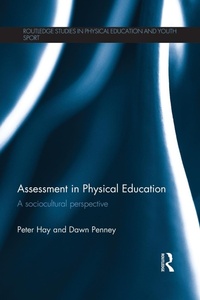
Assessment in Physical Education
A Sociocultural Perspective
1st Edition
Published on 17. July 2014
Book
Paperback/Softback
160 pages
978-1-138-79575-4 (ISBN)
Description
Assessment has widely been acknowledged as a central element of institutional education, shaping curriculum and pedagogy in powerful ways and representing a critical reference point in political, professional and public debates about educational achievement and policy directions. Within physical education there remains significant debate regarding the subject knowledge, skills and understandings that should be assessed, in what ways and at what points in students' education this should occur.
Divided into three parts, Assessment in Physical Education makes an important contribution to our understanding of the socio-cultural issues associated with assessment in physical education, in terms of its systemic development as well as at the level of pedagogic relations between physical education teachers and their students. It provides readers with an insightful critique and theoretically informed ideas for rethinking assessment policies and practices in physical education.
This book will be of interest to advanced students and researchers in physical education and youth sport studies, as well as those involved in initial teacher education and teacher professional development.
Divided into three parts, Assessment in Physical Education makes an important contribution to our understanding of the socio-cultural issues associated with assessment in physical education, in terms of its systemic development as well as at the level of pedagogic relations between physical education teachers and their students. It provides readers with an insightful critique and theoretically informed ideas for rethinking assessment policies and practices in physical education.
This book will be of interest to advanced students and researchers in physical education and youth sport studies, as well as those involved in initial teacher education and teacher professional development.
Reviews / Votes
"In order to obtain quality PE it is essential to be conscious about the role of assessment and this book offers its readers a very useful platform for discussing and elaborating assessment as a pedagogical tool. I strongly recommend the book."- Claes Annerstedt, iddrottsforum.org, Nordic Sport Science ForumMore details
Series
Language
English
Place of publication
London
United Kingdom
Publishing group
Taylor & Francis Ltd
Target group
College/higher education
Dimensions
Height: 234 mm
Width: 156 mm
Thickness: 9 mm
Weight
254 gr
ISBN-13
978-1-138-79575-4 (9781138795754)
Copyright in bibliographic data and cover images is held by Nielsen Book Services Limited or by the publishers or by their respective licensors: all rights reserved.
Schweitzer Classification
Other editions
Additional editions
E-Book
09/2012
Routledge
€87.49
Available for download
E-Book
09/2012
1st Edition
Routledge
€87.49
Available for download
Book
08/2012
1st Edition
Routledge
€232.60
Shipment within 15-20 days
Persons
Peter Hay is a Senior Lecturer in the School of Human Movement Studies, The University of Queensland, Australia. His work has focused on assessment practices and policies in and beyond the field of physical education and the social construction of abilities in institutional education settings.
Dawn Penney is Professor of Physical Education and Sport Pedagogy in the Department of Sport and Leisure Studies in the Faculty of Education at the University of Waikato, New Zealand. Dawn is recognised internationally for her work in policy and curriculum development in Health and Physical Education.
Dawn Penney is Professor of Physical Education and Sport Pedagogy in the Department of Sport and Leisure Studies in the Faculty of Education at the University of Waikato, New Zealand. Dawn is recognised internationally for her work in policy and curriculum development in Health and Physical Education.
Content
Chapter 1. Introduction Part 1: Developing Assessment 'Messages' in Physical Education Chapter 2. Producing Assessment Messages Chapter 3. Definitions, Differentiations and Communications of Assessment Part 2: Enacting Assessment in Physical Education Chapter 4. Defining, Acquiring and Transacting Ability Through Assessment in Physical Education Chapter 5. A Sociocultural View of Assessment Validity in Physical Education Chapter 6. Assessment Literacy in Physical Education Part 3: Promoting Assessment Efficacy in PE Chapter 7. Aligning Curriculum, Pedagogy and Assessment in Physical Education Chapter 8. Reconceptualising Assessment for Learning in Physical Education Chapter 9. Assessment Innovations, Transformations and Technologies Chapter 10. Conclusion