

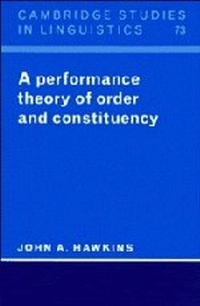
A Performance Theory of Order and Constituency
Published on 2. February 1995
Book
Hardback
516 pages
978-0-521-37261-9 (ISBN)
Description
In this major new book John A. Hawkins presents a new theory of linear ordering in syntax. He argues that processing can provide a simple, functional explanation for syntactic rules of ordering, as well as for the selection among ordering variants in languages and structures in which variation is possible. Insights from generative syntax, typological studies of language universals, and psycholinguistic studies of language processing are combined to show that there is a profound correspondence between performance and grammar. The major ordering principle proposed, Early Immediate Constituents, is tested on performance data from ten distinct languages. The result is a unified theory of free and fixed word orders, in which ordering is driven by efficient structure recognition. This major work will be welcomed by a wide cross-section of readers in syntax, language typology, psycholinguistics, and cognitive science.
More details
Series
Language
English
Place of publication
Cambridge
United Kingdom
Target group
Professional and scholarly
Dimensions
Height: 236 mm
Width: 155 mm
Thickness: 34 mm
Weight
882 gr
ISBN-13
978-0-521-37261-9 (9780521372619)
Copyright in bibliographic data and cover images is held by Nielsen Book Services Limited or by the publishers or by their respective licensors: all rights reserved.
Schweitzer Classification
Other editions
New editions
John A. Hawkins
A Performance Theory of Order and Constituency
Book
01/1995
Cambridge University Press
€60.90
Shipment within 15-20 days
Additional editions
John A. Hawkins
A Performance Theory of Order and Constituency
Book
01/1995
Cambridge University Press
€60.90
Shipment within 15-20 days
Person
Content
Preface; Acknowledgements; 1. Introduction; 2. The grammaticalisation of processing principles; 3. Early Immediate Constituents; 4. Testing EIC's performance predictions; 5. Testing EIC's grammatical predictions; 6. Grammaticalised node construction; 7. Conclusions; References; Index of names; Language index; Subject index; Abbreviations.