

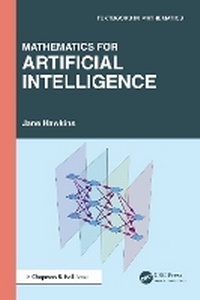
Mathematics for Artificial Intelligence
1st Edition
Will be published approx. on 19. March 2026
Book
Hardback
248 pages
978-1-041-16198-1 (ISBN)
Description
Artificial intelligence (AI) and machine learning (ML) are rapidly growing fields drawing great interest among students. Many students in a range of fields, including mathematics, computer science, statistics, data science, and more, see AI and ML as a key to their future.
This book provides the basic mathematics needed to understand AI and ML. It serves both students of mathematics and those who want to fill any gaps in their mathematics experience. It is written as both a text for a course and as a focused look at mathematics needed for readers hoping to learn more.
The author has taught every topic in this book, often in different contexts, and the material and exercises are drawn from lecture notes. The material in the book represents a curated set of topics from the undergraduate math curriculum, some first-year seminar material, and some student project topics. Through carefully chosen examples and discussion in the text, the reader will learn how and where these tools are applied. AI and ML connections are raised along the way.
It presumes the reader has at least completed the traditional three-semester calculus course. Linear algebra is presented as needed and should not require a completed course. The book is also well-suited for self-paced learning. Each chapter can be read independently with the help of the index for cross-referencing. Exercises are included.
This book provides the basic mathematics needed to understand AI and ML. It serves both students of mathematics and those who want to fill any gaps in their mathematics experience. It is written as both a text for a course and as a focused look at mathematics needed for readers hoping to learn more.
The author has taught every topic in this book, often in different contexts, and the material and exercises are drawn from lecture notes. The material in the book represents a curated set of topics from the undergraduate math curriculum, some first-year seminar material, and some student project topics. Through carefully chosen examples and discussion in the text, the reader will learn how and where these tools are applied. AI and ML connections are raised along the way.
It presumes the reader has at least completed the traditional three-semester calculus course. Linear algebra is presented as needed and should not require a completed course. The book is also well-suited for self-paced learning. Each chapter can be read independently with the help of the index for cross-referencing. Exercises are included.
More details
Series
Language
English
Place of publication
London
United Kingdom
Publishing group
Taylor & Francis Ltd
Target group
College/higher education
Undergraduate Advanced
Illustrations
49 s/w Zeichnungen, 49 s/w Abbildungen
49 Line drawings, black and white; 49 Illustrations, black and white
Dimensions
Height: 240 mm
Width: 161 mm
Thickness: 18 mm
Weight
529 gr
ISBN-13
978-1-041-16198-1 (9781041161981)
Copyright in bibliographic data and cover images is held by Nielsen Book Services Limited or by the publishers or by their respective licensors: all rights reserved.
Schweitzer Classification
Other editions
Additional editions
Jane Hawkins
Mathematics for Artificial Intelligence
Book
approx. 03/2026
1st Edition
CRC Press
€78.90
Not yet published
Jane Hawkins
Mathematics for Artificial Intelligence
E-Book
03/2026
Chapman and Hall
€69.99
Available for download
Jane Hawkins
Mathematics for Artificial Intelligence
E-Book
03/2026
Chapman and Hall
€69.99
Available for download
Person
Jane Hawkins is a Professor Emerita at the University of North Carolina at Chapel Hill who has held faculty positions at Stony Brook University, Cal Tech, and Duke University, with over 50 research papers published in dynamical systems, ergodic theory, differentiable and complex dynamics, Markov shifts, and HIV and Ebola virus dynamics, and is the author of two books, Ergodic Dynamics and The Mathematics of Cellular Automata. An inaugural American Mathematical Society (AMS) Fellow, she chaired the AMS Committee on Science Policy for two years, testified before Congressional committees on the importance of science and mathematics in the U.S., and served as a Program Director in the Division of Mathematical Sciences at the National Science Foundation. Her teaching spans multivariable calculus, linear algebra, differential equations, probability theory, and dynamical systems, often using computational tools, and she has supervised 20 Ph.D. and master's students, many contributing to mathematical breakthroughs through computer-generated insights. She has delivered over 160 research talks across four continents and numerous public lectures on fractals, virus classification, and HIV dynamics, while also teaching undergraduate courses on dynamics, cellular automata, and probability in society, having received her Ph.D. from the University of Warwick in England as a Marshall Scholar.
Content
1. Calculus of one variable 2. Calculus of several variables 3. Matrix Algebra 4. Probability 5. Graphs, shifts, and stochastic matrices 6. Neural networks