

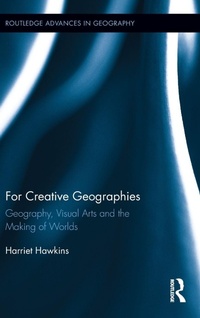
For Creative Geographies
Geography, Visual Arts and the Making of Worlds
1st Edition
Published on 24. September 2013
Book
Hardback
324 pages
978-0-415-63625-4 (ISBN)
Description
This book provides the first sustained critical exploration, and celebration, of the relationship between Geography and the contemporary Visual Arts. With the growth of research in the Geohumanities and the Spatial Humanities, there is an imperative to extend and deepen considerations of the form and import of geography-art relations. Such reflections are increasingly important as geography-art intersections come to encompass not only relationships built through interpretation, but also those built through shared practices, wherein geographers work as and with artists, curators and other creative practitioners.
For Creative Geographies features seven diverse case studies of artists' works and exhibitions made towards the end of the twentieth and the beginning of the twentieth-first century. Organized into three analytic sections, the volume explores the role of art in the making of geographical knowledge; the growth of geographical perspectives as art world analytics; and shared explorations of the territory of the body, In doing so, Hawkins proposes an analytic framework for exploring questions of the geographical "work" art does, the value of geographical analytics in exploring the production and consumption of art, and the different forms of encounter that artworks develop, whether this be with their audiences, or their makers.
For Creative Geographies features seven diverse case studies of artists' works and exhibitions made towards the end of the twentieth and the beginning of the twentieth-first century. Organized into three analytic sections, the volume explores the role of art in the making of geographical knowledge; the growth of geographical perspectives as art world analytics; and shared explorations of the territory of the body, In doing so, Hawkins proposes an analytic framework for exploring questions of the geographical "work" art does, the value of geographical analytics in exploring the production and consumption of art, and the different forms of encounter that artworks develop, whether this be with their audiences, or their makers.
Reviews / Votes
"...the book treats the limits and possibilities of creative geographies with compelling seriousness, and the scholarship is impressive throughout. The imaginative picture of ramifying art-geography entanglements established here will prove an indispensable frame of reference to those forming perspectives on the nascent field. For Creative Geographies looms large in my footnotes already."- Simon Ferdinand, School for Cultural Analysis and Centre for Globalisation Studies, University of Amsterdam, in Antipode
More details
Series
Language
English
Place of publication
London
United Kingdom
Publishing group
Taylor & Francis Ltd
Target group
College/higher education
Illustrations
30 s/w Abbildungen, 30 s/w Photographien bzw. Rasterbilder
30 Halftones, black and white; 30 Illustrations, black and white
Dimensions
Height: 235 mm
Width: 157 mm
Thickness: 22 mm
Weight
622 gr
ISBN-13
978-0-415-63625-4 (9780415636254)
Copyright in bibliographic data and cover images is held by Nielsen Book Services Limited or by the publishers or by their respective licensors: all rights reserved.
Schweitzer Classification
Other editions
Additional editions
Book
09/2015
1st Edition
Routledge
€71.90
Shipment within 10-20 days
E-Book
10/2013
1st Edition
Routledge
€64.49
Available for download
E-Book
10/2013
1st Edition
Routledge
€64.49
Available for download
Person
Harriet Hawkins is a Lecturer in Geography at Royal Holloway, University of London.
Content
Introduction: For Creative Geographies. Section One: Art and the Making/Transforming of Geography 1. Placing Art at the Royal Geographical Society: Creative Compass, Exhibition Imaginaries, and Cartographic Critiques 2. Connecting with Gertrude: Woven Threads and Written Traces: Crafting Disciplinary Histories Section Two: A Geographical Turn? Placing Production: Producing Sites 3. Producing Sites: Michael Landy's Break Down 4. Framing the World: Portraits of Place, Richard Wentworth's Urban Imaginary 5. Insites: On Residency and Collaboration Section Three: Remapping Bodies: Substances, Senses, Spaces and Encounters 6. The Argument of the Eye: Installation Art and the "Experience of Experience" 7. Points of Contact: The Geographies of Ana Mendieta's Earth-Body Works. By Way of Conclusion: Towards an Analytic Framework.