

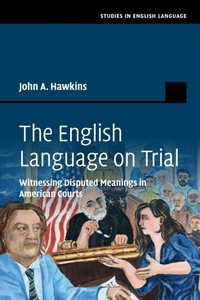
The English Language on Trial
Witnessing Disputed Meanings in American Courts
Will be published approx. on 25. June 2026
Book
Paperback/Softback
285 pages
978-1-009-68282-4 (ISBN)
Description
Many lawsuits arise over disagreements about language and about the meanings of everyday words, phrases, and sentences. This book draws on over fifty cases involving disputed meanings in the American legal system where the author served as an expert witness or consultant, to explore the interaction between language and law. Stepping back from the legal specifics and their outcomes, it analyzes the disputes from the perspective of the language sciences, especially semantics and pragmatics, and language comprehension. It seeks to understand why, and in what areas of English grammar, lexis, and usage, they have arisen among speakers who do not normally miscommunicate and disagree like this. The cases involve contracts, patents, advertising, trademarks, libel, and defamation, and descriptive insights and methods from the language sciences are applied to each case to make explicit the meanings that speakers would normally assign to English.
More details
Other editions
Additional editions
Book
approx. 03/2026
Cambridge University Press
€136.80
Not yet published
Person
John A. Hawkins is Distinguished Professor of Linguistics at the University of California Davis and Emeritus Professor of English and Applied Linguistics at the University of Cambridge. His recent publications include Cross-linguistic Variation and Efficiency (Oxford University Press, 2014) and Criterial Features in L2 English (with Luna Filipovicì, Cambridge University Press, 2012).
Content
1. Introduction: creating meanings in everyday language use; 2. Disputes over individual words; 3. Disputes over word combinations; 4. Disputes over whole clauses; 5. Disputes over inferences; 6. Disputes over reference and unique identification; 7. Disputes over spelling and punctuation; 8. Conclusions.