

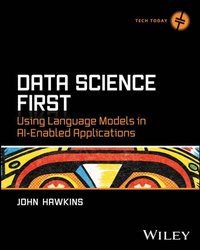
Data Science First
Using Language Models in AI-Enabled Applications
1st Edition
Published on 23. March 2026
Book
Paperback/Softback
368 pages
978-1-394-39047-2 (ISBN)
Description
Proven, practical techniques for integrating language models into your data science workflows
Data Science First: Using Language Models in AI-Enabled Applications, by Intersect AI's Chief AI Officer John Hawkins, explains how practicing data scientists can integrate language models in data science workflows without abandoning essential principles of reliability, accuracy, and efficacy. Hawkins offers crystal-clear guidance on when, where, and how data scientists can integrate language models into their existing workflows without exposing themselves or their companies to unnecessary risks.
This guide walks you through strategic design patterns for incorporating language models into real-world data science projects. It avoids strategies and techniques that rely heavily on proprietary tools that are likely to evolve very quickly (or could disappear entirely) in the near future. Instead, the author presents foundational methodologies that will remain valuable regardless of how individual platforms or services change. The book combines sound theory with practical case studies that cover common data science projects in the education, insurance, telecommunications, media and banking industries. Including customer churn analysis, customer complaint routing and document processing, demonstrating how language models can enhance rather than replace traditional data science methods.
You'll find:
Three chapters providing a solid grounding in the ideas, principles and technologies that are used for data science with language models
Nine chapters that discuss specific patterns for integrating language models into data science workflows, including semantic vector analysis, few-shot prompting, retrieval-based applications, synthetic data generation and AI agent development
Real-world case studies discussing applications like fraud detection, customer churn, translation, document classification and sentiment analysis, with concrete business applications
Comprehensive evaluation methods and testing frameworks are discussed in the context of language model applications in enterprise environments
Practical code examples and implementation guidance using popular tools like HuggingFace, OpenAI, Google Gemini, as well as more development frameworks like LangChain, and PydanticAI
Strategic insights for balancing model accuracy, interpretability, and business requirements while avoiding common pitfalls in AI deployment
An authoritative resource for data scientists and software engineers interested in using modern AI tools to build data-driven applications, Data Science First is a strategy guide for professionals navigating the discipline of data science as it is disrupted by generative AI. Whether you're looking to improve existing workflows or develop entirely new AI-powered solutions, you'll discover how to use language models in ways that consistently add value.
Data Science First: Using Language Models in AI-Enabled Applications, by Intersect AI's Chief AI Officer John Hawkins, explains how practicing data scientists can integrate language models in data science workflows without abandoning essential principles of reliability, accuracy, and efficacy. Hawkins offers crystal-clear guidance on when, where, and how data scientists can integrate language models into their existing workflows without exposing themselves or their companies to unnecessary risks.
This guide walks you through strategic design patterns for incorporating language models into real-world data science projects. It avoids strategies and techniques that rely heavily on proprietary tools that are likely to evolve very quickly (or could disappear entirely) in the near future. Instead, the author presents foundational methodologies that will remain valuable regardless of how individual platforms or services change. The book combines sound theory with practical case studies that cover common data science projects in the education, insurance, telecommunications, media and banking industries. Including customer churn analysis, customer complaint routing and document processing, demonstrating how language models can enhance rather than replace traditional data science methods.
You'll find:
Three chapters providing a solid grounding in the ideas, principles and technologies that are used for data science with language models
Nine chapters that discuss specific patterns for integrating language models into data science workflows, including semantic vector analysis, few-shot prompting, retrieval-based applications, synthetic data generation and AI agent development
Real-world case studies discussing applications like fraud detection, customer churn, translation, document classification and sentiment analysis, with concrete business applications
Comprehensive evaluation methods and testing frameworks are discussed in the context of language model applications in enterprise environments
Practical code examples and implementation guidance using popular tools like HuggingFace, OpenAI, Google Gemini, as well as more development frameworks like LangChain, and PydanticAI
Strategic insights for balancing model accuracy, interpretability, and business requirements while avoiding common pitfalls in AI deployment
An authoritative resource for data scientists and software engineers interested in using modern AI tools to build data-driven applications, Data Science First is a strategy guide for professionals navigating the discipline of data science as it is disrupted by generative AI. Whether you're looking to improve existing workflows or develop entirely new AI-powered solutions, you'll discover how to use language models in ways that consistently add value.
More details
Language
English
Place of publication
New York
United States
Target group
Professional and scholarly
Dimensions
Height: 235 mm
Width: 189 mm
Thickness: 23 mm
Weight
754 gr
ISBN-13
978-1-394-39047-2 (9781394390472)
Copyright in bibliographic data and cover images is held by Nielsen Book Services Limited or by the publishers or by their respective licensors: all rights reserved.
Schweitzer Classification
Other editions
Additional editions
E-Book
03/2026
1st Edition
Wiley-Scrivener
€48.99
Available for download
E-Book
03/2026
1st Edition
Wiley-Scrivener
€48.99
Available for download
Person
JOHN HAWKINS is the Chief AI Officer at Intersect AI, an organization that builds bespoke AI solutions to solve real workplace problems for companies in industries like insurance, media and healthcare. He leads the company's data science initiatives, working with clients directly to analyze their workflow processes and design people centred AI systems.
Content
Acknowledgments vii
About the Author ix
Introduction 1
Chapter 1: Language Models 5
Chapter 2: Tools and Terminology 31
Chapter 3: Data Science Essentials 59
Chapter 4: Semantic Vectors 87
Chapter 5: Insights and Interpretability 113
Chapter 6: Zero-Shot to Few-Shot Prompting 143
Chapter 7: Labeling and Feature Engineering 167
Chapter 8: Synthetic Data Generation 201
Chapter 9: Retrieval Applications 237
Chapter 10: Code as Language 265
Chapter 11: Automated Analytics 291
Chapter 12: Agentic AI 317
Index 347
About the Author ix
Introduction 1
Chapter 1: Language Models 5
Chapter 2: Tools and Terminology 31
Chapter 3: Data Science Essentials 59
Chapter 4: Semantic Vectors 87
Chapter 5: Insights and Interpretability 113
Chapter 6: Zero-Shot to Few-Shot Prompting 143
Chapter 7: Labeling and Feature Engineering 167
Chapter 8: Synthetic Data Generation 201
Chapter 9: Retrieval Applications 237
Chapter 10: Code as Language 265
Chapter 11: Automated Analytics 291
Chapter 12: Agentic AI 317
Index 347