

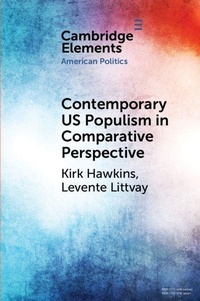
Contemporary US Populism in Comparative Perspective
Published on 30. May 2019
Book
Paperback/Softback
94 pages
978-1-108-45682-1 (ISBN)
Description
With the victory of Donald Trump in the 2016 United States presidential election, populists have come to power in the US for the first time in many years. However, US political scientists have been flat-footed in their response, failing to anticipate or measure populism's impact on the campaign or to offer useful policy responses. In contrast, populism has long been an important topic of study for political scientists studying other regions, especially Latin America and Europe. The conceptual and theoretical insights of comparativist scholars can benefit Americanists, and applying their techniques can help US scholars and policymakers place events in perspective.
More details
Series
Language
English
Place of publication
Cambridge
United Kingdom
Target group
Professional and scholarly
Product notice
Paperback (trade)
Illustrations
Worked examples or Exercises; 21 Line drawings, black and white
Dimensions
Height: 229 mm
Width: 152 mm
Thickness: 5 mm
Weight
150 gr
ISBN-13
978-1-108-45682-1 (9781108456821)
Copyright in bibliographic data and cover images is held by Nielsen Book Services Limited or by the publishers or by their respective licensors: all rights reserved.
Schweitzer Classification
Other editions
Additional editions
Kirk Hawkins
Contemporary US Populism in Comparative Perspective
E-Book
05/2019
Cambridge University Press
€17.49
Available for download
Kirk Hawkins | Levente Littvay
Contemporary US Populism in Comparative Perspective
E-Book
05/2019
Cambridge University Press
€15.49
Available for download
Persons
Kirk Hawkins studies populism and Latin American politics. He wrote Venezuela's Chavismo and Populism in Comparative Perspective (Cambridge, 2010), co-authored Latin American Party Systems (Cambridge, 2010), and co-edited The Ideational Approach to Populism: Concept, Theory, and Analysis (2019). He currently directs Team Populism.
Content
1. Introduction; 2. The concept of populism: putting leaders in context; 3. The causes of populism: explaining the victory with Ethan Busby (Ph.D. candidate, Northwestern University, Evanston, Illinois, US); 4. The consequences of populism and how to mitigate them; 5. Conclusion; References.