

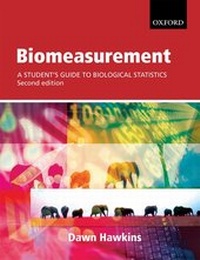
Biomeasurement
A Student's Guide to Biological Statistics
2nd Edition
Published on 19. March 2009
Book
Paperback/Softback
368 pages
978-0-19-921999-5 (ISBN)
Description
Statistical analysis allows us to attach meaning to data which we have collected; it helps us to understand what results really mean, and to assess whether we can trust what experiments seem to be telling us. Yet, despite being a collection of the most valuable and important tools available to bioscientists, statistics is the aspect of study which most students fear more than any other. Biomeasurement offers a refreshing, student-focused introduction to the use of statistics in the study of the biosciences. With an emphasis on why statistical techniques are essential tools for bioscientists, the book removes the stigma attached to statistics by giving students the confidence to use and further explore the key techniques for themselves. The book starts by placing the role of data analysis in the context of wider scientific method, and introduces the student to the key terms and concepts which are common to all statistical tools. It then guides the student through descriptive statistics, and on to inferential statistics, explaining how and why each type of technique is used, and what each can tell us in order to better understand our data.
The book goes on to present the key statistical tests, walking the student step-wise through the use of each, with carefully integrated examples, and plentiful opportunities for hands-on practice. The book closes with an overview of choosing the right test to suit your data, and tools for presenting data and their statistical analyses. Written by a talented educator, whose teaching has won praise from the UK's Quality and Assurance Agency for Higher Education, Biomeasurement is sure to engage even the most wary of students, demonstrating the power and importance of statistics throughout the study of bioscience. Online Resource Centre The Online Resource Centre to accompany Biomeasurement features For lecturers: BL Figures from the book in electronic format, ready to download. For students: BL Data set, for use in a variety of statistical packages, so that students can practise carrying out statistical analysis. BL Literature link articles: full-text versions of the Literature Link articles cited in the text. BL Interactive calculation sheets to help students carry out key statistical tests quickly and easily, without needing other software.
The book goes on to present the key statistical tests, walking the student step-wise through the use of each, with carefully integrated examples, and plentiful opportunities for hands-on practice. The book closes with an overview of choosing the right test to suit your data, and tools for presenting data and their statistical analyses. Written by a talented educator, whose teaching has won praise from the UK's Quality and Assurance Agency for Higher Education, Biomeasurement is sure to engage even the most wary of students, demonstrating the power and importance of statistics throughout the study of bioscience. Online Resource Centre The Online Resource Centre to accompany Biomeasurement features For lecturers: BL Figures from the book in electronic format, ready to download. For students: BL Data set, for use in a variety of statistical packages, so that students can practise carrying out statistical analysis. BL Literature link articles: full-text versions of the Literature Link articles cited in the text. BL Interactive calculation sheets to help students carry out key statistical tests quickly and easily, without needing other software.
Reviews / Votes
This is a very user-friendly introduction to statistical methods for first-year undergraduate biology students. F. James Rohlf, in Quarterly Review of Biology, September 2010 Even from reading the first chapter only it is clear that the writer has put some thought into making the book entertaining to read. Oddly, it has worked! Her style of writing is casual, readable and humorous. This simple and 'easy to read' style makes the book inviting to use. The writer has achieved something I thought was impossible and made statistics interesting/appealing to study! Bethan Clifford, Student, University of Nottingham The presentation allows readers easily to access material which is relevant to their needs. Chapter 13, on presentation of data, provides an ideal conclusion to book. The Society of General Microbiology Biomeasurement is a well researched and planned book. The audience of the book is clearly identified and targeted by the material. The Society for General MicrobiologyMore details
Edition
2nd Revised edition
Language
English
Place of publication
Oxford
United Kingdom
Target group
College/higher education
Professional and scholarly
Edition type
Revised edition
Illustrations
100 black and white illustrations
Dimensions
Height: 246 mm
Width: 189 mm
Thickness: 21.1 mm
Weight
697 gr
ISBN-13
978-0-19-921999-5 (9780199219995)
Copyright in bibliographic data and cover images is held by Nielsen Book Services Limited or by the publishers or by their respective licensors: all rights reserved.
Schweitzer Classification
Other editions
New editions
Book
04/2005
Oxford University Press
€28.46
Article exhausted; check for reprint
Previous edition
Book
04/2005
Oxford University Press
€28.46
Article exhausted; check for reprint
Content
CHAPTER 1: WHY AM I READING THIS BOOK? ; 1.1 My lecturer is a sadist! ; 1.2 Doing science: the big picture ; 1.3 The process in practice ; 1.4 Essential skills for doing science ; 1.5 Types of data analysis ; CHAPTER 2: GETTING TO GRIPS WITH THE BASICS ; 2.1 Populations and samples ; 2.2 Variation and variables ; 2.3 Understanding data ; 2.4 Demystifying formulae ; CHAPTER 3: DESCRIBING A SINGLE SAMPLE ; 3.1 The single sample ; 3.2 Descriptive statistics ; 3.3 Frequency distributions ; 3.4 Pies, boxes, and errors ; 3.5 Example data: ranger patrol tusk records ; 3.6 Worked example: using SPSS ; CHAPTER 4: INFERRING AND ESTIMATING ; 4.1 Overview of inferential statistics ; 4.2 Inferring through estimation ; 4.3 Exampledata: ground squirrels ; 4.4 Worked example: using SPSS ; CHAPTER 5: OVERVIEW OF HYPOTHESIS TESTING ; 5.1 Four steps of (statistical) hypothesis testing ; 5.2 Error and power ; 5.3 Parametric and nonparametric ; 5.4 One-and two-tailed tests ; CHAPTER 6: TESTS ON FREQUENCIES ; 6.1 Introduction to chi-square tests ; 6.2 Example data ; 6.3 One-way classification chi-square test ; 6.4 Two-way classification chi-square test ; CHAPTER 7: TESTS OF DIFFERENCE: TWO UNRELATED SAMPLES ; 7.1 Introduction to the t-and Mann-Whitney U tests ; 7.2 Example data: dem bones ; 7.3 t-Test ; 7.4 Mann-Whitney U test ; CHAPTER 8: TESTS OF DIFFERENCE: TWO RELATED SAMPLES ; 8.1 Introduction to paired t- and Wilcoxon signed- rank tests ; 8.2 Example data: big horn ewes ; 8.3 Paired t-test ; 8.4 Wilcoxon signed-rank test ; CHAPTER 9: TESTS OF DIFFERENCE: MORE THAN TWO SAMPLES ; 9.1 Introduction to one-way and Kruskal-Wallis Anov atests ; 9.2 Example data: nitrogen levels in reeds ; 9.3 One-way Anova test ; 9.4 Two-way Anova test ; 9.5 Kruskal-Wallis test ; 9.6 Model I and model II Anova ; CHAPTER 10: TESTS OF RELATIONSHIP: REGRESSION ; 10.1 Introduction ; 10.2 Example data: species richness ; 10.3 Regression test ; 10.4 Logistic regression ; 10.5 Multiple regression ; 10.6 Model I and model II regression ; CHAPTER 11: TESTS OF RELATIONSHIP: CORRELATION ; 11.1 Introduction to the Pearson and Spearman correlation tests ; 11.2 Example data: eyeballs ; 11.3 Pearson correlation test ; 11.4 Spearman correlation test ; 11.5 Comparison of correlation and regression ; CHAPTER 12: INTRODUCING TH GENERAL LINEAR MODEL ; 12.1 Introduction to General Linear Model ; 12.2 Example data: watered willow ; 12.3 Testing using the General Linear Model ; 12.4 Interaction ; 12.5 Random factors and mixed models ; 12.6 Types of sums of squares ; 12.7 Getting the most out of GLM: Multiple models and model choice ; 12.8 The general and generalized linear models compared ; CHAPTER 13: CHOOSING THE RIGHT TEST AND GRAPH ; 13.1 Introduction to choosing ; 13.2 Which test? ; 13.3 Which graph? ; 13.4 Worked examples: graphs using SPSS ; 13.5 How to report your results