

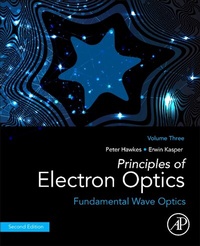
Principles of Electron Optics, Volume 3
Fundamental Wave Optics
2nd Edition
Published on 18. February 2022
Book
Paperback/Softback
558 pages
978-0-12-818979-5 (ISBN)
Description
Principles of Electron Optic: Volume Three: Wave Optics, discusses this essential topic in microscopy to help readers understand the propagation of electrons from the source to the specimen, and through the latter (and from it) to the image plane of the instrument. In addition, it also explains interference phenomena, notably holography, and informal coherence theory. This third volume accompanies volumes one and two that cover new content on holography and interference, improved and new modes of image formation, aberration corrected imaging, simulation, and measurement, 3D-reconstruction, and more.
The study of such beams forms the subject of electron optics, which divides naturally into geometrical optics where effects due to wavelength are neglected, with wave optics considered.
The study of such beams forms the subject of electron optics, which divides naturally into geometrical optics where effects due to wavelength are neglected, with wave optics considered.
More details
Edition
2nd edition
Language
English
Place of publication
San Diego
United States
Publishing group
Elsevier Science Publishing Co Inc
Target group
Professional and scholarly
materials scientists and engineers, electronic engineers, applied physicists, electron microscopists
Illustrations
Approx. 150 illustrations; Illustrations
Dimensions
Height: 235 mm
Width: 191 mm
Weight
1380 gr
ISBN-13
978-0-12-818979-5 (9780128189795)
Copyright in bibliographic data and cover images is held by Nielsen Book Services Limited or by the publishers or by their respective licensors: all rights reserved.
Schweitzer Classification
Other editions
Additional editions
E-Book
02/2022
2nd Edition
Academic Press
€220.00
Available for download
Persons
Peter Hawkes obtained his M.A. and Ph.D (and later, Sc.D.) from the University of Cambridge, where he subsequently held Fellowships of Peterhouse and of Churchill College. From 1959 - 1975, he worked in the electron microscope section of the Cavendish Laboratory in Cambridge, after which he joined the CNRS Laboratory of Electron Optics in Toulouse, of which he was Director in 1987. He was Founder-President of the European Microscopy Society and is a Fellow of the Microscopy and Optical Societies of America. He is a member of the editorial boards of several microscopy journals and serial editor of Advances in Electron Optics. Erwin Kasper studied physics at the Universities of Muenster and Tuebingen (Germany), where he obtained his PhD in 1965 and the habilitation to teach physics in 1969. After scientific spells in the University of Tucson, Arizona (1966) and in Munich (1970), he resumed his research and teaching in the Institute of Applied Physics, University of Tuebingen, where he was later appointed professor. He lectured on general physics and especially on electron optics. The subject of his research was theoretical electron optics and related numerical methods on which he published numerous papers. After his retirement in 1997, he published a book on numerical field calculation (2001).
Author
Founder-President of the European Microscopy Society and Fellow, Microscopy and Optical Societies of America; member of the editorial boards of several microscopy journals and Serial Editor, Advances in Electron Optics, France
Institute of Applied Physics, University of Tuebingen, Tuebingen, Germany
Content
54. Introduction
Part XI - Wave Mechanics
55. The Schroedinger Equation
56. The Relativistic Wave Equation
57. The Eikonal Approximation
58. Paraxial Wave Optics
59. The General Theory of Electron Diffraction and Interference
60. Elementary Diffraction Patterns
Part XII, Electron Interference and Electron Holography
61. General Introduction
62. Interferometry
63. Holography
Part XIII, Theory of Image Formation
64. General Introduction
65. Fundamentals of Transfer Theory
66. The Theory of Bright-field Imaging.
67. Image Formation in the Scanning Transmission Electron Microscope
68. Statistical Parameter Estimation Theory
Part XIV - Electron-specimen Interactions
69. Electron Interactions in Thin Specimens
Part XV - Digital Image Processing
70. Introduction
71. Acquisition, Sampling and Coding
72. Enhancement
73. Linear Restoration
74. Nonlinear Restoration - the Phase Problem
75. Three-dimensional Reconstruction
76. Image Analysis
77. Microscope Parameter Measurement and Instrument Control
Part XVI - Coherence, Brightness and Spectral Functions
78. Coherence and the Brightness Functions
79. Wigner Optics
PART XVII - Vortex Studies, the Quantum Electron Microscope
80. Orbital Angular Momentum, Vortex Beams and the Quantum Electron Microscope
Part XI - Wave Mechanics
55. The Schroedinger Equation
56. The Relativistic Wave Equation
57. The Eikonal Approximation
58. Paraxial Wave Optics
59. The General Theory of Electron Diffraction and Interference
60. Elementary Diffraction Patterns
Part XII, Electron Interference and Electron Holography
61. General Introduction
62. Interferometry
63. Holography
Part XIII, Theory of Image Formation
64. General Introduction
65. Fundamentals of Transfer Theory
66. The Theory of Bright-field Imaging.
67. Image Formation in the Scanning Transmission Electron Microscope
68. Statistical Parameter Estimation Theory
Part XIV - Electron-specimen Interactions
69. Electron Interactions in Thin Specimens
Part XV - Digital Image Processing
70. Introduction
71. Acquisition, Sampling and Coding
72. Enhancement
73. Linear Restoration
74. Nonlinear Restoration - the Phase Problem
75. Three-dimensional Reconstruction
76. Image Analysis
77. Microscope Parameter Measurement and Instrument Control
Part XVI - Coherence, Brightness and Spectral Functions
78. Coherence and the Brightness Functions
79. Wigner Optics
PART XVII - Vortex Studies, the Quantum Electron Microscope
80. Orbital Angular Momentum, Vortex Beams and the Quantum Electron Microscope