

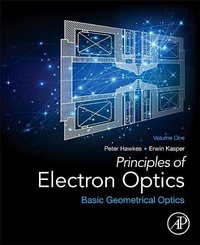
Principles of Electron Optics, Volume 1
Basic Geometrical Optics
2nd Edition
Published on 29. October 2017
Book
Paperback/Softback
728 pages
978-0-08-102256-6 (ISBN)
Description
Volume one of Principles of Electron Optics: Basic Geometrical Optics, Second Edition, explores the geometrical optics needed to analyze an extremely wide range of instruments: cathode-ray tubes; the family of electron microscopes, including the fixed-beam and scanning transmission instruments, the scanning electron microscope and the emission microscope; electron spectrometers and mass spectrograph; image converters; electron interferometers and diffraction devices; electron welding machines; and electron-beam lithography devices.
The book provides a self-contained, detailed, modern account of electron optics for anyone involved with particle beams of modest current density in the energy range up to a few mega-electronvolts. You will find all the basic equations with their derivations, recent ideas concerning aberration studies, extensive discussion of the numerical methods needed to calculate the properties of specific systems and guidance to the literature of all the topics covered. A continuation of these topics can be found in volume two, Principles of Electron Optics: Applied Geometrical Optics.
The book is intended for postgraduate students and teachers in physics and electron optics, as well as researchers and scientists in academia and industry working in the field of electron optics, electron and ion microscopy and nanolithography.
The book provides a self-contained, detailed, modern account of electron optics for anyone involved with particle beams of modest current density in the energy range up to a few mega-electronvolts. You will find all the basic equations with their derivations, recent ideas concerning aberration studies, extensive discussion of the numerical methods needed to calculate the properties of specific systems and guidance to the literature of all the topics covered. A continuation of these topics can be found in volume two, Principles of Electron Optics: Applied Geometrical Optics.
The book is intended for postgraduate students and teachers in physics and electron optics, as well as researchers and scientists in academia and industry working in the field of electron optics, electron and ion microscopy and nanolithography.
More details
Edition
2nd edition
Language
English
Place of publication
London
United Kingdom
Publishing group
Elsevier Science & Technology
Target group
Professional and scholarly
Postgraduate students and teachers in physics and electron optics; researchers and scientists in academia and industry working in the field of electron optics, electron and ion microscopy, and nanolithography
Product notice
Paperback (trade)
Unsewn / adhesive bound
Dimensions
Height: 238 mm
Width: 192 mm
Thickness: 42 mm
Weight
1464 gr
ISBN-13
978-0-08-102256-6 (9780081022566)
Copyright in bibliographic data and cover images is held by Nielsen Book Services Limited or by the publishers or by their respective licensors: all rights reserved.
Schweitzer Classification
Other editions
Additional editions
E-Book
10/2017
2nd Edition
Academic Press
€215.00
Available for download
Previous edition

P. W. Hawkes | Erich Kasper
Hawkes - Kasper Basic Geometric Optics V1
Book
01/1996
Academic Press
€56.99
Article exhausted; check for reprint
Persons
Peter Hawkes obtained his M.A. and Ph.D (and later, Sc.D.) from the University of Cambridge, where he subsequently held Fellowships of Peterhouse and of Churchill College. From 1959 - 1975, he worked in the electron microscope section of the Cavendish Laboratory in Cambridge, after which he joined the CNRS Laboratory of Electron Optics in Toulouse, of which he was Director in 1987. He was Founder-President of the European Microscopy Society and is a Fellow of the Microscopy and Optical Societies of America. He is a member of the editorial boards of several microscopy journals and serial editor of Advances in Electron Optics. Erwin Kasper studied physics at the Universities of Muenster and Tuebingen (Germany), where he obtained his PhD in 1965 and the habilitation to teach physics in 1969. After scientific spells in the University of Tucson, Arizona (1966) and in Munich (1970), he resumed his research and teaching in the Institute of Applied Physics, University of Tuebingen, where he was later appointed professor. He lectured on general physics and especially on electron optics. The subject of his research was theoretical electron optics and related numerical methods on which he published numerous papers. After his retirement in 1997, he published a book on numerical field calculation (2001).
Author
Founder-President of the European Microscopy Society and Fellow, Microscopy and Optical Societies of America; member of the editorial boards of several microscopy journals and Serial Editor, Advances in Electron Optics, France
Institute of Applied Physics, University of Tuebingen, Tuebingen, Germany
Content
1. Introduction
PART I - CLASSICAL MECHANICS
2. Relativistic Kinematics
3. Different Forms of Trajectory Equations
4. Variational Principles
5. Hamiltonian Optics
PART II - CALCULATION OF STATIC FIELDS
6. Basic Concepts and Equations
7. Series Expansions
8. Boundary-Value Problems
9. Integral Equations
10. The Boundary-Element Method
11. The Finite-Difference Method (FDM)
12. The Finite-Element Method (FEM)
13. Field-Interpolation Techniques
PART III - THE PARAXIAL APPROXIMATION
14. Introduction
15. Systems with an Axis of Rotational Symmetry
16. Gaussian Optics of Rotationally Symmetric Systems: Asymptotic Image Formation
17. Gaussian Optics of Rotationally Symmetric Systems: Real Cardinal Elements
18. Electron Mirrors
19. Quadrupole Lenses
20. Cylindrical Lenses
PART IV - ABERRATIONS
21. Introduction
22. Perturbation Theory: General Formalism
23. The Relation Between Permitted Types of Aberration and System Symmetry
24. The Geometrical Aberrations of Round Lenses
25. Asymptotic Aberration Coefficients
26. Chromatic Aberrations
27. Aberration Matrices and the Aberrations of Lens Combinations
28. The Aberrations of Mirrors and Cathode Lenses
29. The Aberrations of Quadrupole Lenses and Octopoles
30. The Aberrations of Cylindrical Lenses
31. Parasitic Aberrations
PART V - DEFLECTION SYSTEMS
32. Paraxial Properties of Deflection Systems
33. The Aberrations of Deflection Systems
PART VI - COMPUTER-AIDED ELECTRON OPTICS
34. Numerical Calculation of Trajectories, Paraxial Properties and Aberrations
PART I - CLASSICAL MECHANICS
2. Relativistic Kinematics
3. Different Forms of Trajectory Equations
4. Variational Principles
5. Hamiltonian Optics
PART II - CALCULATION OF STATIC FIELDS
6. Basic Concepts and Equations
7. Series Expansions
8. Boundary-Value Problems
9. Integral Equations
10. The Boundary-Element Method
11. The Finite-Difference Method (FDM)
12. The Finite-Element Method (FEM)
13. Field-Interpolation Techniques
PART III - THE PARAXIAL APPROXIMATION
14. Introduction
15. Systems with an Axis of Rotational Symmetry
16. Gaussian Optics of Rotationally Symmetric Systems: Asymptotic Image Formation
17. Gaussian Optics of Rotationally Symmetric Systems: Real Cardinal Elements
18. Electron Mirrors
19. Quadrupole Lenses
20. Cylindrical Lenses
PART IV - ABERRATIONS
21. Introduction
22. Perturbation Theory: General Formalism
23. The Relation Between Permitted Types of Aberration and System Symmetry
24. The Geometrical Aberrations of Round Lenses
25. Asymptotic Aberration Coefficients
26. Chromatic Aberrations
27. Aberration Matrices and the Aberrations of Lens Combinations
28. The Aberrations of Mirrors and Cathode Lenses
29. The Aberrations of Quadrupole Lenses and Octopoles
30. The Aberrations of Cylindrical Lenses
31. Parasitic Aberrations
PART V - DEFLECTION SYSTEMS
32. Paraxial Properties of Deflection Systems
33. The Aberrations of Deflection Systems
PART VI - COMPUTER-AIDED ELECTRON OPTICS
34. Numerical Calculation of Trajectories, Paraxial Properties and Aberrations