

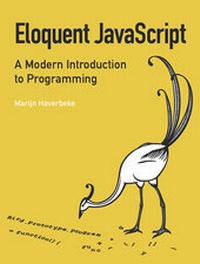
Eloquent JavaScript
1st Edition
Published on 15. January 2011
Book
Paperback/Softback
XIV, 207 pages
978-1-59327-282-1 (ISBN)
Description
JavaScript is at the heart of almost every modern Web application, whether it's Google Apps, Twitter or the newest browser-based game. Though it's simple for beginners to pick up and play with, JavaScript is not a toy - it's a flexible and complex language that can be used to build full-scale applications.
Eloquent JavaScript dives into this flourishing language and teaches you to write code that's beautiful and effective. By imersing you in example code and encouraging experimentation right from the start, the author quickly gives you the tools you need to build your own programs. As you follow along with examples like an artificial life simulation and a version of the classic game Sokoban, you'll learn to:
- Understand the essential elements of programming: syntax, control, and data
- Use object-oriented and functional programming techniques to organize and clarify your programs
- Script the browser and make basic Web applications
- Work with tools like regular expressions and XMLHttpRequest objects
And since programming is an art that's best learned by doing, all example code is available online in an interactive sandbox for you to experiment with. With Eloquent JavaScript as your guide, you can tweak, expand, and modify the author's code, or throw it away and build your own creations from scratch. Before you know it, you'll be fluent in the language of the Web.
Eloquent JavaScript dives into this flourishing language and teaches you to write code that's beautiful and effective. By imersing you in example code and encouraging experimentation right from the start, the author quickly gives you the tools you need to build your own programs. As you follow along with examples like an artificial life simulation and a version of the classic game Sokoban, you'll learn to:
- Understand the essential elements of programming: syntax, control, and data
- Use object-oriented and functional programming techniques to organize and clarify your programs
- Script the browser and make basic Web applications
- Work with tools like regular expressions and XMLHttpRequest objects
And since programming is an art that's best learned by doing, all example code is available online in an interactive sandbox for you to experiment with. With Eloquent JavaScript as your guide, you can tweak, expand, and modify the author's code, or throw it away and build your own creations from scratch. Before you know it, you'll be fluent in the language of the Web.
More details
Language
English
Place of publication
San Francisco
Germany
Target group
Professional and scholarly
Beginning programmers or programmers new to JavaScript
- University students and instructors
- Anyone creating web applications
Product notice
Unsewn / adhesive bound
Dimensions
Height: 22.3 cm
Width: 17.7 cm
ISBN-13
978-1-59327-282-1 (9781593272821)
Schweitzer Classification
Other editions
New editions
Book
12/2018
3rd Edition
No Starch Press
€37.50
Available immediately
Book
07/2014
2nd Edition
No Starch Press
€32.00
Article exhausted; check for reprint
Person
Marijn Haverbeke is an independent developer and author, focused primarily on programming languages and tools for programmers. He spends most of his time working on open source software, such as the CodeMirror editor and the Tern type inference engine.
Content
Dedication; Introduction; On Programming; Why Language Matters; What Is JavaScript?; Trying Programs; Overview of This Book; Typographic Conventions; Chapter 1: Basic JavaScript: Values, Variables, and Control Flow; 1.1 Values; 1.2 Variables; 1.3 The Environment; 1.4 Program Structure; 1.5 More on Types; Chapter 2: Functions; 2.1 The Anatomy of a Function Definition; 2.2 Techniques; Chapter 3: Data Structures: Objects and Arrays; 3.1 The Problem: Aunt Emily's Cats; 3.2 Basic Data Structures; 3.3 Solving the Problem of Aunt Emily's Cats; 3.4 Some More Theory; Chapter 4: Error Handling; 4.1 Types of Problems; 4.2 Handling Errors; 4.3 Automated Testing; Chapter 5: Functional Programming; 5.1 Abstraction; 5.2 Higher-Order Functions; 5.3 The Sad Story of the Recluse; 5.4 Other Functional Tricks; Chapter 6: Object-Oriented Programming; 6.1 Objects; 6.2 Building an Ecosystem Simulation; 6.3 A More Lifelike Simulation; 6.4 Prototypal Inheritance; Chapter 7: Modularity; 7.1 Modules; 7.2 The Shape of a Module; 7.3 Interface Design; 7.4 Libraries; Chapter 8: Regular Expressions; 8.1 Syntax; 8.2 Matching and Replacing; 8.3 Parsing an .ini File; 8.4 Conclusion; Chapter 9: Web Programming: A Crash Course; 9.1 The Internet; 9.2 Basic Web Scripting; 9.3 Browser Incompatibility; 9.4 Further Reading; Chapter 10: The Document Object Model; 10.1 DOM Elements; 10.2 Style Sheets; 10.3 Word of Caution; Chapter 11: Browser Events; 11.1 Event Handlers; 11.2 Example: Implementing Sokoban; Chapter 12: HTTP requests; 12.1 The HTTP Protocol; 12.2 The XMLHttpRequest API; 12.3 Learning HTTP; Colophon; Updates;