

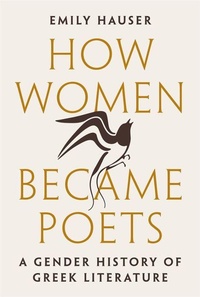
How Women Became Poets
A Gender History of Greek Literature
Published on 22. August 2023
Book
Hardback
376 pages
978-0-691-20107-8 (ISBN)
Description
How the idea of the author was born in the battleground of gender
When Sappho sang her songs, the only word that existed to describe a poet was a male one-aoidos, or "singer-man." The most famous woman poet of ancient Greece, whose craft was one of words, had no words with which to talk about who she was and what she did. In How Women Became Poets, Emily Hauser rewrites the story of Greek literature as one of gender, arguing that the ways the Greeks talked about their identity as poets constructed, played with, and broke down gender expectations that literature was for men alone. Bringing together recent studies in ancient authorship, gender, and performativity, Hauser offers a new history of classical literature that redefines the canon as a constant struggle to be heard through, and sometimes despite, gender.
Women, as Virginia Woolf recognized, need rooms of their own in order to write. So, too, have women writers through history needed a name to describe what it is they do. Hauser traces the invention of that name in ancient Greece, exploring the archaeology of the gendering of the poet. She follows ancient Greek poets, philosophers, and historians as they developed and debated the vocabulary for authorship on the battleground of gender-building up and reinforcing the word for male poet, then in response creating a language with which to describe women who write. Crucially, Hauser reinserts women into the traditionally all-male canon of Greek literature, arguing for the centrality of their role in shaping ideas around authorship and literary production.
When Sappho sang her songs, the only word that existed to describe a poet was a male one-aoidos, or "singer-man." The most famous woman poet of ancient Greece, whose craft was one of words, had no words with which to talk about who she was and what she did. In How Women Became Poets, Emily Hauser rewrites the story of Greek literature as one of gender, arguing that the ways the Greeks talked about their identity as poets constructed, played with, and broke down gender expectations that literature was for men alone. Bringing together recent studies in ancient authorship, gender, and performativity, Hauser offers a new history of classical literature that redefines the canon as a constant struggle to be heard through, and sometimes despite, gender.
Women, as Virginia Woolf recognized, need rooms of their own in order to write. So, too, have women writers through history needed a name to describe what it is they do. Hauser traces the invention of that name in ancient Greece, exploring the archaeology of the gendering of the poet. She follows ancient Greek poets, philosophers, and historians as they developed and debated the vocabulary for authorship on the battleground of gender-building up and reinforcing the word for male poet, then in response creating a language with which to describe women who write. Crucially, Hauser reinserts women into the traditionally all-male canon of Greek literature, arguing for the centrality of their role in shaping ideas around authorship and literary production.
Reviews / Votes
"A Seminary Co-Op Notable Book of the Year" "A Choice Outstanding Academic Title of the Year" "Provocative. . . . A brilliant book."---Shadi Barsch, Times Literary Supplement "[A]n exciting and elegant survey of the entire ancient Greek literary tradition as a male construction, [and] a book that forces the reader to rethink many common assumptions about "women's" poetry from antiquity to today." * Choice * "Exceptionally detailed."---Lilah Grace Canevaro, Greece & Rome "Should be required reading for scholars and students of Greek literature. . . . By revealing the strategies ancient Greek women poets used to respond to a hostile and exclusionary tradition, How Women Became Poets contributes an exciting new chapter to the history of Greek literature."---Erika Weiberg, Bryn Mawr Classical Review "H[auser's] book is rich in observations and alerts us to pay closer attention to the play of linguistic gender."---Eva Marie Stehle, Classical ReviewMore details
Language
English
Place of publication
New Jersey
United States
Target group
College/higher education
Professional and scholarly
Product notice
Trade binding
Illustrations
4 b/w illus.
Dimensions
Height: 238 mm
Width: 163 mm
Thickness: 34 mm
Weight
762 gr
ISBN-13
978-0-691-20107-8 (9780691201078)
Copyright in bibliographic data and cover images is held by Nielsen Book Services Limited or by the publishers or by their respective licensors: all rights reserved.
Schweitzer Classification
Other editions
Additional editions
E-Book
08/2023
1st Edition
Princeton University Press
€24.49
Available for download
Person
Emily Hauser is a senior lecturer in classics and ancient history at the University of Exeter. She is the author of the bestselling Mythica: A New History of Homer's World, Through the Women Written Out of It and a critically acclaimed trilogy of novels that reimagines the women of Greek myth: For the Most Beautiful, For the Winner, and For the Immortal.