

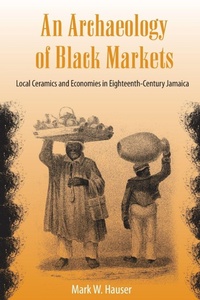
An Archaeology of Black Markets
Local Ceramics and Economies in Eighteenth-Century Jamaica
Published on 31. July 2013
Book
Paperback/Softback
296 pages
978-0-8130-4902-1 (ISBN)
Description
In eighteenth-century Jamaica, an informal, underground economy existed among enslaved labourers. Mark Hauser uses pottery fragments to examine their trade networks and to understand how enslaved and free Jamaicans created communities that transcended plantation boundaries.
An Archaeology of Black Markets utilises both documentary and archaeological evidence to reveal how slaves practiced their own systematic forms of economic production, exchange, and consumption. Hauser compares the findings from a number of previously excavated sites and presents new analyses that reinterpret these collections in the context of island-wide trading networks.
Trading allowed enslaved labourers to cross boundaries of slave life and enter into a black market of economic practices with pots in hand. By utilising secret trails that connected plantations, sectarian churches, and street markets, the enslaved remained in contact, exchanged information, news, and gossip, and ultimately stoked the colony's 1831 rebellion. Hauser considers how uprooted peoples from Africa created new networks in Jamaica, and interjects into archaeological discussions the importance of informal economic practice among non-elite members of society.
An Archaeology of Black Markets utilises both documentary and archaeological evidence to reveal how slaves practiced their own systematic forms of economic production, exchange, and consumption. Hauser compares the findings from a number of previously excavated sites and presents new analyses that reinterpret these collections in the context of island-wide trading networks.
Trading allowed enslaved labourers to cross boundaries of slave life and enter into a black market of economic practices with pots in hand. By utilising secret trails that connected plantations, sectarian churches, and street markets, the enslaved remained in contact, exchanged information, news, and gossip, and ultimately stoked the colony's 1831 rebellion. Hauser considers how uprooted peoples from Africa created new networks in Jamaica, and interjects into archaeological discussions the importance of informal economic practice among non-elite members of society.
More details
Series
Language
English
Place of publication
Florida
United States
Illustrations
64 black & white illustrations
Dimensions
Height: 229 mm
Width: 152 mm
Thickness: 18 mm
Weight
487 gr
ISBN-13
978-0-8130-4902-1 (9780813049021)
Copyright in bibliographic data and cover images is held by Nielsen Book Services Limited or by the publishers or by their respective licensors: all rights reserved.
Schweitzer Classification
Person
Mark W. Hauser is assistant professor of anthropology at Northwestern University, USA.