

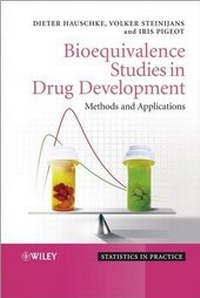
Bioequivalence Studies in Drug Development
Methods and Applications
Published on 19. January 2007
Book
Hardback
328 pages
978-0-470-09475-4 (ISBN)
Description
Studies in bioequivalence are the commonly accepted method to demonstrate therapeutic equivalence between two medicinal products. Savings in time and cost are substantial when using bioequivalence as an established surrogate marker of therapeutic equivalence. For this reason the design, performance and evaluation of bioequivalence studies have received major attention from academia, the pharmaceutical industry and health authorities.
Bioequivalence Studies in Drug Development focuses on the planning, conducting, analysing and reporting of bioequivalence studies, covering all aspects required by regulatory authorities. This text presents the required statistical methods, and with an outstanding practical emphasis, demonstrates their applications through numerous examples using real data from drug development.
* Includes all the necessary pharmacokinetic background information.
* Presents parametric and nonparametric statistical techniques.
* Describes adequate methods for power and sample size determination.
* Includes appropriate presentation of results from bioequivalence studies.
* Provides a practical overview of the design and analysis of bioequivalence studies.
* Presents the recent developments in methodology, including population and individual bioequivalence.
* Reviews the regulatory guidelines for such studies, and the existing global discrepancies.
* Discusses the designs and analyses of drug-drug and food-drug interaction studies.
Bioequivalence Studies in Drug Development is written in an accessible style that makes it ideal for pharmaceutical scientists, clinical pharmacologists, and medical practitioners, as well as biometricians working in the pharmaceutical industry. It will also be of great value for professionals from regulatory bodies assessing bioequivalence studies.
Reviews / Votes
"The book provides an excellent introduction for researchers approaching the concept of bioequivalence and is a complete and useful compendium for experienced statisticians." (Biometrical Journal, April 2009) "The book provides an important reference providing many worked examples with real data from drug development. Professionals from the harmaceutical industry and regulatory bodies will particularly appreciate the emphasis made on regulatory guidelines." (Statistical Methods in Medical Research, February 2009)"Bioequivalence Studies in Drug Development: Methods and Applications is an informative, timely, and easy-to-read contribution to bioequivalence and drug-drug/food-drug interaction literature." (Journal of the American Statistical Association, September 2008)
"...those statisticians working in this area of research will find that this book will serve as an excellent reference for their work..." (Journal of Biopharmaceutical Statistics, January 2008)
"This book would be beneficial to both pharmaceutical scientists/researchers and biostatisticians..." (Biometrics, September 2007)
"For anyone interested in any aspect of bioequivalence, the book is a very valuable reference." (International Statistical Review, 2007)
"...my pleasure to review...I would like to add this book to my book collection of pharmaceutical research and development." (Biometrics, September 2007)
More details
Series
Edition
1. Auflage
Language
English
Place of publication
New York
United States
Target group
Professional and scholarly
College/higher education
Product notice
sewn/stitched
Cloth over boards
Dimensions
Height: 251 mm
Width: 174 mm
Thickness: 24 mm
Weight
757 gr
ISBN-13
978-0-470-09475-4 (9780470094754)
Schweitzer Classification
Other editions
Additional editions
Dieter Hauschke | Volker Steinijans | Iris Pigeot
Bioequivalence Studies in Drug Development
Methods and Applications
E-Book
03/2007
Wiley
€94.99
Available for download
Persons
Dieter Hauschke, ALTANA Pharma, Konstanz, Germany. Well-respected statistician working in the pharmaceutical industry, specializing in bioequivalence studies, with over 60 publications in leading journals.
Volker Steinijans, ALTANA Pharma, Konstanz, Germany. Head of the Department of Biometry and Clinical Data Management at ALTANA.
Iris Pigeot, Institute for Statistics, University of Bremen, Germany. Has over 50 published papers, and also written a number of books in German.
Content
Preface.
1 Introduction.
1.1 Definitions.
1.2 When are bioequivalence studies performed.
1.3 Design and conduct of bioequivalence studies.
1.4 Aims and structure of the book.
References.
2 Metrics to characterize concentration-time profiles in single- and multiple-dose bioequivalence studies.
2.1 Introduction.
2.2 Pharmacokinetic characteristics (metrics) for single-dose studies.
2.3 Pharmacokinetic rate and extent characteristics (metrics) for multiple-dose studies.
2.4 Conclusions.
References.
3 Basic statistical considerations.
3.1 Introduction.
3.2 Additive and multiplicative model.
3.3 Hypotheses testing.
3.4 The RT/TR crossover design assuming an additive model.
References.
4 Assessment of average bioequivalence in the RT/TR design.
4.1 Introduction.
4.2 The RT/TR crossover design assuming a multiplicative model.
4.3 Test procedures for bioequivalence assessment.
4.4 Conclusions.
References.
5 Power and sample size determination for testing average bioequivalence in the RT/TR design.
5.1 Introduction.
5.2 Challenging the classical approach.
5.3 Exact power and sample size calculation.
5.4 Modified acceptance ranges.
5.5 Approximate formulas for sample size calculation.
5.6 Exact power and sample size calculation by nQuery(r).
References.
Appendix.
6 Presentation of bioequivalence studies.
6.1 Introduction.
6.2 Results from a single-dose study.
6.3 Results from a multiple-dose study.
6.4 Conclusions.
References.
7 Designs with more than two formulations.
7.1 Introduction.
7.2 Williams designs.
7.3 Example: Dose linearity study.
7.4 Multiplicity.
7.5 Conclusions.
References.
8 Analysis of pharmacokinetic interactions.
8.1 Introduction.
8.2 Pharmacokinetic drug-drug interaction studies.
8.3 Pharmacokinetic food-drug interactions.
8.4 Goal posts for drug interaction studies including no effect boundaries.
8.5 Labeling.
8.6 Conclusions.
References.
9 Population and individual bioequivalence.
9.1 Introduction.
9.2 Brief history.
9.3 Study designs and statistical models.
9.4 Population bioequivalence.
9.5 Individual bioequivalence.
9.6 Disaggregate criteria.
9.7 Other approaches.
9.8 Average bioequivalence in replicate designs.
9.9 Example: The anti-hypertensive patch dataset.
9.10 Conclusions.
References.
10 Equivalence assessment in case of clinical endpoints.
10.1 Introduction.
10.2 Design and testing procedure.
10.3 Power and sample size calculation.
10.4 Conclusions.
Apendix.
References.
Index.