

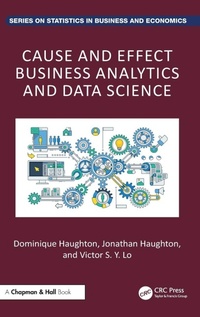
Cause and Effect Business Analytics and Data Science
For Big and Small Data
1st Edition
Published on 30. July 2025
Book
Hardback
350 pages
978-1-4822-1647-9 (ISBN)
Description
Among the most important questions that businesses ask are some very simple ones: If I decide to do something, will it work? And if so, how large are the effects? To answer these predictive questions, and later base decisions on them, we need to establish causal relationships.
Establishing and measuring causality can be difficult. This book explains the most useful techniques for discerning causality and illustrates the principles with numerous examples from business. It discusses randomized experiments (aka A/B testing) and techniques such as propensity score matching, synthetic controls, double differences, and instrumental variables. There is a chapter on the powerful AI approach of Directed Acyclic Graphs (aka Bayesian Networks), another on structural equation models, and one on time-series techniques, including Granger causality.
At the heart of the book are four chapters on uplift modeling, where the goal is to help firms determine how best to deploy their resources for marketing or other interventions. We start by modeling uplift, discuss the test-and-learn process, and provide an overview of the prescriptive analytics of uplift.
The book is written in an accessible style and will be of interest to data analysts and strategists in business, to students and instructors of business and analytics who have a solid foundation in statistics, and to data scientists who recognize the need to take seriously the need for causality as an essential input into effective decision-making.
Establishing and measuring causality can be difficult. This book explains the most useful techniques for discerning causality and illustrates the principles with numerous examples from business. It discusses randomized experiments (aka A/B testing) and techniques such as propensity score matching, synthetic controls, double differences, and instrumental variables. There is a chapter on the powerful AI approach of Directed Acyclic Graphs (aka Bayesian Networks), another on structural equation models, and one on time-series techniques, including Granger causality.
At the heart of the book are four chapters on uplift modeling, where the goal is to help firms determine how best to deploy their resources for marketing or other interventions. We start by modeling uplift, discuss the test-and-learn process, and provide an overview of the prescriptive analytics of uplift.
The book is written in an accessible style and will be of interest to data analysts and strategists in business, to students and instructors of business and analytics who have a solid foundation in statistics, and to data scientists who recognize the need to take seriously the need for causality as an essential input into effective decision-making.
More details
Series
Language
English
Place of publication
Oxford
United States
Publishing group
Taylor & Francis Inc
Target group
Professional and scholarly
Academic
Illustrations
47 s/w Abbildungen, 47 s/w Zeichnungen, 63 s/w Tabellen, 11 farbige Tabellen
11 Tables, color; 63 Tables, black and white; 47 Line drawings, black and white; 47 Illustrations, black and white
Dimensions
Height: 240 mm
Width: 161 mm
Thickness: 24 mm
Weight
708 gr
ISBN-13
978-1-4822-1647-9 (9781482216479)
Copyright in bibliographic data and cover images is held by Nielsen Book Services Limited or by the publishers or by their respective licensors: all rights reserved.
Schweitzer Classification
Other editions
Additional editions
Dominique Haughton | Jonathan Haughton | Victor S. y. Lo
Cause and Effect Business Analytics and Data Science
E-Book
07/2025
Chapman & Hall/CRC
€73.99
Available for download
Dominique Haughton | Jonathan Haughton | Victor S. y. Lo
Cause and Effect Business Analytics and Data Science
E-Book
07/2025
Chapman & Hall/CRC
€73.99
Available for download
Persons
Dominique Haughton (PhD MIT 1983) is Professor Emerita of Mathematical Sciences and Global Studies at Bentley University near Boston, and Affiliated Researcher at Universite Paris 1 (Pantheon-Sorbonne, SAMM) and at Universite Toulouse 1 (TSE-R). Her widely published work concentrates on how to best leverage modern analytics techniques to address questions of business or societal interest. She is an alumna of the Ecole Normale Superieure and a Fellow of the American Statistical Association.
Jonathan Haughton earned his PhD in economics from Harvard University in 1983. He has published widely in the areas of economic development, taxation, the environment, and the analysis and measurement of poverty. Until recently, he chaired the economics department at Suffolk University, Boston, and he has taught or worked as a consultant in over 20 countries on five continents.
Victor S.Y. Lo is an executive with over three decades of consulting and corporate experience employing data-driven solutions in a wide variety of business areas, including Marketing, Risk Management, Financial Econometrics, Insurance, Product Development, Transportation, Healthcare, Operations Management, and Human Resources, and is a pioneer of uplift modeling. He is currently SVP, Data Science and AI at Fidelity Investments, and has led data science and analytics teams in various organizations. Victor earned a master's degree in Operational Research and a PhD in Statistics, and was a Postdoctoral Fellow in Management Science.
Jonathan Haughton earned his PhD in economics from Harvard University in 1983. He has published widely in the areas of economic development, taxation, the environment, and the analysis and measurement of poverty. Until recently, he chaired the economics department at Suffolk University, Boston, and he has taught or worked as a consultant in over 20 countries on five continents.
Victor S.Y. Lo is an executive with over three decades of consulting and corporate experience employing data-driven solutions in a wide variety of business areas, including Marketing, Risk Management, Financial Econometrics, Insurance, Product Development, Transportation, Healthcare, Operations Management, and Human Resources, and is a pioneer of uplift modeling. He is currently SVP, Data Science and AI at Fidelity Investments, and has led data science and analytics teams in various organizations. Victor earned a master's degree in Operational Research and a PhD in Statistics, and was a Postdoctoral Fellow in Management Science.
Content
1. Introduction to Cause-and-Effect Business Analytics 2. Review of common data mining techniques 3. Causality 4. Causality: Synthetic Control, Regression Discontinuity, and Instrumental Variables 5. Directed Acyclic Graphs 6. Uplift Analytics I: Mining for the Truly Responsive Customers and Prospects 7. Test and Learn for Uplift 8. Uplift Analytics III: Model-Driven Decision-Making and Treatment Optimization Using Prescriptive Analytics 9. Uplift Analytics IV: Advanced Modeling Techniques for Randomized and Non-Randomized Experiments 10. Causality in Times Series Data 11. Structural Equation Models 12. Discussion and Summary