

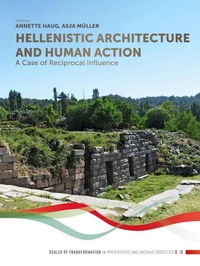
Hellenistic Architecture and Human Action
A Case of Reciprocal Influence
1st Edition
Published on 15. November 2020
Book
Paperback/Softback
212 pages
978-90-8890-909-2 (ISBN)
Description
This book examines the mutual influence of architecture and human action during a key period of history: the Hellenistic age. During this era, the profound transformations in the Mediterranean's archaeological and historical record are detectable, pointing to a conscious intertwining of the physical (landscape, architecture, bodies) and social (practice) components of built space.
Compiling the outcomes of a conference held in Kiel in 2018, the volume assembles contributions focusing on Hellenistic architecture as an action context, perceived in movement through built space. Sanctuaries, as a particularly coherent kind of built space featuring well-defined sets of architecture combined with ritual action, were chosen as the general frame for the analyses. The reciprocity between this sacred architecture and (religious) human action is traced through several layers starting from three specific case studies (Messene, Samothrace, Pella), extending to architectural modules, and finally encompassing overarching principles of design and use. As two additional case studies on caves and agorai show, the far-reaching entanglement of architecture and human action was neither restricted to highly architecturalised nor sacred spaces, but is characteristic of Hellenistic built space in general.
Compiling the outcomes of a conference held in Kiel in 2018, the volume assembles contributions focusing on Hellenistic architecture as an action context, perceived in movement through built space. Sanctuaries, as a particularly coherent kind of built space featuring well-defined sets of architecture combined with ritual action, were chosen as the general frame for the analyses. The reciprocity between this sacred architecture and (religious) human action is traced through several layers starting from three specific case studies (Messene, Samothrace, Pella), extending to architectural modules, and finally encompassing overarching principles of design and use. As two additional case studies on caves and agorai show, the far-reaching entanglement of architecture and human action was neither restricted to highly architecturalised nor sacred spaces, but is characteristic of Hellenistic built space in general.
More details
Series
Edition
1. Auflage
Language
English
Place of publication
Leiden
Netherlands
Target group
Professional and scholarly
Illustrations
29fc/38bw
Dimensions
Height: 280 mm
Width: 210 mm
Thickness: 14 mm
Weight
767 gr
ISBN-13
978-90-8890-909-2 (9789088909092)
DOI
https://doi.org/10.59641/k3679nw
Copyright in bibliographic data and cover images is held by Nielsen Book Services Limited or by the publishers or by their respective licensors: all rights reserved.
Schweitzer Classification
Persons
Institute of Classical Studies / Classical Archaeology, CAU Kiel (present). Studies of Classical Archaeology, Art History and Prehistory in Heidelberg and Paris, binational Phd 2003, Habilitation Leipzig 2009, LMU Muenchen Heisenberg Fellow; Professor of Classics, especially Classical Archaeology at the Christian-Albrechts-Universitaet zu Kiel 2012, Co-Coordinator of the Kiel Graduate School 'Human Development in Landscapes' 2016-.
Key publications:
Haug 2003: A. Haug, Die Stadt als Lebensraum. Eine kulturhistorische Analyse zum spaetantiken Stadtleben in Norditalien. Internationale Archaeologie 85 (Rahden 2003).
Haug 2012: A. Haug, Die Entdeckung des Koerpers. Koerper- und Rollenbilder im Athen des 8. und 7. Jh. v. Chr. (Berlin/New York 2012).
Haug/Steuernagel 2014: A. Haug/D. Steuernagel, Das Haus XV B in Megara Hyblaia. Studien zur antiken Stadt 14 (Wiesbaden 2014).
Haug 2015: A. Haug, Bild und Ornament im fruehen Athen (Regensburg 2015).
Haug/Steuernagel 2014: A. Haug/D. Steuernagel (eds.), Hellenistische Haeuser und ihre Funktionen. Internationale Tagung Kiel, 4. bis 6. April 2013 (Bonn 2014).
Haug/Kreuz 2016: A. Haug/P.-A. Kreuz (eds.), Stadterfahrung als Sinneserfahrung in der Roemischen Kaiserzeit (Turnhout 2016). Institute of Classical Archaeology, Freie Universitaet Berlin (present). Studies of Classical Archaeology, Prehistoric Archaeology, Experimental Archaeology and Egyptology at Leipzig and Exeter (UK); PhD Kiel 2017; Postdoc Research Fellow CRC 1266, project E3 at the Institute of Classical Studies / Classical Archaeology, CAU Kiel, 2016-2017; Travel Scholarship of the German Archaeological Institute 2017-2018; Assistant Professor at the Institute of Classical Archaeology, Freie Universitaet Berlin 2018-.
Key publications:
Mueller, A., 2017. Provenancing Roman period mummy masks: workshop groups and distribution areas. In: M. Tomorad and J. Popielska-Gzybowska, eds. Egypt 2015: Perspectives of Research. Proceedings of the Seventh European Conference of Egyptologists, 2nd-7th June 2015, Zagreb, Croatia, Archaeopress Egyptology 18. Oxford: Archaeopress, 127-145.
Mueller, A., 2018. Masking the dead in Roman Egypt. In: A. Berlejung and J.E. Filitz, eds. The physicality of the other: masks from the ancient Near East and the Eastern Mediterranean, Orientalische Religionen in der Antike 27, Tuebingen: Mohr Siebeck, 91-112.
Mueller, A., forthcoming. Hellenistic built space and human Action: the Asclepieion of Cos. In: A. Haug and S. Merten, eds. Urban Practices.
Key publications:
Haug 2003: A. Haug, Die Stadt als Lebensraum. Eine kulturhistorische Analyse zum spaetantiken Stadtleben in Norditalien. Internationale Archaeologie 85 (Rahden 2003).
Haug 2012: A. Haug, Die Entdeckung des Koerpers. Koerper- und Rollenbilder im Athen des 8. und 7. Jh. v. Chr. (Berlin/New York 2012).
Haug/Steuernagel 2014: A. Haug/D. Steuernagel, Das Haus XV B in Megara Hyblaia. Studien zur antiken Stadt 14 (Wiesbaden 2014).
Haug 2015: A. Haug, Bild und Ornament im fruehen Athen (Regensburg 2015).
Haug/Steuernagel 2014: A. Haug/D. Steuernagel (eds.), Hellenistische Haeuser und ihre Funktionen. Internationale Tagung Kiel, 4. bis 6. April 2013 (Bonn 2014).
Haug/Kreuz 2016: A. Haug/P.-A. Kreuz (eds.), Stadterfahrung als Sinneserfahrung in der Roemischen Kaiserzeit (Turnhout 2016). Institute of Classical Archaeology, Freie Universitaet Berlin (present). Studies of Classical Archaeology, Prehistoric Archaeology, Experimental Archaeology and Egyptology at Leipzig and Exeter (UK); PhD Kiel 2017; Postdoc Research Fellow CRC 1266, project E3 at the Institute of Classical Studies / Classical Archaeology, CAU Kiel, 2016-2017; Travel Scholarship of the German Archaeological Institute 2017-2018; Assistant Professor at the Institute of Classical Archaeology, Freie Universitaet Berlin 2018-.
Key publications:
Mueller, A., 2017. Provenancing Roman period mummy masks: workshop groups and distribution areas. In: M. Tomorad and J. Popielska-Gzybowska, eds. Egypt 2015: Perspectives of Research. Proceedings of the Seventh European Conference of Egyptologists, 2nd-7th June 2015, Zagreb, Croatia, Archaeopress Egyptology 18. Oxford: Archaeopress, 127-145.
Mueller, A., 2018. Masking the dead in Roman Egypt. In: A. Berlejung and J.E. Filitz, eds. The physicality of the other: masks from the ancient Near East and the Eastern Mediterranean, Orientalische Religionen in der Antike 27, Tuebingen: Mohr Siebeck, 91-112.
Mueller, A., forthcoming. Hellenistic built space and human Action: the Asclepieion of Cos. In: A. Haug and S. Merten, eds. Urban Practices.
Content
Acknowledgements
Introduction: Hellenistic Architecture, Landscape, and Human Action
Annette Haug - Asja Mueller
Three sanctuaries as case studies
The Sanctuary of Artemis Limnatis in Messene: Natural Setting and Human Action
Stefan Feuser - Maria Spathi
Interstitial Space in the Sanctuary of the Great Gods on Samothrace
Bonna D. Wescoat - Susan Ludi Blevins - Maggie L. Popkin - Jessica Paga - Andrew Farinholt Ward - Michael C. Page - William Size
Sanctuary Disposition and Cult Practice: The Thesmophorion in Pella
Soi Agelidis
Principles of design: Hellenistic sanctuaries between agency and perception
The Usage of the Pronaos of Hellenistic Temples
Philipp Kobusch
Constructing the Sublime: Landscape, Architecture and Human Encounter in Hellenistic Sanctuaries
Christina G. Williamson
Secluded or Entangled: Two Modes of Architecture-Landscape Design in Hellenistic Sanctuaries
Asja Mueller
Roman Awe for Greek Sanctuaries: Polybius and Livy Illustrate Roman Encounters with Greek Patrimony
Jessica van 't Westeinde
Man-Made Space versus Natural Space in Greek Sacred Caves
Katja Sporn
Beyond sanctuaries: the agora
The Upper Agora at Ephesos in Hellenistic Times: in Search of the 'State Market' (in honour of Wilhelm Alzinger, 1918-1998, on his centenary)
Dirk Steuernagel
Introduction: Hellenistic Architecture, Landscape, and Human Action
Annette Haug - Asja Mueller
Three sanctuaries as case studies
The Sanctuary of Artemis Limnatis in Messene: Natural Setting and Human Action
Stefan Feuser - Maria Spathi
Interstitial Space in the Sanctuary of the Great Gods on Samothrace
Bonna D. Wescoat - Susan Ludi Blevins - Maggie L. Popkin - Jessica Paga - Andrew Farinholt Ward - Michael C. Page - William Size
Sanctuary Disposition and Cult Practice: The Thesmophorion in Pella
Soi Agelidis
Principles of design: Hellenistic sanctuaries between agency and perception
The Usage of the Pronaos of Hellenistic Temples
Philipp Kobusch
Constructing the Sublime: Landscape, Architecture and Human Encounter in Hellenistic Sanctuaries
Christina G. Williamson
Secluded or Entangled: Two Modes of Architecture-Landscape Design in Hellenistic Sanctuaries
Asja Mueller
Roman Awe for Greek Sanctuaries: Polybius and Livy Illustrate Roman Encounters with Greek Patrimony
Jessica van 't Westeinde
Man-Made Space versus Natural Space in Greek Sacred Caves
Katja Sporn
Beyond sanctuaries: the agora
The Upper Agora at Ephesos in Hellenistic Times: in Search of the 'State Market' (in honour of Wilhelm Alzinger, 1918-1998, on his centenary)
Dirk Steuernagel