

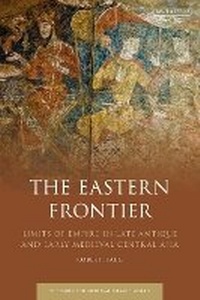
The Eastern Frontier
Limits of Empire in Late Antique and Early Medieval Central Asia
Published on 27. June 2019
Book
Hardback
312 pages
978-1-78831-003-1 (ISBN)
Description
Transoxania, Khurasan, and ?ukharistan - which comprise large parts of today's Central Asia - have long been an important frontier zone. In the late antique and early medieval periods, the region was both an eastern political boundary for Persian and Islamic empires and a cultural border separating communities of sedentary farmers from pastoral-nomads.
Given its peripheral location, the history of the 'eastern frontier' in this period has often been shown through the lens of expanding empires. However, in this book, Robert Haug argues for a pre-modern Central Asia with a discrete identity, a region that is not just a transitory space or the far-flung corner of empires, but its own historical entity. From this locally specific perspective, the book takes the reader on a 900-year tour of the area, from Sasanian control, through the Umayyads and Abbasids, to the quasi-independent dynasties of the Tahirids and the Samanids. Drawing on an impressive array of literary, numismatic and archaeological sources, Haug reveals the unique and varied challenges the eastern frontier presented to imperial powers that strove to integrate the area into their greater systems. This is essential reading for all scholars working on early Islamic, Iranian and Central Asian history, as well as those with an interest in the dynamics of frontier regions.
Given its peripheral location, the history of the 'eastern frontier' in this period has often been shown through the lens of expanding empires. However, in this book, Robert Haug argues for a pre-modern Central Asia with a discrete identity, a region that is not just a transitory space or the far-flung corner of empires, but its own historical entity. From this locally specific perspective, the book takes the reader on a 900-year tour of the area, from Sasanian control, through the Umayyads and Abbasids, to the quasi-independent dynasties of the Tahirids and the Samanids. Drawing on an impressive array of literary, numismatic and archaeological sources, Haug reveals the unique and varied challenges the eastern frontier presented to imperial powers that strove to integrate the area into their greater systems. This is essential reading for all scholars working on early Islamic, Iranian and Central Asian history, as well as those with an interest in the dynamics of frontier regions.
Reviews / Votes
The book is not only about an important problem in the history of empire, but also a very useful introduction into the history of this region ... This is an important book, a contribution to the revision of the view of caliphate as well as other empires as monolithic structures. * Der Islam *More details
Series
Language
English
Place of publication
United Kingdom
Publishing group
Bloomsbury Publishing PLC
Target group
College/higher education
Illustrations
7 Maps
Dimensions
Height: 234 mm
Width: 156 mm
Weight
612 gr
ISBN-13
978-1-78831-003-1 (9781788310031)
Copyright in bibliographic data and cover images is held by Nielsen Book Services Limited or by the publishers or by their respective licensors: all rights reserved.
Schweitzer Classification
Other editions
Additional editions
E-Book
06/2019
1st Edition
I.B. Tauris
€36.49
Available for download
Person
Robert Haug is Associate Professor of History at the McMicken College of Arts and Sciences, University of Cincinnati, where he also runs the Middle East Studies programme. He received his PhD from the University of Michigan and has published in peer-reviewed journals and edited collections on medieval frontier regions.
Content
INTRODUCTION
Chapter 1 - THE GATE OF IRON: CONCEPTUALIZING THE EASTERN FRONTIER IN MEDIEVAL GEOGRAPHIC LITERATURE
Chapter 2 - SHAPING THE EASTERN FRONTIER: THE SASANIAN EMPIRE AND ITS EASTERN NEIGHBORS
Chapter 3 - THE ARAB-MUSLIM CONQUESTS AND THE LATE ANTIQUE IMPERIAL SHATTERZONE
Chapter 4 - THE FRONTIER BEYOND THE CALIPHATE: KHURASAN AND THE SECOND FITNA
Chapter 5 - EXTENDING THE FRONTIER: THE UMAYYADS IN SOGDIANA AND BEYOND
Chapter 6 - THE UNSETTLED FRONTIER: THE ABBASID AND OTHER REVOLUTIONS AND THE EASTERN FRONTIER
Chapter 7 - UNIFYING THE FRONTIER: THE FORMATION OF GREATER KHURASAN
CONCLUSION: AT THE END OF THE FRONTIER
Chapter 1 - THE GATE OF IRON: CONCEPTUALIZING THE EASTERN FRONTIER IN MEDIEVAL GEOGRAPHIC LITERATURE
Chapter 2 - SHAPING THE EASTERN FRONTIER: THE SASANIAN EMPIRE AND ITS EASTERN NEIGHBORS
Chapter 3 - THE ARAB-MUSLIM CONQUESTS AND THE LATE ANTIQUE IMPERIAL SHATTERZONE
Chapter 4 - THE FRONTIER BEYOND THE CALIPHATE: KHURASAN AND THE SECOND FITNA
Chapter 5 - EXTENDING THE FRONTIER: THE UMAYYADS IN SOGDIANA AND BEYOND
Chapter 6 - THE UNSETTLED FRONTIER: THE ABBASID AND OTHER REVOLUTIONS AND THE EASTERN FRONTIER
Chapter 7 - UNIFYING THE FRONTIER: THE FORMATION OF GREATER KHURASAN
CONCLUSION: AT THE END OF THE FRONTIER