

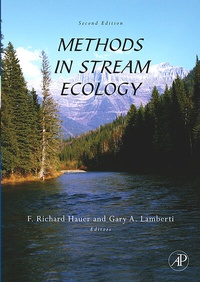
Methods in Stream Ecology
2nd Edition
Published on 25. July 2007
Book
Paperback/Softback
896 pages
978-0-12-332908-0 (ISBN)
Description
Methods in Stream Ecology, Second Edition, provides a complete series of field and laboratory protocols in stream ecology that are ideal for teaching or conducting research.
This updated edition reflects recent advances in the technology associated with ecological assessment of streams, including remote sensing. In addition, the relationship between stream flow and alluviation has been added, and a new chapter on riparian zones is also included.
The book features exercises in each chapter; detailed instructions, illustrations, formulae, and data sheets for in-field research for students; and taxanomic keys to common stream invertebrates and algae.
With a student-friendly price, this book is key for all students and researchers in stream and freshwater ecology, freshwater biology, marine ecology, and river ecology. This text is also supportive as a supplementary text for courses in watershed ecology/science, hydrology, fluvial geomorphology, and landscape ecology.
This updated edition reflects recent advances in the technology associated with ecological assessment of streams, including remote sensing. In addition, the relationship between stream flow and alluviation has been added, and a new chapter on riparian zones is also included.
The book features exercises in each chapter; detailed instructions, illustrations, formulae, and data sheets for in-field research for students; and taxanomic keys to common stream invertebrates and algae.
With a student-friendly price, this book is key for all students and researchers in stream and freshwater ecology, freshwater biology, marine ecology, and river ecology. This text is also supportive as a supplementary text for courses in watershed ecology/science, hydrology, fluvial geomorphology, and landscape ecology.
Reviews / Votes
"This book is packed with the latest and best 'how to' information for field and laboratory work in streams. The new edition has expanded content, a larger format, and much better graphics...The greatest content change is the addition of a 6th section entitled Ecosystem Quality. Section 6 is anchored by a substantially rewritten chapter on 'Macroinvertebrates as Biotic Indicators of Environmental Quality'...I like the way in which doable, detailed, stepwise exercises, including the math, are provided in a format appealing to students interested in conducting stream studies...I think that even an advanced high school student with access to this book should be able design an independent study project in stream ecology. I would really like to see it in high school libraries, as well as on college and university campuses. The greatest strength of this book is that it is written by leading authorities in stream ecology. The structure is better organized and more informative than the previous edition. The format is conducive to teaching and learning. I grade this book an 'A'. --Ben Stout, Wheeling Jesuit University, West Virginia, USAMore details
Edition
2nd edition
Language
English
Place of publication
San Diego
United States
Publishing group
Elsevier Science Publishing Co Inc
Target group
Professional and scholarly
Faculty, graduate students, researchers, advanced undergraduates, federal, state and local government officials interested in and repsonsible for stream evaluation and monitoring.
Edition type
New edition
Dimensions
Height: 260 mm
Width: 184 mm
Weight
2130 gr
ISBN-13
978-0-12-332908-0 (9780123329080)
Copyright in bibliographic data and cover images is held by Nielsen Book Services Limited or by the publishers or by their respective licensors: all rights reserved.
Schweitzer Classification
Other editions
New editions
Book
06/2017
3rd Edition
Academic Press
€74.50
Shipment within 10-15 days
Book
04/2017
3rd Edition
Academic Press
€67.00
Shipment within 10-15 days
Additional editions
F. Richard Hauer | Richard Hauer | Gary A. Lamberti
Methods in Stream Ecology
E-Book
04/2011
2nd Edition
Academic Press
€45.95
Available for download
F. Richard Hauer | Gary Lamberti
Methods in Stream Ecology
Book
06/2006
2nd Edition
Academic Press
€86.65
Article exhausted; check for reprint
Previous edition

F. Richard Hauer | Gary Anthony Lamberti
Methods in Stream Ecology
Book
05/1998
Academic Press
€40.84
Article exhausted; check for reprint
Persons
F. Richard (Ric) Hauer, is Director of the University of Montana's Center for Integrated Research on the Environment (CIRE) and Professor of Stream Ecology at the Flathead Lake Biological Station where he taught Stream Ecology for >25 years. His major research interests encompass the broad, interdisciplinary field of ecosystem ecology with focus on freshwaters, especially running waters and gravel-bed river floodplains and wetlands. The breadth of his research spans from physical processes of sediment transport and groundwater/surface water interactions to aquatic insect life histories and ecosystem assessment. He is particularly interested in the application of remotely sensed data to understanding biophysical processes of floodplain ecology. To this end, he pilots his own airplane in the acquisition of digital imagery used to evaluate the landscape scale linkages between hydrology, geomorphology and ecology in river and floodplain ecosystems. Dr. Hauer has conducted his research around the eastern Pacific-rim from Alaska to Patagonia; his primary research site being the transboundary Crown-of-the-Continent Ecosystem and the Flathead River of Montana and British Columbia. While it was the fascination with aquatic invertebrates, especially caddisflies, that captured his interest, it has been his love for streams and rivers as disproportionately important components of biodiversity of mountain landscapes that has maintained that passion. Dr. Hauer has published >100 research articles in international peer-reviewed journals such as Science, Science Advances, BioScience and Freshwater Science. In addition to his personal research, he has served at the national level in developing environmental policy and implementation of environmental assessment in the Clean Water Act working with both the US Army Corps of Engineers and the US EPA. Ric is past-President of the international scientific society "Society for Freshwater Science.? At the University of Montana, Hauer held the Stream Ecology Endowed Chair at Flathead Lake Biological Station from 2000-2016 and received the university's Distinguished Scholar Award in 2011. He is founding director of the university's interdisciplinary sciences graduate program, Systems Ecology. Dr. Gary A. Lamberti is Professor of Biological Sciences and Director of the Stream and Wetland Ecology Laboratory (SWEL) at the University of Notre Dame, where he teaches Biostatistics, Stream Ecology, Restoration Ecology, and a variety of topical graduate courses. His major research interests include (1) food web ecology of streams and wetlands, ranging from microbes to fish; (2) the ecology of native and introduced Pacific salmon; and (3) the impacts of climate change, toxins, and invasive species on aquatic ecosystem function. He retains a fundamental love for aquatic invertebrates, which permeates all of his research. He has also successfully advised 27 M.S. and Ph.D. students to completion and countless undergraduates have conducted research in his laboratory. Dr. Lamberti has over 175 publications dealing with various aspects of aquatic ecology, and has co-edited the Elsevier book entitled Methods in Stream Ecology, now in its 3rd edition. At Notre Dame, he also directs the GLOBES Graduate Certificate Program in Environment and Society. Dr. Lamberti is a Fellow of the American Association for the Advancement of Science and past-President of the Society for Freshwater Science, an international society of aquatic ecologists.
Content
Section A: Physical Processes
1. Landscapes And Catchment Basins
2. Valley Segments, Stream Reaches, And Channel Units
3. Discharge Measurements And Streamflow Analysis
4. Dynamics Of Flow
5. Temperature, Light, And Oxygen
6. Hyporheic Zones
Section B: Material Storage And Transport
7. Fluvial Geomorphic Processes
8. Solute Dynamics
9. Phosphorus Limitation, Uptake, And Turnover In Stream Algae
10. Nitrogen Dynamics
11. Dissolved Organic Carbon
12. Transport And Storage Of Fpom
13. Cpom And Large Wood
Section C: Stream Biota
14. Heterotrophic Mirobes
15. Fungi: Biomass, Production And Sporulation Of Aquatic Hyphomycetes
16. Benthic Algae: Distribution And Structure
17. Biomass And Pigments Of Benthic Algae
18. Macrophytes And Bryophytes
19. Meiofauna
20. Macroinvertebrates
21. Macroinvertebrate Movements: Drift, Colonization, And Emergence
22. Fish Community Composition
Section D: Community Interactions
23. Plant - Herbivore Interactions
24. Predator-Prey Interactions
25. Trophic Relations Of Macroinvertebrates
26. Trophic Relations Of Stream Fishes
27. Stream Food Webs
Section E: Ecosystem Processes
28. Primary Productivity And Community Respiration
29. Secondary Production Of Macroinvertebrates
30. Decomposition In Stream Ecosystems
31. Riparian Processes And Interactions
32. Effects Of Nutrient Enrichment On Periphyton
33. Surface-Subsurface Interactions In Streams
Section F: Ecosystem Quality
34. Algae As Biotic Indicators Of Environmental Quality
35. Macroinvertebrates As Biotic Indicators Of Environmental Quality
36. Pollution And Toxicological Assessment
1. Landscapes And Catchment Basins
2. Valley Segments, Stream Reaches, And Channel Units
3. Discharge Measurements And Streamflow Analysis
4. Dynamics Of Flow
5. Temperature, Light, And Oxygen
6. Hyporheic Zones
Section B: Material Storage And Transport
7. Fluvial Geomorphic Processes
8. Solute Dynamics
9. Phosphorus Limitation, Uptake, And Turnover In Stream Algae
10. Nitrogen Dynamics
11. Dissolved Organic Carbon
12. Transport And Storage Of Fpom
13. Cpom And Large Wood
Section C: Stream Biota
14. Heterotrophic Mirobes
15. Fungi: Biomass, Production And Sporulation Of Aquatic Hyphomycetes
16. Benthic Algae: Distribution And Structure
17. Biomass And Pigments Of Benthic Algae
18. Macrophytes And Bryophytes
19. Meiofauna
20. Macroinvertebrates
21. Macroinvertebrate Movements: Drift, Colonization, And Emergence
22. Fish Community Composition
Section D: Community Interactions
23. Plant - Herbivore Interactions
24. Predator-Prey Interactions
25. Trophic Relations Of Macroinvertebrates
26. Trophic Relations Of Stream Fishes
27. Stream Food Webs
Section E: Ecosystem Processes
28. Primary Productivity And Community Respiration
29. Secondary Production Of Macroinvertebrates
30. Decomposition In Stream Ecosystems
31. Riparian Processes And Interactions
32. Effects Of Nutrient Enrichment On Periphyton
33. Surface-Subsurface Interactions In Streams
Section F: Ecosystem Quality
34. Algae As Biotic Indicators Of Environmental Quality
35. Macroinvertebrates As Biotic Indicators Of Environmental Quality
36. Pollution And Toxicological Assessment