

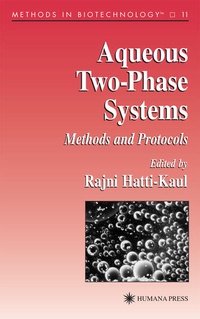
Aqueous Two-Phase Systems
Methods and Protocols
Published on 19. November 2010
Book
Paperback/Softback
XIV, 454 pages
978-1-61737-067-0 (ISBN)
Description
A mixture of two polymers, or one polymer and a salt, in an aqueous medium separates into two phases: this phenomenon is useful in biotechn- ogy for product separations. Separation of biological molecules and particles in these aqueous two-phase systems (ATPS) was initiated over 40 years ago by P.-Å. Albertsson, and later proved to be of immense utility in biochemical and cell biological research. A boost in the application of ATPS was seen when problems of separations in biotechnology processes were encountered. Its simplicity, biocompatibility, and amenability to easy scaleup operations make the use of ATPS very attractive for large-scale bioseparations. Despite the advantages ATPS enjoys over other separation techniques, the application of two-phase systems has for a long time been confined to selected labora- ries. Recent years have, however, shown a trend in which increasing numbers of researchers employ two-phase partitioning techniques in both basic and applied research.
More details
Series
Edition
1st ed. Softcover of orig. ed. 2000
Language
English
Place of publication
Totowa
United States
Target group
Professional and scholarly
Research
Product notice
Paperback (trade)
Unsewn / adhesive bound
Illustrations
XIV, 454 p.
Dimensions
Height: 229 mm
Width: 152 mm
Thickness: 26 mm
Weight
680 gr
ISBN-13
978-1-61737-067-0 (9781617370670)
DOI
10.1385/1592590284
Schweitzer Classification
Other editions
Additional editions
Book
02/2000
Humana Press Inc.
€106.99
Shipment within 15-20 days
Content
Preparation and Characterization of Aqueous Two-Phase Systems.- Aqueous Two-Phase Systems.- The Phase Diagram.- Preparation of Aqueous Two-Phase Systems.- Measurement of Some Physical Properties of Aqueous Two-Phase Systems.- Partitioning Techniques.- Single-Step Partitioning in Aqueous Two-Phase Systems.- Partition by Countercurrent Distribution (CCD).- Liquid-Liquid Partition Chromatography (LLPC).- Partitioning of Soluble Molecules and Particulates.- Metal Ion Separations in Aqueous Biphasic Systems and with ABECT Resins.- Partition of Amino Acids and Peptides in Aqueous Two-Phase Systems.- Predicting Partition Coefficients of Small Solutes Based on Hydrophobicity.- Eukaryotic Cell Partition.- Concentration and Purification of Viruses.- Isolation of Plant Plasma Membranes and Production of Inside-Out Vesicles.- Isolation of Inside-Out Thylakoid Vesicles.- Two-Phase Partitioning as a Method for Isolation of Tight Plasma Membrane Vesicles from Saccharomyces cerevisiae and from Chlamydomonas reinhardtii.- Purification of Cyanobacterial Thylakoid, Plasma, and Outer Membranes by Two-Phase Partitioning.- Purification of Plasma Membranes by Affinity Partitioning.- Studying the Influence of Salts on Partitioning of Proteins.- Partitioning of Chemically Modified Proteins.- Detection and Analysis of Interactions by Two-Phase Partition.- Cryopartitioning in Two-Phase Systems Containing Organic Solvents.- Isolation and Purification of Proteins by Two-Phase Extraction.- Optimization of Extractions in Aqueous Two-Phase Systems.- Two-Phase Extraction of Proteins from Cell Debris.- Aqueous Two-Phase Extraction of Proteins from Animal Tissue.- Chaotropic Aqueous Two-Phase Systems.- Temperature-Induced Phase Partitioning for Protein Purification.- Extraction of Amphiphilic ProteinsUsing Detergent-Based Aqueous Two-Phase Systems.- Use of Charged PEG and Dextran Derivatives for Biomolecule Partitioning.- Affinity Partitioning Using Poly(ethylene glycol) with Covalently Coupled Hydrophobic Groups.- Dye-Ligand Affinity Partitioning of Proteins.- Metal Affinity Protein Partitioning.- Recovery of Proteins and Phase Components.- Combination of Extraction with Adsorption for Protein Purification.- Integration of Extraction with Affinity Precipitation.- Affinity Partitioning Using Magnetic Two-Phase Systems.- 36 Large-Scale Extraction of Proteins.- Bioconversions in Two-Phase Systems.- Extractive Bioconversion in Aqueous Two-Phase Systems.- Enzyme Reaction in Polymer-Polymer Organic Solvent Two-Phase Systems.