

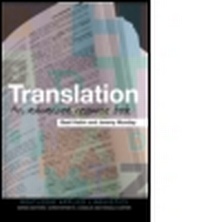
Translation
An Advanced Resource Book
1st Edition
Published on 2. December 2004
Book
Hardback
400 pages
978-0-415-28305-2 (ISBN)
Description
Routledge Applied Linguistics is a series of comprehensive textbooks, providing students and researchers with the support they need for advanced study in the core areas of English language and Applied Linguistics.
Each book in the series guides readers through three main sections, enabling them to explore and develop major themes within the discipline.
Section A, Introduction, establishes the key terms and concepts and extends readers' techniques of analysis through practical application.
Section B, Extension, brings together influential articles, sets them in context, and discusses their contribution to the field.
Section C, Exploration, builds on knowledge gained in the first two sections, setting thoughtful tasks around further illustrative material. This enables readers to engage more actively with the subject matter and encourages them to develop their own research responses.
Throughout the book, topics are revisited, extended, interwoven and deconstructed, with the reader's understanding strengthened by tasks and follow-up questions.
Translation:
examines the theory and practice of translation from a variety of linguistic and cultural angles, including semantics, functional linguistics, corpus and cognitive linguistics, discourse analysis, gender studies and postcolonialism
draws on a wide range of languages, including French, Spanish, German, Italian, Russian and Arabic
explores material from a variety of sources, such as the Internet, advertisements, religious texts, literary and technical texts
gathers together influential readings from the key names in the discipline, including James S. Holmes, George Steiner, Vinay and Darbelnet, Eugene Nida, Werner Koller and Ernst-August Gutt.
Written by experienced teachers and researchers in the field, Translation: An Advanced Resource Book is an essential textbook for students and researchers of English language and Applied Linguistics.
The accompanying website to this book can be found at http://www.routledge.com/textbooks/041528306X
Each book in the series guides readers through three main sections, enabling them to explore and develop major themes within the discipline.
Section A, Introduction, establishes the key terms and concepts and extends readers' techniques of analysis through practical application.
Section B, Extension, brings together influential articles, sets them in context, and discusses their contribution to the field.
Section C, Exploration, builds on knowledge gained in the first two sections, setting thoughtful tasks around further illustrative material. This enables readers to engage more actively with the subject matter and encourages them to develop their own research responses.
Throughout the book, topics are revisited, extended, interwoven and deconstructed, with the reader's understanding strengthened by tasks and follow-up questions.
Translation:
examines the theory and practice of translation from a variety of linguistic and cultural angles, including semantics, functional linguistics, corpus and cognitive linguistics, discourse analysis, gender studies and postcolonialism
draws on a wide range of languages, including French, Spanish, German, Italian, Russian and Arabic
explores material from a variety of sources, such as the Internet, advertisements, religious texts, literary and technical texts
gathers together influential readings from the key names in the discipline, including James S. Holmes, George Steiner, Vinay and Darbelnet, Eugene Nida, Werner Koller and Ernst-August Gutt.
Written by experienced teachers and researchers in the field, Translation: An Advanced Resource Book is an essential textbook for students and researchers of English language and Applied Linguistics.
The accompanying website to this book can be found at http://www.routledge.com/textbooks/041528306X
Reviews / Votes
'To complement and enrich this truly innovative advanced resource book, there is a very useful website where students can browse in search of further text samples, translations, and updated information on developments and events pertaining to the discipline of Translation Studies.' - The Linguist List'Fills a space that I'm sure many translation academics feel needs to be filled ... This book will help to define and shape translation pedagogy for the next few years. In brief, I see it as Mona Baker's In Other Words ten years on.' - Stuart Campbell, University of Western Sydney
'This truly comprehensive work is doubly innovative: it goes beyond the abstract presentation of translation issues and concepts and it is interactive, containing many exercises and readings to help readers explore all aspects of translation theory and improve their translation skills. Add to this the use of English back translation ... and you have a resource that is destined to enjoy broad appeal and become a primary textbook for undergraduate and graduate programs in translation, modern languages and linguistics.' - Malcolm Williams, University of Ottawa, Canada
More details
Series
Language
English
Place of publication
London
United Kingdom
Publishing group
Taylor & Francis Ltd
Target group
College/higher education
Professional and scholarly
Postgraduate
Illustrations
9 s/w Tabellen
9 Tables, black and white
Dimensions
Height: 246 mm
Width: 174 mm
Weight
975 gr
ISBN-13
978-0-415-28305-2 (9780415283052)
Copyright in bibliographic data and cover images is held by Nielsen Book Services Limited or by the publishers or by their respective licensors: all rights reserved.
Schweitzer Classification
Other editions
New editions
Book
08/2019
2nd Edition
Routledge
€207.50
Shipment within 15-20 days
Additional editions
Book
12/2004
1st Edition
Routledge
€60.84
Article exhausted; check for reprint
Persons
Basil Hatim is Professor of Translation and Linguistics at Heriot Watt University, UK and Professor of English and Translation at the American University of Sharjah, UAE. He is very well known internationally for his books with Ian Mason and single-authored texts. Jeremy Munday is Deputy Director of the Centre for Translation Studies, University of Surrey, UK and author of our very successful Introducing Translation Studies. Both are practising translators as well as theorists and experienced teachers.
Content
Section A: Introduction A1. What is Translation? A2. Translation Strategies A3. The Unit of Translation A4. Translation Shifts A5. The Analysis of Meaning A6. Dynamic Equivalence and the Receptor of the Message A7. Textual Pragmatics and Equivalence A8. Translation and Relevance A9. Text Type in Translation A10. Text Register in Translation A11. Text, Genre and Discourse Shifts in Translation A12. Agents of Power in Translation A13. Ideology and Translation A14. Translation in the Information Technology Era Section B: Extension B1. What is Translation? B2. Translation Strategies B3. The Unit of Translation B4. Translation Shifts B5. The Analysis of Meaning B6. Dynamic Equivalence and the Receptor of the Message B7. Textual Pragmatics and Equivalence B8. Translation and Relevance B9. Text Type in Translation B10. Text Register in Translation B11. Text, Genre and Discourse Shifts in Translation B12. Agents of Power in Translation B13: Ideology and Translation B14. Translation in the Information Technology Era Section C: Exploration C1. What is Translation? C2. Translation Strategies C3. The Unit of Translation C4. Translation Shifts C5. The Analysis of Meaning C6. Dynamic Equivalence and the Receptor of the Message C7. Textual Pragmatics and Equivalence C8. Translation and Relevance C9. Text Type in Translation C10. Text Register in Translation C11. Text, Genre and Discourse Shifts in Translation C12. Agents of Power in Translation C13. Ideology and Translation C14. Translation in the Information Technology Era: Developing Words and Cultures. Glossary. Bibliography