

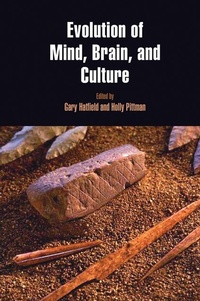
Evolution of Mind, Brain, and Culture
Published on 19. April 2013
Book
Hardback
496 pages
978-1-934536-49-0 (ISBN)
Description
Descartes boldly claimed: "I think, therefore I am." But one might well ask: Why do we think? How? When and why did our human ancestors develop language and culture? In other words, what makes the human mind human?
Evolution of Mind, Brain, and Culture offers a comprehensive and scientific investigation of these perennial questions. Fourteen essays bring together the work of archaeologists, cultural and physical anthropologists, psychologists, philosophers, geneticists, a neuroscientist, and an environmental scientist to explore the evolution of the human mind, the brain, and the human capacity for culture. The volume represents and critically engages major theoretical approaches, including Donald's stage theory, Mithen's cathedral model, Tomasello's joint intentionality, and Boyd and Richerson's modeling of the evolution of culture in relation to climate change.
No recent publication combines this breadth of evidential and theoretical perspective. The essays range in topic from the macroscopic (the evolution of social cooperation) to the microscopic (examining genetic data to infer evolutions in brain structure and function), and from the ancient (paleoanthropological reconstructions of hominin cognitive abilities) to the modern (including modern hominin's similarities to our primate cousins). Considered together, these essays constitute a fascinating, detailed look at what makes us human.
Evolution of Mind, Brain, and Culture offers a comprehensive and scientific investigation of these perennial questions. Fourteen essays bring together the work of archaeologists, cultural and physical anthropologists, psychologists, philosophers, geneticists, a neuroscientist, and an environmental scientist to explore the evolution of the human mind, the brain, and the human capacity for culture. The volume represents and critically engages major theoretical approaches, including Donald's stage theory, Mithen's cathedral model, Tomasello's joint intentionality, and Boyd and Richerson's modeling of the evolution of culture in relation to climate change.
No recent publication combines this breadth of evidential and theoretical perspective. The essays range in topic from the macroscopic (the evolution of social cooperation) to the microscopic (examining genetic data to infer evolutions in brain structure and function), and from the ancient (paleoanthropological reconstructions of hominin cognitive abilities) to the modern (including modern hominin's similarities to our primate cousins). Considered together, these essays constitute a fascinating, detailed look at what makes us human.
More details
Language
English
Place of publication
Philadelphia
United States
Publishing group
University of Pennsylvania Press
Target group
College/higher education
Professional and scholarly
Product notice
Laminated cover
Dimensions
Height: 236 mm
Width: 160 mm
Thickness: 25 mm
Weight
1089 gr
ISBN-13
978-1-934536-49-0 (9781934536490)
Copyright in bibliographic data and cover images is held by Nielsen Book Services Limited or by the publishers or by their respective licensors: all rights reserved.
Schweitzer Classification
Persons
Gary Hatfield is Adam Seybert Professor in Moral and Intellectual Philosophy at the University of Pennsylvania. Holly Pittman is Bok Family Professor in the Humanities and Professor of History of Art at the University of Pennsylvania, and Curator in the Near East Section at the University of Pennsylvania Museum of Archaeology and Anthropology.