

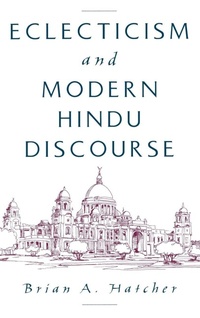
Eclecticism and Modern Hindu Discourse
Published on 29. July 1999
Book
Hardback
216 pages
978-0-19-512538-2 (ISBN)
Description
Hindu apologists routinely support their interpretations of the Hindu world view with what seems an almost promiscuous use of the world's many philosophies and religions. The truths of Hindu thought are commonly demonstrated with references to sources as disparate as the Upanishads, the New Testament, and the sermons of Theodore Parker. These strange, even bizarre, juxtapositions pose a troubling problem for many sympathetic Western scholars of this tradition, namely, what to do about the absurdities that Indian thinkers want to pass for historical truths?
This book examines the classical roots and contempoary significance of eclecticism within modern Hindu discourse. Hatcher begins by focusing on the thought of Swami Vivekananda as exemplary of the tone and character of modern Hindu eclecticism. Vivekananda, who became well-known in the West after his sensational appearance at the Chicago World's Fair of 1893, regularly spiced his lectures with references to Jesus, the Buddha, and the prophet Muhammad, as well as to his own personal guru, Sri Ramakrishna. Hatcher then seeks to identify the ancient Indian antecedents of this eclecticism, finding them especially in the sacrificial ritualism of the Vedas. Returning to the modern period, he focuses on 19th-century Bengal, introducing the reader to a wide range of modern Indian eclecticisms. The development of Hindu thought during this period, Hatcher argues, can only be understood within the context of the enforced cultural encounter created by British colonial rule. In conclusion, Hatcher attempts to strike a delicate balance between the contending views of eclecticism as poesis and as a form of false consciousness. He proposes a pragmatic approach to evaluating the validity of eclectic knowledge.
This book examines the classical roots and contempoary significance of eclecticism within modern Hindu discourse. Hatcher begins by focusing on the thought of Swami Vivekananda as exemplary of the tone and character of modern Hindu eclecticism. Vivekananda, who became well-known in the West after his sensational appearance at the Chicago World's Fair of 1893, regularly spiced his lectures with references to Jesus, the Buddha, and the prophet Muhammad, as well as to his own personal guru, Sri Ramakrishna. Hatcher then seeks to identify the ancient Indian antecedents of this eclecticism, finding them especially in the sacrificial ritualism of the Vedas. Returning to the modern period, he focuses on 19th-century Bengal, introducing the reader to a wide range of modern Indian eclecticisms. The development of Hindu thought during this period, Hatcher argues, can only be understood within the context of the enforced cultural encounter created by British colonial rule. In conclusion, Hatcher attempts to strike a delicate balance between the contending views of eclecticism as poesis and as a form of false consciousness. He proposes a pragmatic approach to evaluating the validity of eclectic knowledge.
Reviews / Votes
Eclecticism and Modern Hindu Discourse is a brilliant, erudite, and wide-ranging study that will be of interest in many fields of study. * History of Religions *More details
Language
English
Place of publication
New York
United States
Target group
Professional and scholarly
Illustrations
3 line drawings
Dimensions
Height: 235 mm
Width: 157 mm
Thickness: 17 mm
Weight
508 gr
ISBN-13
978-0-19-512538-2 (9780195125382)
Copyright in bibliographic data and cover images is held by Nielsen Book Services Limited or by the publishers or by their respective licensors: all rights reserved.
Schweitzer Classification
Other editions
Additional editions
Brian A. Hatcher
Eclecticism and Modern Hindu Discourse
E-Book
05/1999
1st Edition
OUP eBook
€81.99
Available for download
Person
Content
1. Introduction ; 2. "Difference Relates": Eclecticism Past and Present ; 3. Swami in Wonderland: Vivekananda's Eclectic Hermeneutics ; 4. What's the Connection? India's Eclectic Heritage ; 5. Varieties of Eclectic Experience: The Case of Colonial Bengal ; 6. My Own Private Bungalow: The Dynamics of Eclectic Home-Building ; 7. Conclusion ; Bibliography ; Index