

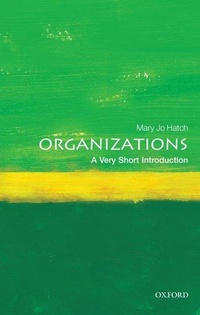
Organizations
A Very Short Introduction
Published on 24. March 2011
Book
Paperback/Softback
176 pages
978-0-19-958453-6 (ISBN)
Description
Most of us recognize that organizations are everywhere. You meet them on every street corner in the form of families and shops, study in them, work for them, buy from them, pay taxes to them. But have you given much thought to where they came from, what they are today, and what they might become in the future? How and why do they have so much influence over us, and what influences them? How do they contribute to and detract from the meaningfulness of lives, and how might we improve them so they better serve our needs and desires?
This Very Short Introductions addresses all of these questions and considers many more. Mary Jo Hatch introduces the concept of organizations by presenting definitions and ideas drawn from the a variety of subject areas including the physical sciences, economics, sociology, psychology, anthropology, literature, and the visual and performing arts. Drawing on examples from prehistory and everyday life, from the animal kingdom as well as from business, government, and other formal organizations, Hatch provides a lively and thought provoking introduction to the process of organization.
ABOUT THE SERIES: The Very Short Introductions series from Oxford University Press contains hundreds of titles in almost every subject area. These pocket-sized books are the perfect way to get ahead in a new subject quickly. Our expert authors combine facts, analysis, perspective, new ideas, and enthusiasm to make interesting and challenging topics highly readable.
This Very Short Introductions addresses all of these questions and considers many more. Mary Jo Hatch introduces the concept of organizations by presenting definitions and ideas drawn from the a variety of subject areas including the physical sciences, economics, sociology, psychology, anthropology, literature, and the visual and performing arts. Drawing on examples from prehistory and everyday life, from the animal kingdom as well as from business, government, and other formal organizations, Hatch provides a lively and thought provoking introduction to the process of organization.
ABOUT THE SERIES: The Very Short Introductions series from Oxford University Press contains hundreds of titles in almost every subject area. These pocket-sized books are the perfect way to get ahead in a new subject quickly. Our expert authors combine facts, analysis, perspective, new ideas, and enthusiasm to make interesting and challenging topics highly readable.
More details
Series
Language
English
Place of publication
Oxford
United Kingdom
Illustrations
15 black and white halftones
Dimensions
Height: 179 mm
Width: 113 mm
Thickness: 14 mm
Weight
145 gr
ISBN-13
978-0-19-958453-6 (9780199584536)
Copyright in bibliographic data and cover images is held by Nielsen Book Services Limited or by the publishers or by their respective licensors: all rights reserved.
Schweitzer Classification
Other editions
Additional editions
E-Book
03/2011
OUP eBook
€5.49
Available for download
Person
Mary Jo Hatch is an organization theorist doing research, teaching, and consulting in the areas of organizational culture, identity, and corporate branding. She has worked with, and studied, many companies including LEGO Group, Novo Nordisk, Johnson & Johnson, and Nissan. She has written or co-authored several books including Organization Theory: Modern, Symbolic and Postmodern Perspectives (2nd edition 2006, Oxford University Press), The Three Faces of Leadership: Manager, Artist, Priest (2005, Blackwell Publishing), and most recently, Taking Brand Initiative: How Corporations Can Align Strategy, Culture and Identify through Corporate Branding (2008, Jossey-Bass/Wiley).
Content
Introduction ; 1. What is organization? ; 2. What is the best way to organize? ; 3. What does it mean to be an organization? ; 4. Who does organizing serve? ; 5. How does organizing happen? ; 6. Why do organizational scholars disagree? ; 7. Where do we go from here?