

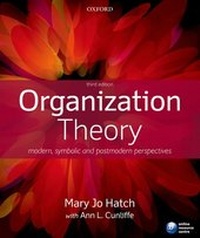
Organization Theory
Modern, Symbolic and Postmodern Perspectives
3rd Edition
Published on 22. November 2012
Book
Paperback/Softback
384 pages
978-0-19-964037-9 (ISBN)
Description
Organization Theory offers a clear and comprehensive introduction to the study of organizations and organizing processes. It encourages an even-handed appreciation of the main perspectives defining our knowledge of organizations and challenges readers to broaden their intellectual reach. Organization Theory is presented in three parts:
Part I introduces the reader to theorizing using the multi-perspective approach. Part II presents different core concepts useful for analysing and understanding organizations - as entities within an environment, as social structures, technologies, cultures and physical structures, and as the products of power and political processes. Part III explores applications of organization theory to the practical matters of organizational design and change, and introduces the latest ideas, including
organizational identity theory, process and practice theories, and aesthetics.
An Online Resource Centre accompanies this text and includes:
For students:
Multiple Choice Questions
For registered adopters:
Lecturer's guide
PowerPoint slides
Figures and tables from the book
Part I introduces the reader to theorizing using the multi-perspective approach. Part II presents different core concepts useful for analysing and understanding organizations - as entities within an environment, as social structures, technologies, cultures and physical structures, and as the products of power and political processes. Part III explores applications of organization theory to the practical matters of organizational design and change, and introduces the latest ideas, including
organizational identity theory, process and practice theories, and aesthetics.
An Online Resource Centre accompanies this text and includes:
For students:
Multiple Choice Questions
For registered adopters:
Lecturer's guide
PowerPoint slides
Figures and tables from the book
Reviews / Votes
This by now well-established textbook gets better with each edition. The frame of normative, symbolic, modern, and postmodern perspectives is now well-established. This is an excellent introduction and guide to organization theory. * Stewart Clegg, University of Technology, Sydney * I really like this book! Written in the first person and using a variety of interesting perspectives, Mary Jo Hatch inspires a rich repertoire of ways to expand our understanding of organizations. * Andy Van de Ven, University of Minnesota * This is a very engaging and lucid treatment of organization theory that is equally accessible to the thoughtful manager and the seasoned scholar ... Three cheers for the Organization Theory text ... that doesn't apologise for applying theory to the study and practice of management. This excellent book again confirms Kurt Lewin's adage: "There is nothing quite so practical as a good theory. * Professor David Whetten, Marriot School of Management, Brigham Young University * Organization Theory is unique among textbooks in organization and management. It is theoretically accurate, giving a comprehensive and up-to-date view of this dynamic, diverse and quickly developing field. In addition, the book is written in such a way that it encourages a reflexive stance towards both academic theory and organizational practices. We have used the book extensively in our undergraduate education, and it has proved to enrich students;understanding of this important field of theory and practice. * Rolf Lind, Stockholm University School of Business (Review from previous edition) * I very much welcome this second edition of Organization Theory. As a textbook it is not only comprehensive and instructive, but also original and evocative - it makes a significant contribution to the study of organizations. In particular the book demonstrates convincingly the advantages of taking a multiperspectival approach to organization theory. Taking the student through the complex literatures of modern, symbolic, and postmodern analysis it offers the reader a
repertoire of new ways of understanding complex organizations. In my view it is a mist for students of organization. * John Hassard, Manchester University (Review from previous edition) *
More details
Edition
3rd Revised edition
Language
English
Place of publication
Oxford
United Kingdom
Target group
Professional and scholarly
Edition type
Revised edition
Illustrations
45 BW Line, 5 BW Half-tone
Dimensions
Height: 246 mm
Width: 190 mm
Thickness: 19 mm
Weight
646 gr
ISBN-13
978-0-19-964037-9 (9780199640379)
Copyright in bibliographic data and cover images is held by Nielsen Book Services Limited or by the publishers or by their respective licensors: all rights reserved.
Schweitzer Classification
Other editions
Previous edition
Book
02/2006
2nd Edition
Oxford University Press
€51.98
Article exhausted; check for reprint
Persons
Mary Jo Hatch (PhD Stanford, 1985) is the C. Coleman McGehee Eminent Scholars Research Professor of Banking and Commerce, Emerita, at the McIntire School of Commerce, University of Virginia. She is also an Adjunct Professor at Copenhagen Business School, Visiting Professor Gothenburg University, and an International Research Fellow of the Centre for Corporate Reputation, Oxford University. Her research has been published in Harvard Business Review,
California Management Review, Academy of Management Review, European Journal of Marketing, Human Relations, Journal of Management Inquiry, Strategic Organization, Administrative Science Quartely, and Organization. She co-authored The Three Faces of Leadership (Blackwell) with M. Kostera and A. Kozminski. She received
the 2011 Distinguished Educator Award from the Academy of Management's Organization and Management Theory (OMT) Division.
Ann L. Cunliffe is currently Professor of Organization Studies at the University of Leeds in the UK. She has held positions at the University of New Mexico, California State University and the University of New Hampshire. She obtained her Master of Philosophy degree and Ph.D. from Lancaster University Management School. Recent publications in the field of leadership, sensemaking, reflexivity, and qualitative research methods are found in Human Relations, Organizational Research
Methods and Management Learning. She was awarded the 2002 'Breaking the Frame Award' from the Journal of Management Inquiry for the article that best exemplifies a challenge to existing thought. Ann is currently co Editor-in-Chief of Management Learning, Consulting Editor for the International Journal of
Qualitative Research in Organizations and Management, and a member of eight international journal Editorial Boards.
California Management Review, Academy of Management Review, European Journal of Marketing, Human Relations, Journal of Management Inquiry, Strategic Organization, Administrative Science Quartely, and Organization. She co-authored The Three Faces of Leadership (Blackwell) with M. Kostera and A. Kozminski. She received
the 2011 Distinguished Educator Award from the Academy of Management's Organization and Management Theory (OMT) Division.
Ann L. Cunliffe is currently Professor of Organization Studies at the University of Leeds in the UK. She has held positions at the University of New Mexico, California State University and the University of New Hampshire. She obtained her Master of Philosophy degree and Ph.D. from Lancaster University Management School. Recent publications in the field of leadership, sensemaking, reflexivity, and qualitative research methods are found in Human Relations, Organizational Research
Methods and Management Learning. She was awarded the 2002 'Breaking the Frame Award' from the Journal of Management Inquiry for the article that best exemplifies a challenge to existing thought. Ann is currently co Editor-in-Chief of Management Learning, Consulting Editor for the International Journal of
Qualitative Research in Organizations and Management, and a member of eight international journal Editorial Boards.
Content
PART I WHAT IS ORGANIZATION THEORY?; PART II CORE CONCEPTS AND THEORIES; PART III LOOKING BACK AND LOOKING FORWARD